Maine Transfer on Death Deed (Married Sole Owner, Nonowner Spouse Consent)
County Specific Legal Forms Validated as recently as October 27, 2026 by our Forms Development Team
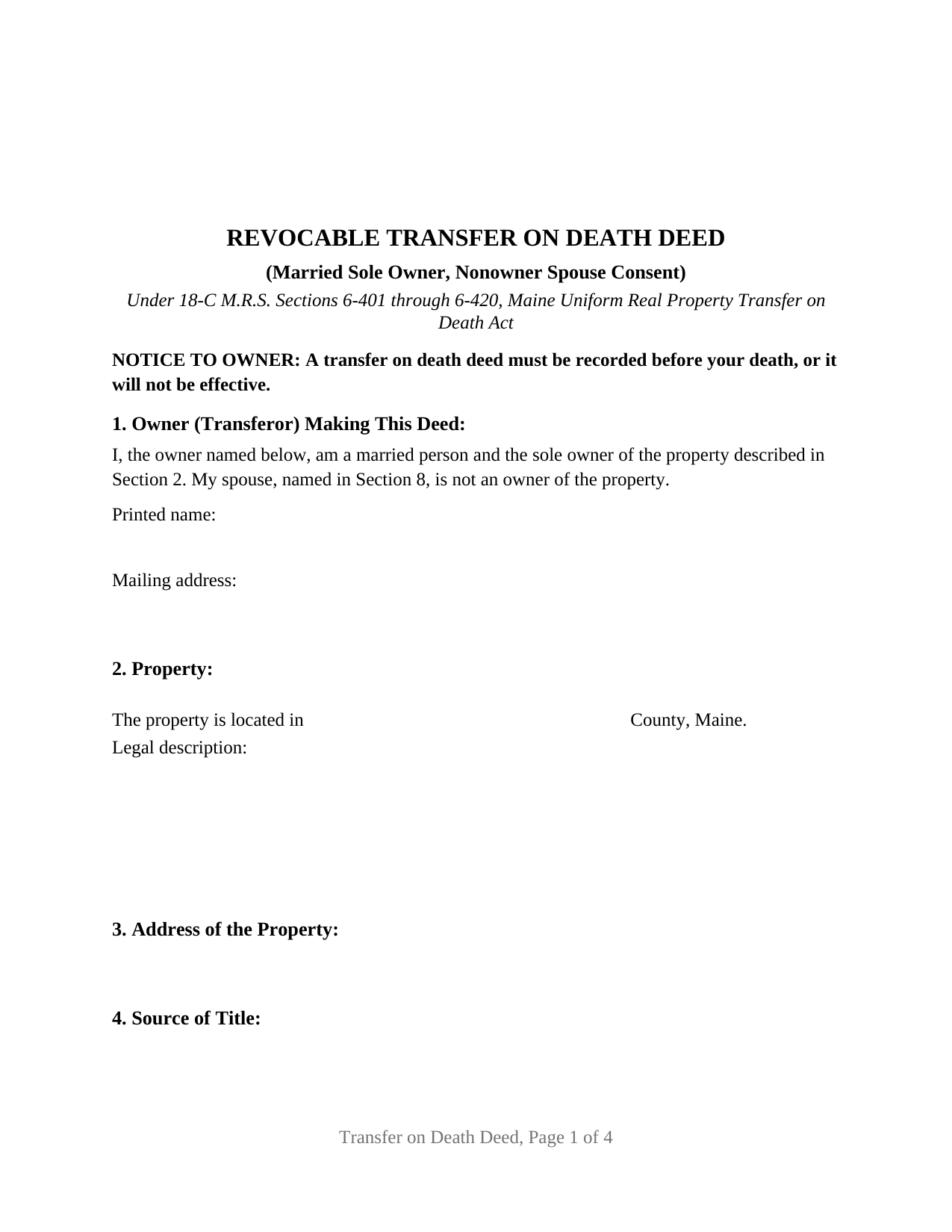
About the Maine Transfer on Death Deed (Married Sole Owner, Nonowner Spouse Consent)
How to Use This Form
- Select your county from the list
- Download the county-specific form
- Fill in the required information
- Have the document notarized if required
- Record with your county recorder's office
What Others Like You Are Saying
"The experience was generally very satisfactory. I was able to fill out the Trust Deed and send it vi…"
"Quick and efficient"
"Easy to use"
"getting the proper forms was easy--filling them out, not so much"
"very easy to use this site as I live out of state."
4.8/5 from 4,836 reviews. Read all
A married Maine owner who holds real estate alone can name who receives it at death, and this deed adds the one signature Maine's elective-share statute gives effect to: the written consent of the nonowner spouse, on the deed itself. The form prepares a Maine transfer on death deed, also searched as a Maine TOD deed or beneficiary deed, under Title 18-C, Article 6, Part 4 of the Maine Revised Statutes for a married sole owner and a consenting spouse who owns nothing in the property.
Why a spouse who owns nothing signs
Maine does not require a nonowner spouse's signature on a deed. Title 33, Section 480 lets an owner convey free of the spouse's claim without it, with two exceptions, one of which points to 18-C M.R.S. Section 2-208 in the elective-share part of the probate code. A surviving spouse may elect 50 percent of the marital-property portion of the augmented estate; Section 2-205 brings the decedent's nonprobate transfers to others into that estate, naming property held in TOD registration; and Section 6-413 of the transfer on death act makes the transfer at death subject to that part. Section 2-208, subsection 1, paragraph B then excludes property transferred with the written joinder of, or consented to in writing by, the surviving spouse. Section 8 of this deed is written as that consent and joinder, signed under an acknowledgment certificate of its own.
A consent, not a waiver
Section 8 is narrow on purpose. The spouse states that the spouse is not an owner, consents to and joins in the transfer the deed makes, transfers nothing, and waives nothing under 18-C M.R.S. Section 2-213, the provision governing a written waiver of the right of election, homestead allowance, exempt property and family allowance. The consent reaches only the transfer made by this deed; a later deed naming different beneficiaries is a different transfer. How the exclusion is valued in a particular augmented estate is a question for the attorney handling the estate; the guide describes what the signed consent says.
The configuration this deed recites
The owner section opens with a fixed recital: the owner named is a married person and the sole owner of the described property, and the spouse named in Section 8 is not an owner; only the owner is a transferor. The deed carries two signature blocks, OWNER and NONOWNER SPOUSE, the second labeled Consenting Signature so that no reader takes it for a grantor's, and two acknowledgment certificates, one after each block, so the two may appear before different notarial officers on different dates. An owner whose spouse also appears on the vesting deed, an unmarried owner, a trustee, an entity, an agent under a power of attorney, and three or more owners are configurations this deed does not recite. Revocation stays the owner's act alone, by an acknowledged instrument recorded before death under Section 6-411.
Beneficiaries, survival, and shares
The beneficiary sections carry the operative sentences of the Section 6-417 statutory template word for word, and under Section 6-402 a beneficiary may be an individual, a trust named through its trustee, or an entity. Where more than one is named, Section 6-413 supplies the rules unless the deed provides otherwise: each interest depends on surviving the owner, concurrent beneficiaries hold equal undivided shares without survivorship, and a lapsed share goes to the remaining beneficiaries in proportion. Whoever takes does so subject to every mortgage and lien on the property at the death, without warranty of title.
Recorded before death, in the county registry
Section 6-409 makes recording before the owner's death, in the registry of deeds for the county where the land lies, a condition of the deed having any effect, and the Section 6-417 recording notice is printed in bold at the head of page one. A transfer by transfer on death deed is exempt from the Maine real estate transfer tax and from the declaration of value, so the registry receives the deed and the $40 flat recording fee, nothing more. The layout follows the Maine Registers of Deeds Association all-county format standard, with a non-recorded instructions cover page removed before signing.
The package includes the fillable transfer on death deed with the nonowner spouse consent, a completed example filled in for a York County fact pattern, and a guide to every section, both signatures, and recording at the registry. This description and the guide describe the form and the governing Maine statutes in general terms; they are not legal advice.
Important: County-Specific Forms
Our transfer on death deed (married sole owner, nonowner spouse consent) forms are specifically formatted for each of the 16 counties in Maine.
After selecting your county, you'll receive forms that meet all local recording requirements, ensuring your documents will be accepted without delays or rejection fees.