Maryland Quitclaim Deed (Corrective)
County or Independent City Specific Legal Forms Validated as recently as October 5, 2026 by our Forms Development Team
About the Maryland Quitclaim Deed (Corrective)
How to Use This Form
- Select your county or independent city from the list
- Download the county or independent city-specific form
- Fill in the required information
- Have the document notarized if required
- Record with your county or independent city recorder's office
What Others Like You Are Saying
"This site was so easy. Got my documents in minutes. downloaded and they work perfectly and accuratel…"
"Wow this was nice that I could used the service . Love it"
"Great Forms, Detailed explanation on how to fill them out properly. No Issues at all. Very e-z to us…"
"Holy cow. I was told by several people that getting a deed recorded would take 7-10 days. So I thoug…"
"Deeds.com is a godsend! Being able to download the pertinent state and county specific forms reassur…"
4.8/5 from 4,836 reviews. Read all
Nothing on this Maryland deed is new. The parcel, the parties, and the conveyance all sit in the land records already; what the instrument does is put one entry in them right. A corrective quitclaim deed, called a correction deed or a confirmatory deed in Maryland practice, runs from the grantor named in an earlier recorded deed to the grantee named in that same deed, restating the release with the misstatement identified, corrected, and dated on the face of the record.
What Maryland cures on its own, and what it leaves
Some defects need no second instrument. Real Property Article Section 4-109 provides that for an instrument recorded on or after January 1, 1973, a failure to comply with the formal requisites it lists has no effect unless challenged in a judicial proceeding commenced within six months after recording. The list is procedural: defective acknowledgments, missing clerk's certificates, omitted seals, improper affidavits of consideration, agency, or disbursement, omitted attestations, unnamed trustees in a deed of trust, and defective witness attestations to a power of attorney. The Court of Appeals read the section as unambiguous in Guttman v. Wells Fargo Bank, N.A., 421 Md. 227 (2011). A misspelled surname, a transposed plat folio, an omitted parcel, or a misdescribed estate is nowhere on that list. Substance is what a corrective deed exists to reach.
A deed that names the deed it corrects
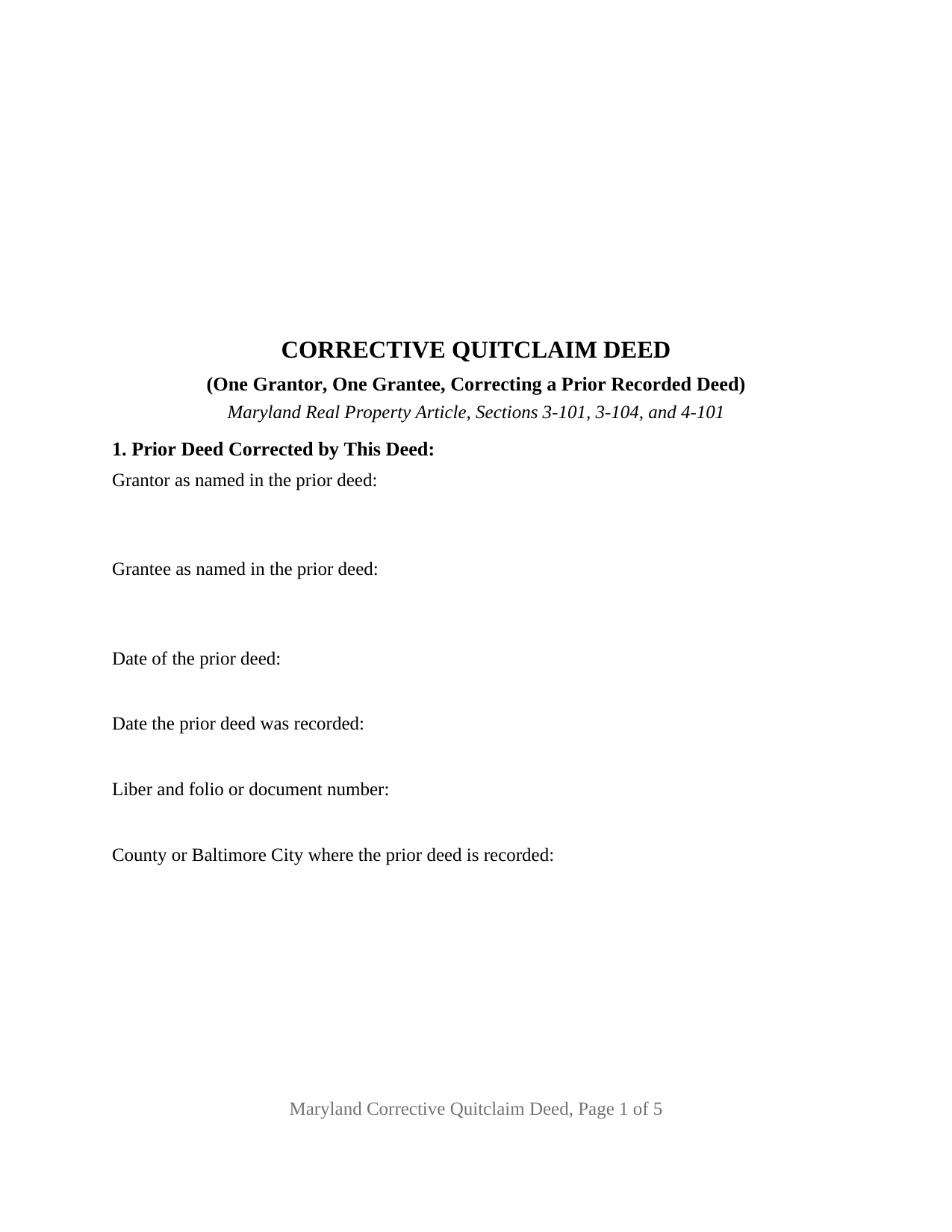
Section 1 carries the earlier instrument in six blanks: the party names exactly as that deed printed them, misspelling included, its date, its recording date, its liber and folio, and its county. Sections 6 and 7 then separate the error from the fix. Maryland tax law supplies the vocabulary for the category, defining a supplemental instrument of writing at Tax-Property Article Section 12-101 as one that confirms, corrects, modifies, supplements, or amends and restates a previously recorded instrument of writing, regardless of whether recordation tax was paid on the earlier one.
The tax a correction usually does not pay
That definition carries real money. Section 12-108(e) exempts a supplemental instrument of writing from recordation tax except to the extent that actual consideration is payable on it or unpaid outstanding principal debt is increased by it, and Section 13-207(a)(4) lists the same subsection among the State transfer tax exemptions. Consideration is still recited under Section 12-104, and a correction carrying no payment enters zero, the answer Tax-General Article Section 10-912(d)(6) also reads for nonresident withholding. Section 10 gives the exemption citation its own blank, repeated on the Land Instrument Intake Sheet, whose conveyance type box treats a confirmatory deed as other than an arms-length sale.
What the corrective configuration recites
One grantor signs, the person who signed the prior deed, personally; one grantee is named, the person that deed named, and signs nothing. The instrument holds one acknowledgment certificate drawn to the short form of State Government Article Section 18-216, printed names beside the signatures, and a preparation certificate with its own capacity blank. Errors reach the land records in recognizable shapes: a settlement deed whose plat citation transposes the folio digits, a grantee surname printed the way an older assessment record spelled it, a subdivision section number one digit off the recorded plat. The form is not set up for a prior deed made by two grantors or by spouses holding as tenants by the entirety, for an entity grantor, for a trustee, personal representative, or attorney-in-fact signer, or for an instrument naming a different grantee or adding land.
Where the correction stops
A later deed carries its own effective date into Maryland's priority rules, and Real Property Article Section 3-201 fixes that date at delivery, presumed to be the last acknowledgment or the date the deed states, whichever falls later. Section 3-203 then ranks it behind a subsequent grantee who took in good faith, without constructive notice, for value, and recorded first. A lien or conveyance filed between the two deeds therefore survives the correction, and Section 8 says as much in operative terms. At the counter the ordinary requirements apply: the Section 3-104(f) preparation certificate, the Section 3-104(d) printed names, and the page geometry of Section 3-104(e)(1)(i)2, in 12 point type.
Three files arrive: the blank fillable quit claim deed configured for a single correcting grantor, a completed example working a Calvert County plat reference through every blank, and a plain-language guide to the thirteen sections, grantee vesting, signing, the taxes, and county recording. The contents are informational and are not legal advice.
Important: County or Independent City-Specific Forms
Our quitclaim deed (corrective) forms are specifically formatted for each of the 24 county or independent cities in Maryland.
After selecting your county or independent city, you'll receive forms that meet all local recording requirements, ensuring your documents will be accepted without delays or rejection fees.