Maryland Quitclaim Deed (Trustee Grantor)
County or Independent City Specific Legal Forms Validated as recently as September 17, 2026 by our Forms Development Team
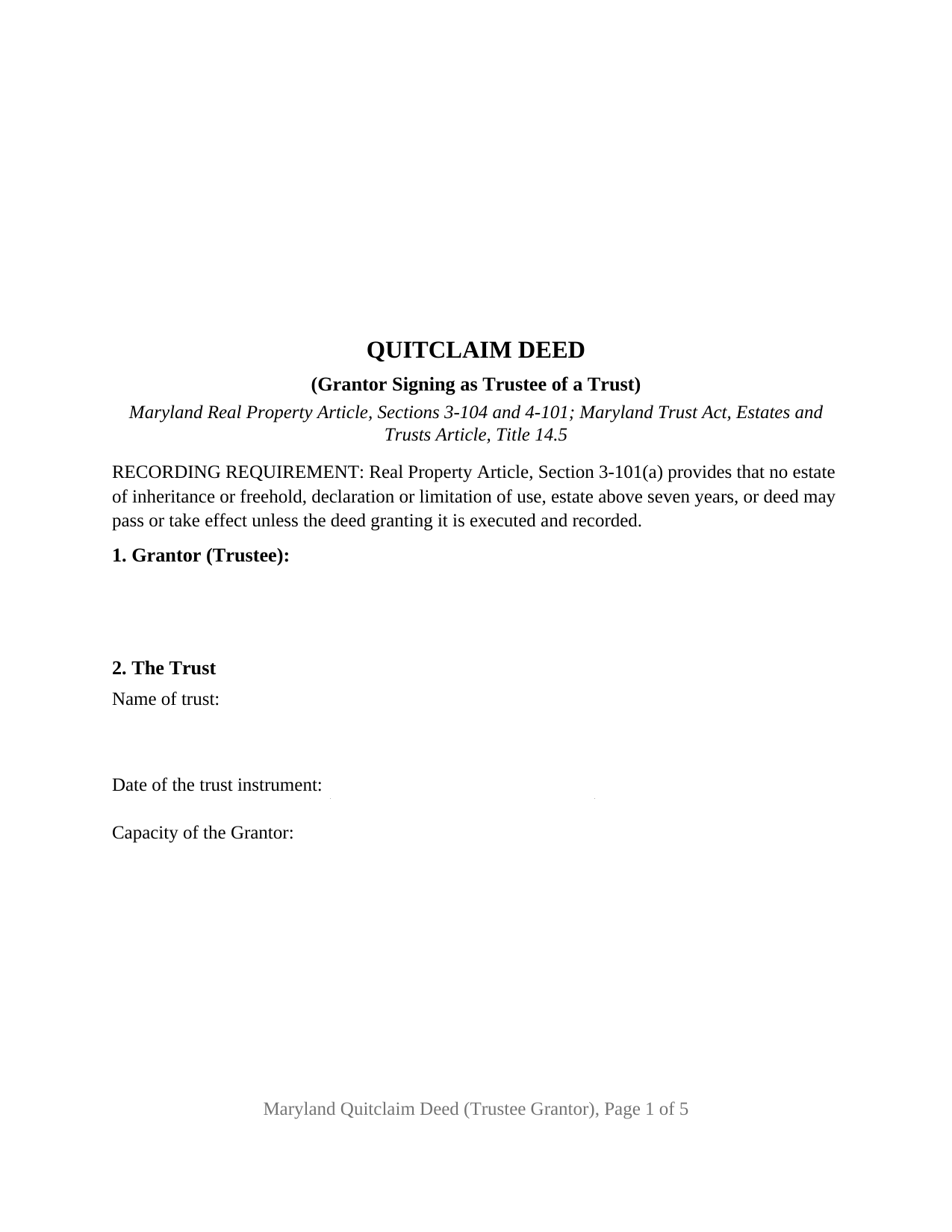
About the Maryland Quitclaim Deed (Trustee Grantor)
How to Use This Form
- Select your county or independent city from the list
- Download the county or independent city-specific form
- Fill in the required information
- Have the document notarized if required
- Record with your county or independent city recorder's office
What Others Like You Are Saying
"Your instructions and sample are geared towards businesses. It would have been helpful to have inclu…"
"thumbs up"
"Appreciated the prompt answers to my inquiries…"
"Good site, had the information I needed. Quicker than I expected. Thanks."
"The only problem I had was that it doesn't let you create a file for all documents to go into as one…"
4.8/5 from 4,829 reviews. Read all
The Grantor on this Maryland quitclaim deed holds title in a fiduciary capacity rather than a personal one. One acting trustee signs the instrument, and it releases to the named Grantee whatever right, title, and interest the trust holds in the described property, with no covenant or warranty of title. The trust is identified on the face of the deed by name and by the date of its trust instrument, and the notarial certificate is the one Maryland prints for a signer appearing on behalf of another.
Where a trustee's power to convey comes from
Not from the deed. Estates and Trusts Article Section 14.5-815(a) provides that a trustee, without authorization by the court, may exercise powers conferred by the terms of the trust or, except as those terms limit them, all powers over the trust property that an unmarried competent owner has over individually owned property. Subsection (b) subjects the exercise of any such power to the fiduciary duties of the Maryland Trust Act. Section 7 of this form recites the acting trustee, the capacity in which the interest is held, and the exercise of powers granted by the trust and by Section 14.5-815. A recital states what it asserts and no more; the trust instrument holds the power, and a purchaser or title insurer commonly asks the trustee for a certification of trust under Section 14.5-910, prepared separately and not included here.
A conveyance the land records have to finish
Two rules bracket what a trustee accomplishes here. A Maryland deed carries warranty only where express covenant words put it there, so a quit claim deed hands over the trust's interest as it stands, with every lien, easement, and record defect attached. And Real Property Article Section 3-101(a) provides that no estate of inheritance or freehold, declaration or limitation of use, estate above seven years, or deed may pass or take effect unless the deed granting it is executed and recorded. Filing with the Clerk of the Circuit Court is part of this conveyance, not a housekeeping step after it.
The tax rule for a transfer out of a trust
Estates and Trusts Article Section 14.5-1001(b) can lift the recordation tax, the transfer tax, and any other State or local excise tax off a transfer of real property made without consideration, and two conditions reach the trustee's side: a transfer to a person who would be exempt under Title 12 or Title 13 of the Tax-Property Article had the grantor of the trust conveyed to that person directly, and a transfer made during the life of the grantor of the trust where the trustee originally acquired the property for adequate consideration. Debt encumbering the property does not count as consideration there. Tax-Property Article Section 12-108(ee) states the recordation tax result for an instrument transferring real property from a trust to one or more beneficiaries in those circumstances, and Section 13-207(a)(23) carries it into the State transfer tax exemptions. Where money does change hands, Section 12-104(a) has the amount recited in the deed, and the county rate per $500 and any county transfer tax compute from it.
A certificate written for a signer acting in a capacity
The form recites exactly one Grantor, the acting trustee, with one signature block, a printed name line carrying name and office, one acknowledgment certificate, and a certificate of preparation with a capacity blank. The certificate follows State Government Article Section 18-216(c), the short form for an acknowledgment in a representative capacity, which records the appearance of a named individual as a stated type of authority of the party on whose behalf the record was executed. Patterns presenting this configuration appear in the land records: a successor trustee distributing a house to the beneficiaries after the settlor's death, a trustee selling trust land to a buyer content with a release and no covenants, and a trustee deeding a parcel back to a settlor who revoked the trust. The form is not set up for a trust whose terms call for more than one cotrustee to sign, for an owner signing in a personal capacity, or for a signer acting as a personal representative or an attorney-in-fact.
Inside the download
The download holds the blank fillable deed configured for a trustee grantor, a completed example working a Wicomico County trust distribution through every blank, and a plain-language guide covering each section, trustee authority, grantee vesting, notarization, the taxes, and recording. The package describes Maryland law and this form; it is not legal advice.
Important: County or Independent City-Specific Forms
Our quitclaim deed (trustee grantor) forms are specifically formatted for each of the 24 county or independent cities in Maryland.
After selecting your county or independent city, you'll receive forms that meet all local recording requirements, ensuring your documents will be accepted without delays or rejection fees.