Maryland Quitclaim Deed (Corporation Grantor)
County or Independent City Specific Legal Forms Validated as recently as October 12, 2026 by our Forms Development Team
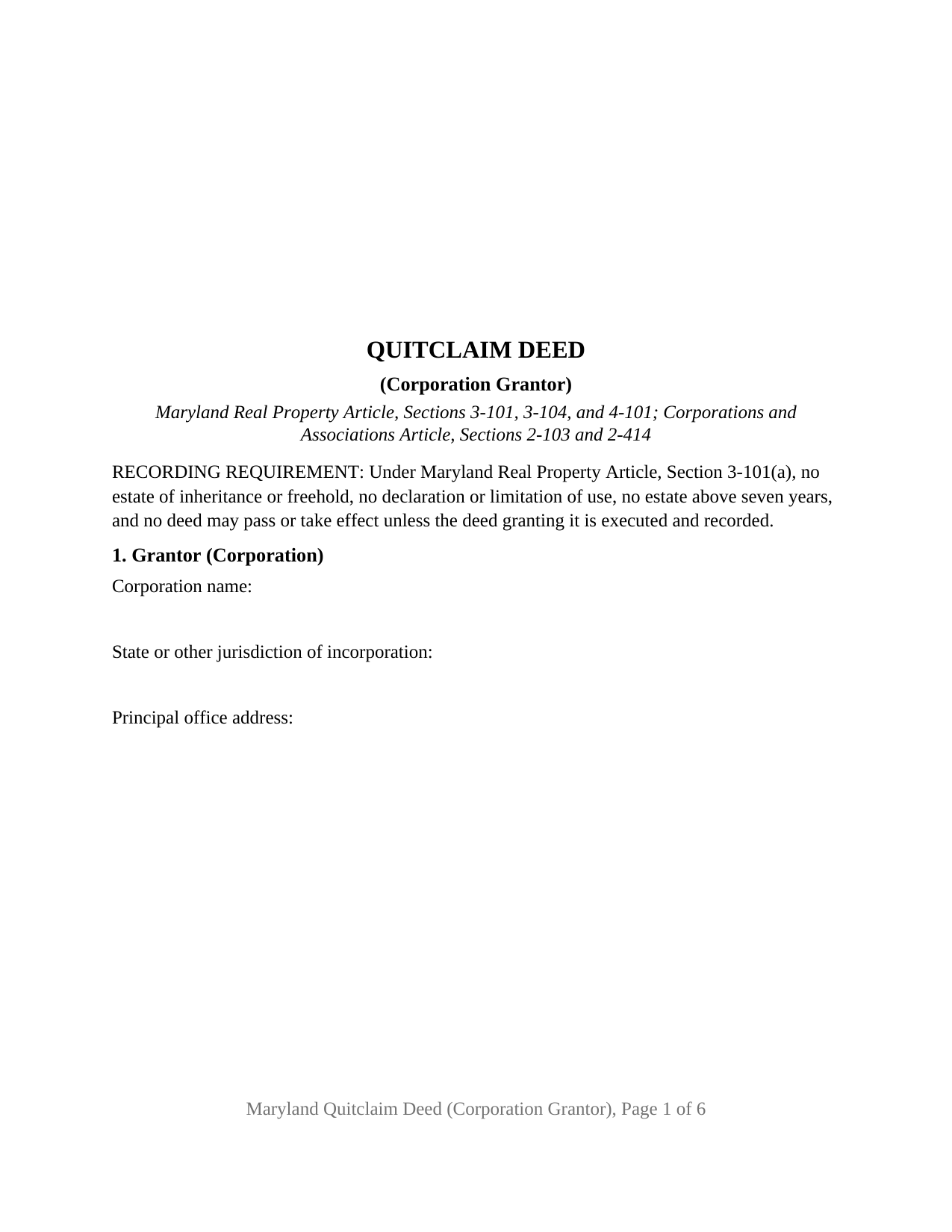
About the Maryland Quitclaim Deed (Corporation Grantor)
How to Use This Form
- Select your county or independent city from the list
- Download the county or independent city-specific form
- Fill in the required information
- Have the document notarized if required
- Record with your county or independent city recorder's office
What Others Like You Are Saying
"I AM VERY PLEASED WITH YOUR WEBSITE. EASY AND I WAS GIVEN A SAMPLE OF THE FORM AND INSTRUCTIONS. I A…"
"This has been a lifesaver for me. Exactly what I needed. Forma are easy to fill in. Thank you for of…"
"Everything was professionally, handled and the process was simple and easy. I appreciated the respon…"
"Love it"
"I love how quick the turnaround is, my only request would be for an email notification be sent once …"
4.8/5 from 4,828 reviews. Read all
One officer's signature carries a corporate deed in Maryland, and the General Assembly has stripped the old ceremony off it. This fill-in-the-blank quitclaim deed is drawn for that arrangement: the Grantor is a corporation, named with its jurisdiction of incorporation and principal office, and one authorized individual signs in the corporation's name. What passes is the interest the corporation holds at delivery, free of any covenant or warranty of title.
No seal, no attesting secretary, no countersignature
Real Property Article Section 4-101(b) answers the question a corporate deed raises first. The absence of a seal or attestation leaves validity untouched, and the subsection then speaks directly to entities: a corporate seal is not required for the execution of any deed or other instrument, notwithstanding any provision to the contrary in the corporation's charter, bylaws, or other documents. A bylaw calling for the seal cannot make an unsealed recorded deed defective, so the execution block holds one signature line, one printed name line, and a date.
Where the signer's authority sits
Corporate power and personal authority are separate questions. Corporations and Associations Article Section 2-103 lists the general powers a Maryland corporation holds whether or not its charter repeats them, and paragraph (6) includes the power to sell, transfer, convey, and otherwise dispose of any or all of its assets. Authority to exercise it is internal: Section 2-414(a) fixes an officer's authority by the bylaws and by resolution of the board of directors, and Section 2-414(b) leaves a third party's rights unaffected by such a bylaw or resolution absent knowledge of it. Section 2 of the deed collects the individual, the office or capacity, and the authorization relied on. A capacity recital states the authority asserted; the minute book documents it.
Ordinary business or extraordinary action
One line in the corporation statute changes what a conveyance takes. Section 3-105 governs a transfer of all or substantially all of a corporation's assets: the board resolves on it and directs it to the stockholders, whose approval takes two-thirds of all votes entitled to be cast. Section 3-104(a) exempts other transactions absent a contrary charter or bylaw, among them a transfer in the ordinary course of the business actually conducted. Which side of that line a parcel falls on turns on corporate facts, not on the deed.
What the corporation configuration recites
The form recites exactly one Grantor, a corporation identified by name, jurisdiction of incorporation, and principal office, and exactly one individual signing in its name, with the office or capacity recorded beside the signature. It carries one acknowledgment certificate written for a representative signer under State Government Article Section 18-216(c), and a certificate of preparation carrying its own capacity blank. A residency section answers Tax-General Article Section 10-912 in the recitals, the certification path that statute allows inside a deed; the Comptroller's withholding publication puts the nonresident entity figure at 8.25 percent. Patterns presenting this configuration appear across the land records: a corporation releasing a residual interest an earlier instrument left in its name after a reorganization, a closely held corporation releasing a parcel to a stockholder in a redemption, and a corporation that took title by deed in lieu of foreclosure passing it on. The form is not set up for a conveyance the governing documents require two officers to sign, for a limited liability company, partnership, or business trust as Grantor, for an owner signing personally, or for a trustee, personal representative, or attorney-in-fact.
Reaching the Land Records
Filing is part of this conveyance, not a step after it: Section 3-101(a) provides that no freehold estate, and no deed, passes or takes effect unless the deed granting it is executed and recorded. Section 11 carries the preparation certificate Section 3-104(f) demands, printed names sit with the signatures under Section 3-104(d), and the page answers Section 3-104(e)(1)(i)2 in 12 point type: three inches of official-use space atop page one, an inch clear at both sides. A clerk gained the power to refuse a nonconforming instrument on October 1, 2025. Consideration is recited under Tax-Property Article Section 12-104, and the taxes read from that figure at the counter, where a Land Instrument Intake Sheet accompanies the deed.
The download holds the blank fillable deed configured for a corporate grantor, a completed example working a Washington County release through every blank, and a plain-language guide covering the sections in order, officer authority, grantee vesting, notarization, and recording. It describes Maryland law and this form, and it is not legal advice.
Important: County or Independent City-Specific Forms
Our quitclaim deed (corporation grantor) forms are specifically formatted for each of the 24 county or independent cities in Maryland.
After selecting your county or independent city, you'll receive forms that meet all local recording requirements, ensuring your documents will be accepted without delays or rejection fees.