Maryland Quitclaim Deed
County or Independent City Specific Legal Forms Validated as recently as September 29, 2026 by our Forms Development Team
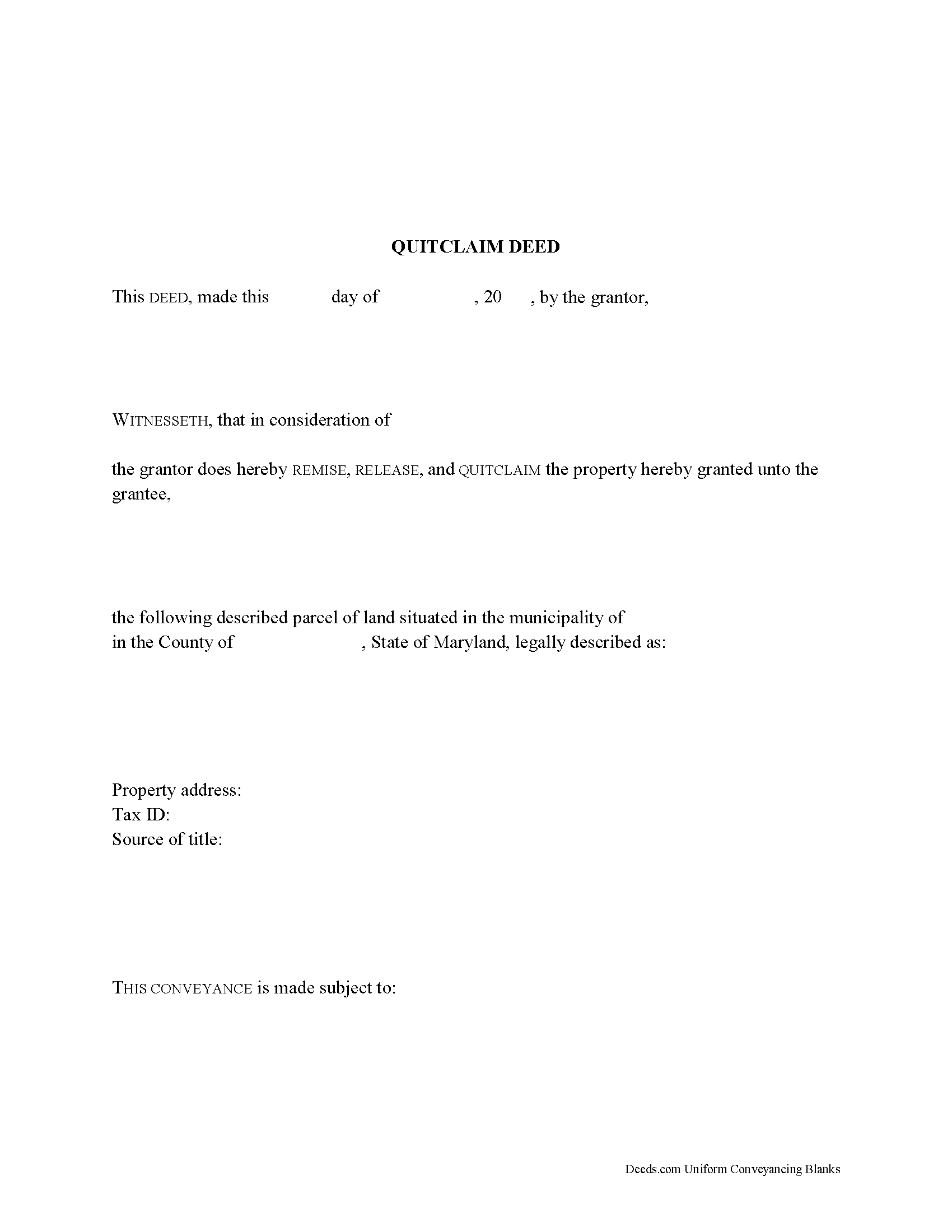
About the Maryland Quitclaim Deed
How to Use This Form
- Select your county or independent city from the list
- Download the county or independent city-specific form
- Fill in the required information
- Have the document notarized if required
- Record with your county or independent city recorder's office
What Others Like You Are Saying
"Well thought out and user friendly website. The forms were easily fillable as well."
"Very helpful! Easy and clear guidance. Good examples on sample forms."
"Not totally satisfied as unable to edit as needed on signature page of the deed. I want to be able t…"
"Excellent service A+"
"Great service"
4.8/5 from 4,828 reviews. Read all
Maryland prints a deed in a single sentence. Real Property Article Section 4-202(a) sets out the statutory form: made on a stated day by a named grantor, and in consideration of a stated amount, the grantor grants the described property to a named grantee. A quit claim deed is that sentence with release words in place of the bare grant and one thing said out loud, that nothing is promised about the title. This fill-in-the-blank Maryland quitclaim deed is drawn for individuals signing in their own names, and it moves whatever interest the grantors hold at delivery.
A deed identified by the covenants it leaves out
No warranty attaches to a Maryland deed by implication. Every promise about title comes from words a drafter chooses: Section 2-105 supplies the meaning of warrant generally, Section 2-106 the meaning of warrant specially, and Sections 2-107 through 2-112 the covenants of seisin, of the right to grant, of quiet enjoyment, and against encumbrances. This deed uses none of them, and Section 4-101(a)(1) leaves it sufficient anyway: a deed suffices when it names the parties, describes the property with reasonable certainty, and states the interest granted. What is left doing the work is Section 2-101, under which words purporting to transfer the whole estate of the grantor pass that grantor's whole interest unless a limitation or reservation shows a different intent. On a release that whole interest is the entire measure of the conveyance, so one printed instrument carries a whole parcel, an undivided one-third, or a doubtful claim without a word changing.
One or two people on either side
The form recites open party blocks rather than a fixed party pattern. Section 1 takes one or two grantors, each a natural person signing personally, with whatever status that person states after the name, and Section 2 takes one or two grantees, with whatever words describe the form in which they take title. Nothing about marital status, capacity, or tenancy is preprinted, so four count patterns run through the same page: one grantor to one grantee, one to two, two to one, and two to two. Two signature blocks and two certificates follow, and a deed signed by a single grantor leaves the second block and the second certificate empty, which keeps the signings independent when a second grantor signs on another day before another notary. Those counts, not the stories behind them, are what this configuration describes. The form is not set up for an entity grantor, for a trustee, a personal representative, a guardian, or an attorney-in-fact signing in a representative capacity, or for three or more owners on either side.
Where the vesting words belong
Because the grantee block is open, the words that fix co-ownership are written into it. Maryland reads silence as a tenancy in common: Section 2-117 provides that no written instrument creates an estate in joint tenancy unless it expressly says the property is to be held that way, so survivorship between unmarried grantees exists only where the deed says so. Two grantees married to each other are presumed to take as tenants by the entirety instead. Section 4-108 allows either estate to be created by direct grant, with no straw man in the middle, and Section 8 makes the grantee designation part of the deed.
Reaching the clerk's counter
In Maryland the filing is a condition of the conveyance, not an errand after it: under Section 3-101(a) a deed passes nothing and takes no effect until it is executed and recorded, so this release becomes operative in the land records of the Clerk of the Circuit Court. Section 11 carries the certification of preparation Section 3-104(f) demands from a party named in the deed or a Maryland attorney, and the page is built to the format standards of Section 3-104(e), enforceable by refusal since October 1, 2025. Section 3 states the consideration Tax-Property Article Section 12-104 calls for, and the county recordation tax charged per $500, the 0.5 percent State transfer tax of Section 13-203, and any county transfer tax compute from that figure at the window, where a Land Instrument Intake Sheet accompanies the deed.
This download includes three files: the blank fillable quit claim deed, a completed example carrying a Carroll County family release through every blank, and a plain-language guide that walks the thirteen sections, the vesting words a grantee entry can hold, the signing formalities, and the taxes collected at filing. The materials are informational and are not legal advice.
Important: County or Independent City-Specific Forms
Our quitclaim deed forms are specifically formatted for each of the 24 county or independent cities in Maryland.
After selecting your county or independent city, you'll receive forms that meet all local recording requirements, ensuring your documents will be accepted without delays or rejection fees.