Maryland Quitclaim Deed (Individual Grantor by Attorney-in-Fact)
County or Independent City Specific Legal Forms Validated as recently as November 5, 2026 by our Forms Development Team
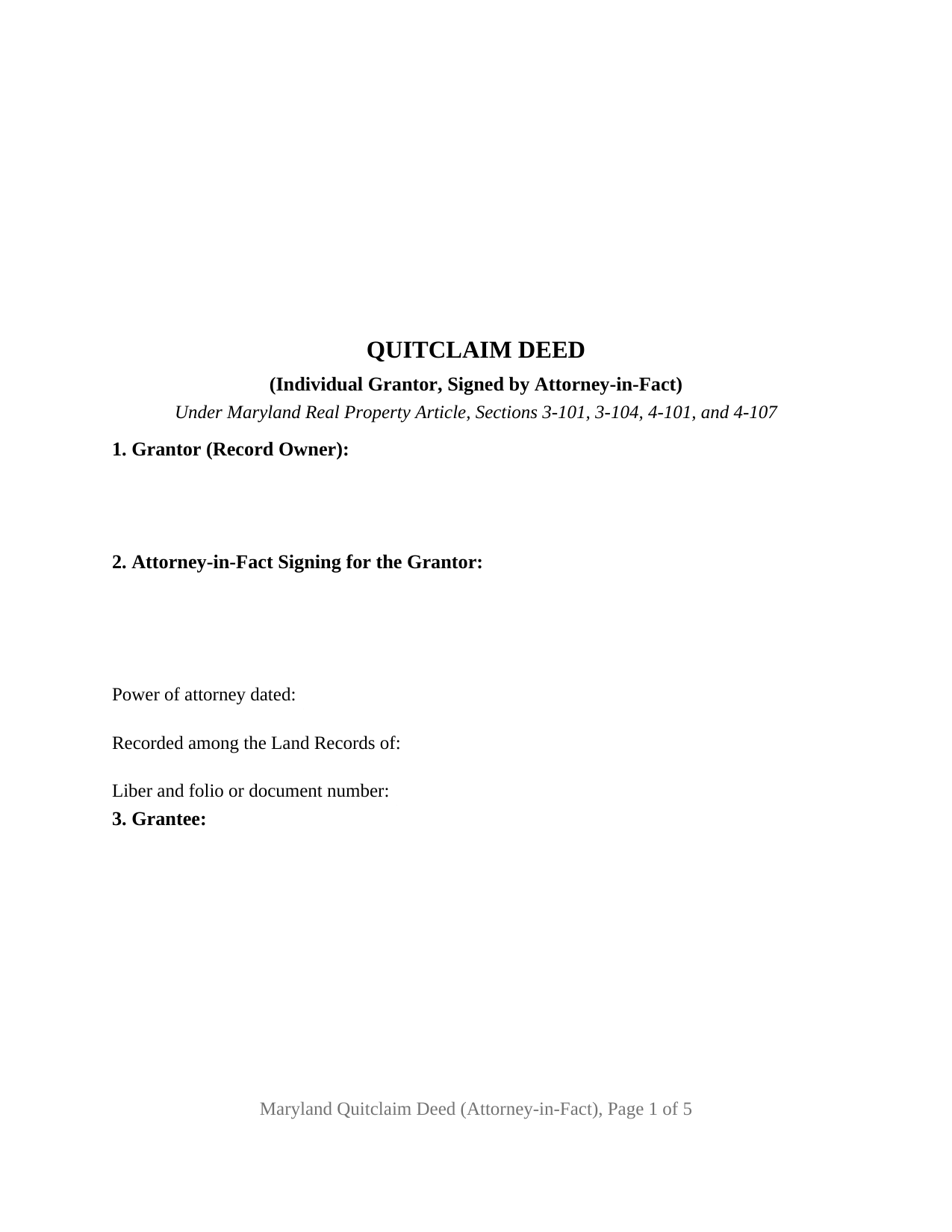
About the Maryland Quitclaim Deed (Individual Grantor by Attorney-in-Fact)
How to Use This Form
- Select your county or independent city from the list
- Download the county or independent city-specific form
- Fill in the required information
- Have the document notarized if required
- Record with your county or independent city recorder's office
What Others Like You Are Saying
"Forms were very easy to use using the completed form as an example."
"Service was fast and complete. Would use again."
"Great Tool! Very easy to complete."
"Outstanding. I will definitely recommend your company."
"Signing up was easy and the form was amazing. The ability to type on it (I am on a MAC) was beyond m…"
4.8/5 from 4,850 reviews. Read all
Somebody other than the owner signs this Maryland quitclaim deed, often called a POA deed. The Grantor is one record owner, and an attorney-in-fact under a power of attorney signs in that owner's name, passing along whatever interest the owner then holds and promising nothing about it. Two instruments reach the land records, the deed and the power of attorney, and Maryland sequences them by statute.
The statute that pairs a deed with a power of attorney
Real Property Article Section 4-107(a) has a power of attorney authorizing an agent to sell and grant property executed in the same manner as a deed and recorded, before, on, or after the day the deed is recorded. Recording afterward carries three conditions in Section 4-107(b), the third of which reaches the deed: the deed, or a recorded instrument supplementing it, contains an affidavit or certification by the agent stating substantially that the agent had no actual knowledge, at the time of execution, of the revocation of the power of attorney by death of the principal or by the principal's later disability or incompetence. Section 8 of this form carries that certification.
How the signature line reads
Section 4-107(c) has a person executing a deed as agent describe himself in the deed and sign as agent. Section 2 identifies the attorney-in-fact and the power of attorney by date and recording reference. The execution block runs in the record owner's name, signed by the attorney-in-fact in that capacity, with the printed name line Section 3-104(d) puts beneath a signature. The notarial certificate is the representative-capacity short form of State Government Article Section 18-216(c), naming the individual, the type of authority, and the party on whose behalf the record was executed; under Section 18-201(b) that acknowledgment is the signer's declaration of having signed with proper authority and as the act of the person named in the record.
Where the authority itself sits
Not in the deed. The Maryland General and Limited Power of Attorney Act, Estates and Trusts Article Title 17, governs the instrument that grants it; Section 17-110 sets the execution standard: the principal signs, acknowledges before a notary public, and has two or more adult witnesses attest and sign, the notary permitted to be one of them. A written power of attorney is durable by default under Section 17-105. The statutory form limited power of attorney at Section 17-203 names the power to quitclaim expressly in its real property category, the personal financial form at Section 17-202 authorizes the agent to sell and convey real property, and gift authority sits apart in a grant of specific authority the principal marks separately. That instrument is prepared, executed, and recorded separately and is not included in this package.
What the attorney-in-fact configuration recites
The form recites exactly one record owner as Grantor, exactly one attorney-in-fact signing in that owner's name, one acknowledgment certificate written for a representative signer, and a certificate of preparation with a capacity blank. Patterns presenting this configuration turn up in the land records: an owner in another state whose agent signs at a Maryland settlement, an owner in a care facility whose agent acts under a durable power of attorney granted years earlier, and an owner abroad on the settlement date. The form is not set up for a record owner signing personally, for two record owners, for coagents who act together unanimously under their power of attorney, or for a signer whose authority comes from a trust instrument, letters of administration, or appointment as guardian of the property.
What the clerk collects
Consideration is stated under Tax-Property Article Section 12-104, including mortgage debt the Grantee assumes, and the county recordation tax per $500, the State transfer tax, and any county transfer tax compute from that figure. A Land Instrument Intake Sheet travels with the deed to the Clerk of the Circuit Court with the tax entries and the Grantee's tax bill address. Page geometry keeps the 3 inch first-page top margin and 1 inch side margins of Section 3-104(e)(1)(i)2 in 12 point type, and Section 5 collects the election district Section 3-104(f)(2) puts on the face of a deed recorded in Prince George's County.
The download holds the blank fillable quit claim deed configured for an attorney-in-fact signer, a completed example working a Charles County release through every blank, and a plain-language guide covering each section, the power of attorney requirements, grantee vesting, notarization, the taxes, and recording. It describes Maryland law and this form and is not legal advice.
Important: County or Independent City-Specific Forms
Our quitclaim deed (individual grantor by attorney-in-fact) forms are specifically formatted for each of the 24 county or independent cities in Maryland.
After selecting your county or independent city, you'll receive forms that meet all local recording requirements, ensuring your documents will be accepted without delays or rejection fees.