Maryland Quitclaim Deed (Interspousal)
County or Independent City Specific Legal Forms Validated as recently as October 13, 2026 by our Forms Development Team
About the Maryland Quitclaim Deed (Interspousal)
How to Use This Form
- Select your county or independent city from the list
- Download the county or independent city-specific form
- Fill in the required information
- Have the document notarized if required
- Record with your county or independent city recorder's office
What Others Like You Are Saying
"Very easy to navigate, download,and print forms!"
"The information/forms/and ease of filling in the blanks provided me with the confidence to "do …"
"This was a very quick and convenient way to complete one of the tasks for my divorce that I imagined…"
"Deed.com is an amazing site. After calling many places and going on many websites to figure out what…"
"got the forms needed plus all the information needed to fill them out."
4.8/5 from 4,828 reviews. Read all
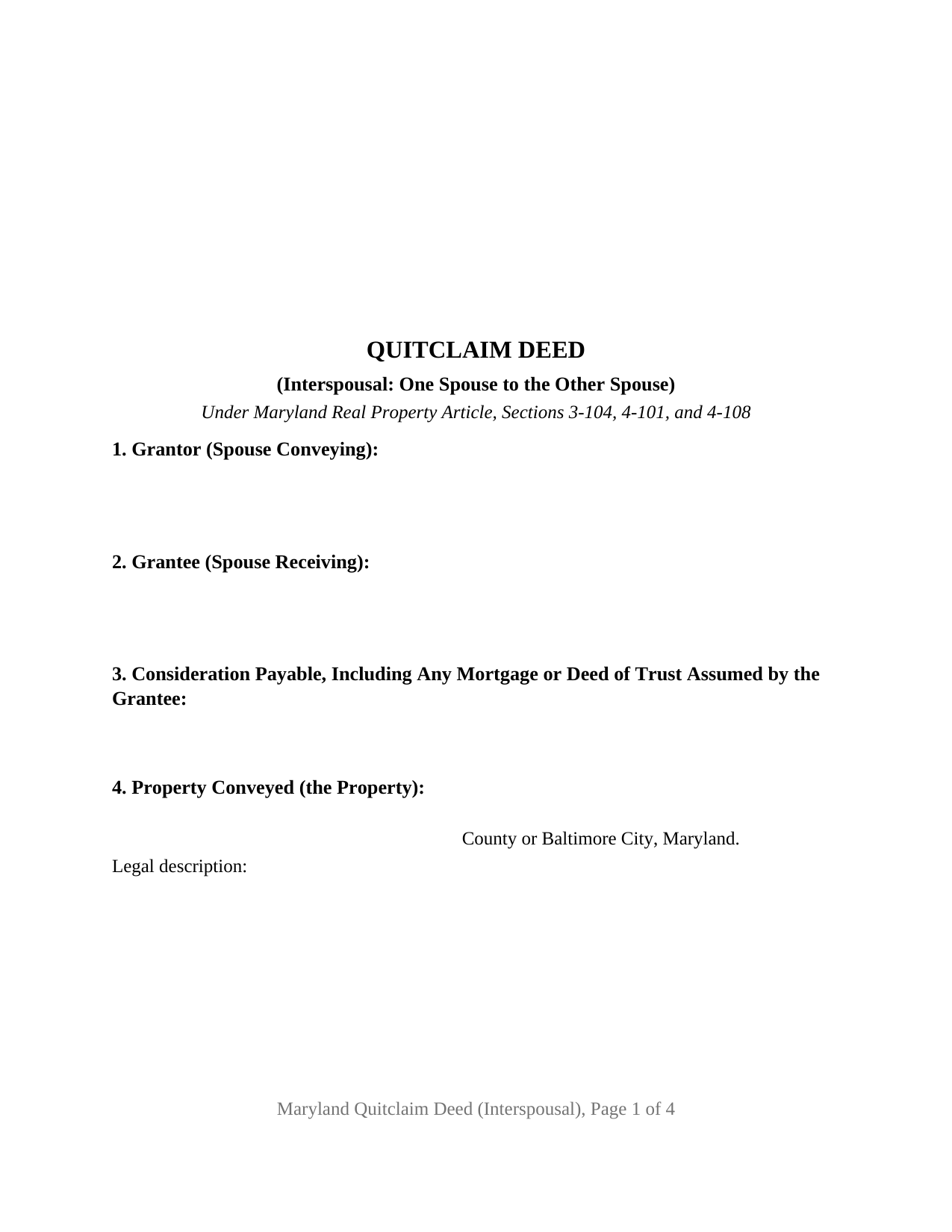
Both parties to this Maryland quitclaim deed are married to each other, and only one of them signs it. The Grantor is the spouse whose name the land records carry, and the Grantee is the other spouse, taking whatever right, title, and interest the Grantor holds at delivery, with no covenant or warranty of title attached. A single signature reaches further on an interspousal deed than anywhere else in the Maryland quit claim line, for two reasons sitting in different articles of the Code: one statute lets a spouse act alone where an entireties estate is involved, and another lifts the recording taxes off the transfer entirely.
The one grant a spouse may make alone
Maryland presumes that a married couple takes title as tenants by the entirety, and that estate normally moves only when both spouses sign, since neither may convey, encumber, sever, or partition it acting alone. Real Property Article Section 4-108(b)(3) states the exception this deed is built on: an interest held by spouses in tenancy by the entirety may be granted by either spouse acting individually to the other in tenancy in severalty, without a straw man as an intermediate grantee and grantor. The conveyance section states that result on the face of the instrument, so the record itself shows what became of the entireties estate. Where the Grantor instead owns alone or holds an undivided share, the same release words carry that interest without the subsection.
A deed the recordation and transfer taxes do not reach
Tax-Property Article Section 12-108(d)(1)(i) provides that an instrument of writing transferring property between spouses or former spouses is not subject to recordation tax, and Section 13-207(a)(3) makes the same instrument exempt from the state transfer tax to the same extent, so the county rate charged per $500 and the state tax of Section 13-203 both drop out of the calculation. County transfer taxes are creatures of local ordinance, confirmed with the county finance office. Consideration is still recited: Section 12-104(a) calls for the consideration payable, including the principal amount of any mortgage the Grantee assumes, to appear in the deed's recitals or acknowledgment or in an affidavit. A transfer without payment enters zero, which also answers Tax-General Article Section 10-912, exempting the deed from nonresident withholding. The exemption is cited on the Land Instrument Intake Sheet, the separate cover form that travels with the deed.
What the interspousal configuration recites
The form recites exactly one Grantor, a married record owner signing personally, and exactly one Grantee, that owner's spouse, with one printed name line, one acknowledgment certificate, and a certificate of preparation carrying a capacity blank. The Grantee signs nothing. Ownership patterns presenting this configuration run through the land records: spouses holding as tenants by the entirety who consolidate the whole title in one spouse's name, a refinance in which the lender's requirements leave both the new loan and the record title with a single spouse, and a couple who place a rental parcel in the name of the spouse who manages it. The form is not set up as a conveyance to anyone other than the Grantor's spouse, as a deed signed by both spouses together, as a release by an unmarried sole owner, or as an instrument signed in a trustee, personal representative, or attorney-in-fact capacity.
Formalities Maryland measures at the counter
Real Property Article Section 4-101(b) provides that the absence of a seal or attestation does not affect a deed's validity, so acknowledgment before a notarial officer is the governing formality and the form carries no witness lines. The certificate follows the short form at State Government Article Section 18-216, and Maryland authorizes notarial acts for remotely located individuals when the statutory conditions are met. A printed name sits with the signature under Section 3-104(d), the preparation certificate answers Section 3-104(f), and the page geometry answers Section 3-104(e)(1)(i)2: three inches of official-use space across the top of page one, an inch clear at each side of every page, and body type set at 12 points against a statutory minimum of 8. On October 1, 2025 a power to refuse a nonconforming instrument joined the treble recording charge already in that statute.
The download holds the blank fillable deed configured for one spouse conveying to the other, a completed example filling every blank with a Harford County transfer, and a plain-language guide covering each section, the vesting a grantee may take, signing, the taxes, and recording. The contents are informational only and are not legal advice.
Important: County or Independent City-Specific Forms
Our quitclaim deed (interspousal) forms are specifically formatted for each of the 24 county or independent cities in Maryland.
After selecting your county or independent city, you'll receive forms that meet all local recording requirements, ensuring your documents will be accepted without delays or rejection fees.