Maryland Quitclaim Deed (Trustee Grantee)
County or Independent City Specific Legal Forms Validated as recently as October 5, 2026 by our Forms Development Team
About the Maryland Quitclaim Deed (Trustee Grantee)
How to Use This Form
- Select your county or independent city from the list
- Download the county or independent city-specific form
- Fill in the required information
- Have the document notarized if required
- Record with your county or independent city recorder's office
What Others Like You Are Saying
"Great Job guys! I would not even have thought to look for this service. The county recorder's office…"
"Web site was easy to navigate and I was very satisfied with my search and forms downloaded"
"On multiple tries, I could not get validation mail through my Yahoo email address. I tried Gmail, wo…"
"I could not be happier with the service. Shortly after I uploaded my documents, my package was prepa…"
"Recording with Deeds.com was a seamless experience. Communications were timely, clear and profession…"
4.8/5 from 4,828 reviews. Read all
Trust real estate in Maryland is titled in the trustee, never in the trust as such, and that is the entry this quitclaim deed is built around. A single Grantor releases the right, title, and interest the land records show in that Grantor's name, and the release runs to a named trustee and to the successor trustees under the trust the deed identifies. No covenant or warranty of title comes with it, so what reaches the trustee is what the Grantor could give, held in a fiduciary capacity rather than personally.
A grantee entry that names a capacity
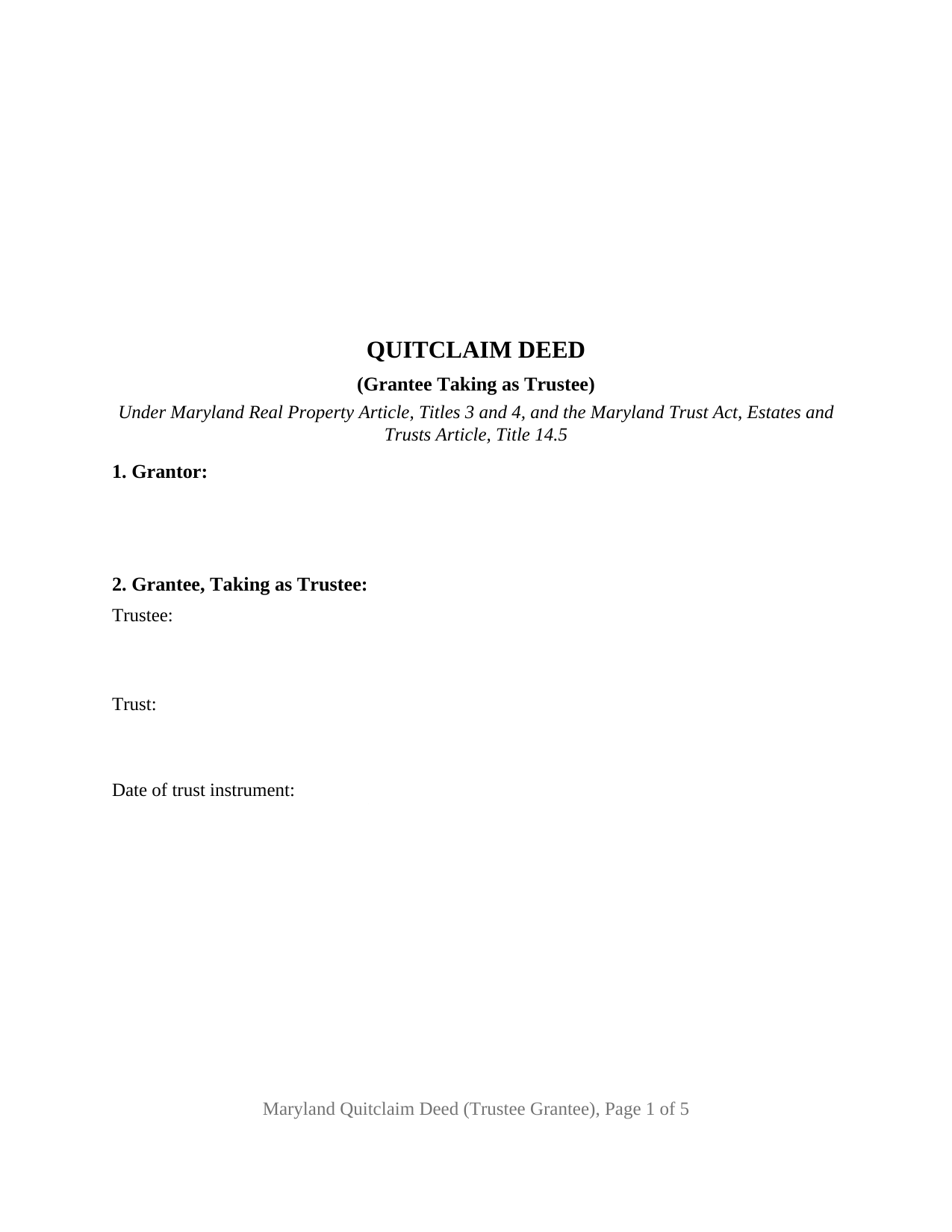
Where an ordinary deed asks for a grantee, this one asks for three things: the trustee's name and mailing address, the name of the trust, and the date of the trust instrument. Those coordinates let a later reader of the chain place the title. Estates and Trusts Article Section 14.5-910 works from the same set when it lists what a certification of trust may state, among them the date the trust instrument was executed, the identity and address of the acting trustee, the trustee's powers in the pending transaction, and the manner and name in which title to trust property may be taken. That certification, which keeps the trust instrument itself private, is prepared separately and is not included here. The deed does the narrower job of moving the interest and stating the capacity in which the Grantee takes it.
The tax rule that meets a transfer into trust
Estates and Trusts Article Section 14.5-1001(b) is unusually direct. A recordation tax, a transfer tax, or any other State or local excise tax may not be imposed on a transfer of real property, or on the recordation of an instrument transferring real property, made without consideration, where the transfer is to a trust. The Tax-Property Article says the same thing from the tax side: Section 12-108(ee) exempts an instrument transferring real property to a trust under the circumstances Section 14.5-1001 specifies, and Section 13-207(a)(23) carries that subsection into the roster of State transfer tax exemptions. Consideration is still recited: Section 12-104(a) puts the consideration payable, including the principal amount of any mortgage debt the grantee assumes, in the recitals or the acknowledgment or in an accompanying affidavit. A funding transfer enters zero there, the same zero Tax-General Article Section 10-912(a)(6) reads for nonresident withholding. The form gives the exemption its own numbered section, so the citation sits on the face of the instrument as well as on the intake sheet.
One signature, and it is not the trustee's
The form recites exactly one Grantor, signing personally, with a single acknowledgment certificate on the State Government Article Section 18-216 short form and a certificate of preparation carrying a capacity blank. The Grantee signs nothing, because acceptance and authority live in the trust instrument rather than on the deed. Patterns presenting this configuration appear in the land records: an owner funding an irrevocable trust with a parcel, a relative serving as trustee of a family trust taking land from the person who created it, and a conveyance placing title in the named trustee where an earlier instrument had named only the trust. The form is not set up as a release by two Grantors, as a grant to grantees taking in their individual capacities, or as an instrument executed on the Grantor side by a trustee, a personal representative, or an attorney-in-fact.
Maryland formalities on the face of the form
Acknowledgment before a notarial officer is the governing execution formality, and the deed carries no witness line and no seal, since Real Property Article Section 4-101(b) leaves validity untouched by the absence of either. Section 3-104(f) supplies the preparation certificate a Maryland deed cannot be recorded without, Section 3-104(d) puts a printed name with the signature, and the page answers the margin reserve of Section 3-104(e)(1)(i)2, enforceable by refusal as well as by extra charge since October 1, 2025. Filing happens at the Clerk of the Circuit Court for the county or Baltimore City where the land lies.
What the download contains
The download holds three items: the blank fillable Maryland quitclaim deed configured for a grantee taking as trustee, a completed example working a Carroll County trust funding transfer through every blank, and a plain-language guide covering the sections in order, the vesting forms a Maryland grantee may take, signing and notarization, the taxes, and county recording. Everything here describes Maryland law and this form; it is informational and is not legal advice.
Important: County or Independent City-Specific Forms
Our quitclaim deed (trustee grantee) forms are specifically formatted for each of the 24 county or independent cities in Maryland.
After selecting your county or independent city, you'll receive forms that meet all local recording requirements, ensuring your documents will be accepted without delays or rejection fees.