Maryland Quitclaim Deed (Married Couple as Grantors)
County or Independent City Specific Legal Forms Validated as recently as October 7, 2026 by our Forms Development Team
About the Maryland Quitclaim Deed (Married Couple as Grantors)
How to Use This Form
- Select your county or independent city from the list
- Download the county or independent city-specific form
- Fill in the required information
- Have the document notarized if required
- Record with your county or independent city recorder's office
What Others Like You Are Saying
"Very easy to understand and complete the process. This is the third attempt to download a Quit Claim…"
"was great!"
"Form and info was good"
"Always helpful!"
"Thank you for your help the website is simple and easy to use and dealing with this county for the 1…"
4.8/5 from 4,828 reviews. Read all
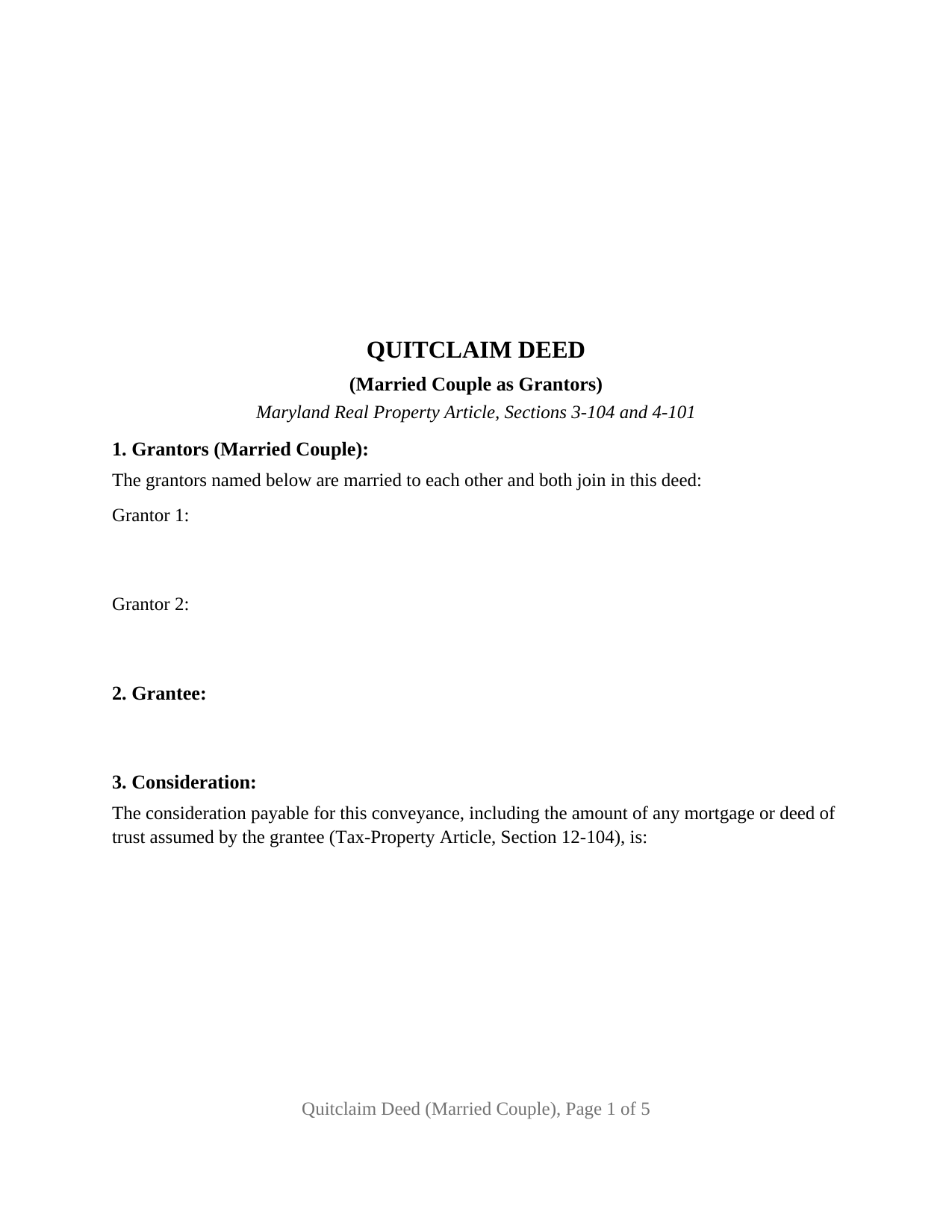
Marriage is the architecture of this Maryland quitclaim deed: the two grantors it recites are spouses, identified on the face of the form as married to each other, and both join in one instrument to release their right, title, and interest to a named grantee, free of any covenant or warranty of title. Maryland gives that pairing real legal weight. Property titled to a married couple is presumed held as tenants by the entirety, an estate that neither spouse acting alone can convey, encumber, sever, or partition, so a deed moving it out of the couple's names arrives at the land records with two signatures or does not arrive at all.
An estate neither spouse conveys alone
Maryland recognizes tenancy by the entirety at common law, and the presumption runs in its favor: a grant to two persons married to each other creates an entireties estate absent contrary language, the rule the Court of Appeals applied in Columbian Carbon Co. v. Kight, 207 Md. 203 (1955). Real Property Article Section 4-108 lets spouses create and regrant these interests directly, without the old straw conveyance. The other side of that protection is the joinder rule this form is built around: a conveyance of entireties property takes both spouses. Nothing else joins them on the deed, because Maryland abolished dower and curtesy (Estates and Trusts Article Section 3-202) and has no community property regime; the spouses sign as the holders of the interest, not as consenting bystanders. After an absolute divorce, entireties title converts to a tenancy in common, and former spouses conveying together present an unmarried co-owner configuration rather than the one this deed recites.
Two spouses, one release
The form recites exactly two grantors, married to each other and signing personally, with a marital recital above the grantor entries and a conveyance paragraph in which each spouse releases that spouse's entire interest, expressly including any interest held with the other as tenants by the entirety. The operative words are Maryland's customary release words, remise, release, and forever quitclaim, followed by a plain statement that no covenant or warranty of title is made or implied. Couples appear in this posture throughout the land records: spouses deeding the entireties home to an adult child and the child's new spouse, a couple retitling land they hold together to the trustee of a shared revocable trust, and neighbors ending a fence-line question by having the husband and wife on one side release the disputed strip. The form is not set up as a sole-owner release, as an instrument for co-owners who are not married to each other, or as a deed signed in a trustee, personal representative, or attorney-in-fact capacity.
From the signature lines to the clerk's counter
Each spouse signs above a printed name line, the placement Real Property Article Section 3-104(d) describes, and the form carries an acknowledgment certificate for each spouse drawn to the State Government Article Section 18-216 short form, so the two can appear together before one notary or separately before different officers; remote online notarization is also authorized when Maryland's statutory conditions are met. A certificate of preparation, required by Section 3-104(f) before any deed reaches the record, is signed by a party named in the deed or by, or under the supervision of, a member of the Maryland Bar. The first page holds the 3 inch top margin reserved for the clerk, the body sits in 12 point type on 1 inch side margins, and the consideration section performs the recital Tax-Property Article Section 12-104 requires, the figure from which the county recordation tax and the state and county transfer taxes are computed at recording. The deed travels with a Land Instrument Intake Sheet, where any claimed exemption is cited.
Inside the download
The download holds the blank fillable deed formatted for a married couple, a completed example working a Frederick County family sale from the marital recital through the preparation certificate, and a plain-language guide covering each section, entireties title, the grantee vesting forms Maryland recognizes, signing, and county recording. The materials describe Maryland law and this form; they are informational only and are not legal advice.
Important: County or Independent City-Specific Forms
Our quitclaim deed (married couple as grantors) forms are specifically formatted for each of the 24 county or independent cities in Maryland.
After selecting your county or independent city, you'll receive forms that meet all local recording requirements, ensuring your documents will be accepted without delays or rejection fees.