Maryland Quitclaim Deed (Partnership or Limited Partnership Grantor)
County or Independent City Specific Legal Forms Validated as recently as October 16, 2026 by our Forms Development Team
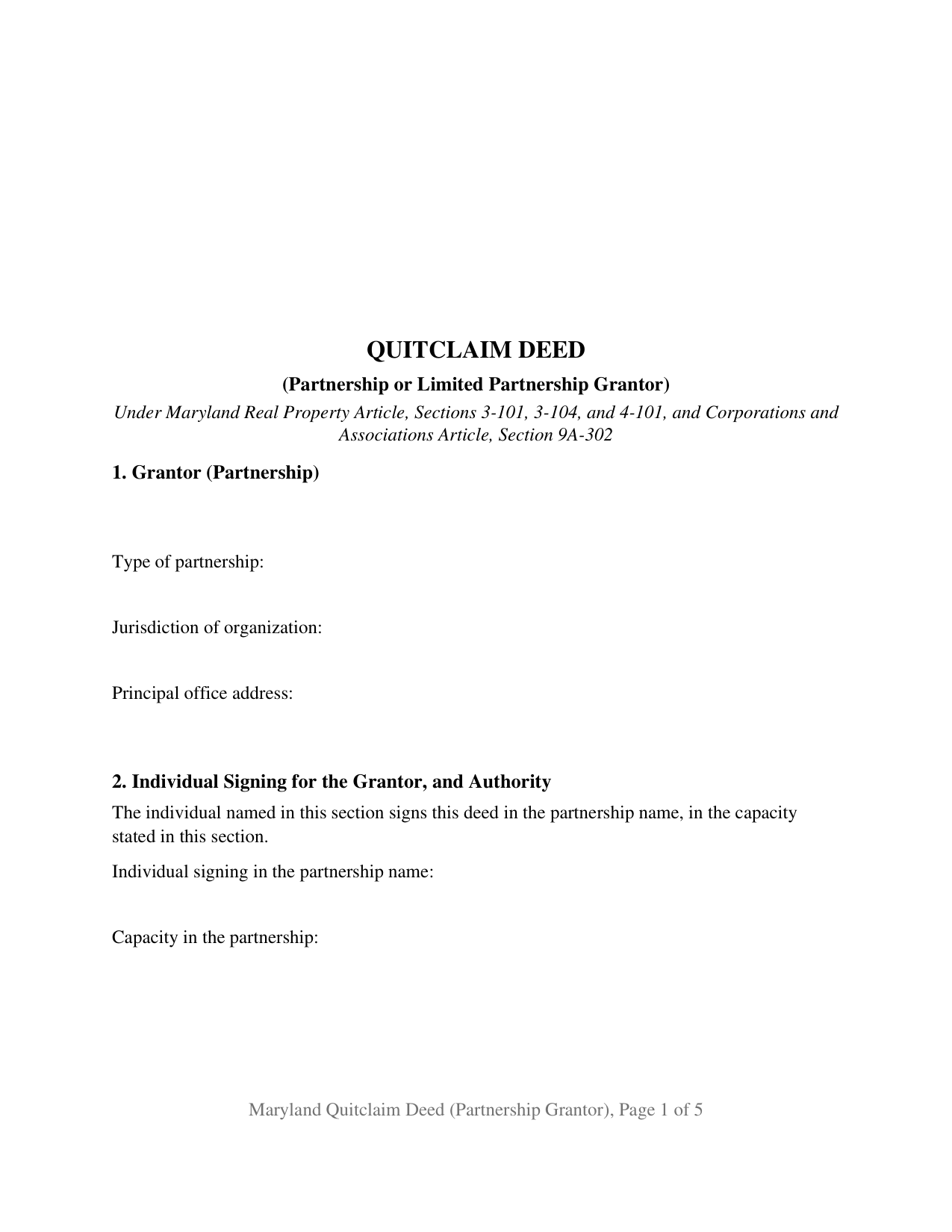
About the Maryland Quitclaim Deed (Partnership or Limited Partnership Grantor)
How to Use This Form
- Select your county or independent city from the list
- Download the county or independent city-specific form
- Fill in the required information
- Have the document notarized if required
- Record with your county or independent city recorder's office
What Others Like You Are Saying
"Thanks"
"Great job with these forms. Super easy and up to date, a rare find online these days. Thank you."
"I just completed my first deed filing and I’m very happy with the experience. The deeds staff was ex…"
"Deeds.com did an excellent job in providing me the Real Estate documents I needed. You delivered the…"
"Excellent service and professionalism"
4.8/5 from 4,836 reviews. Read all
The authority behind a partnership's deed can be a matter of public filing in Maryland. This quitclaim deed recites a partnership as the Grantor, holding Maryland real property under its own name, with one authorized individual executing the instrument in that name. What reaches the Grantee is the interest the partnership holds when the deed is delivered, and no covenant or warranty of title travels with it.
How partnership real estate moves
Corporations and Associations Article Section 9A-204(a) makes a parcel partnership property when it is acquired in the name of the partnership. Section 9A-302(a)(1) supplies the transfer mechanism for that pattern, the one this form recites: such property may be transferred by an instrument of transfer executed by a partner in the partnership name, subject to the effect of a statement of partnership authority. Section 9A-301(1) carries the agency half: a partner's execution of an instrument in the partnership name for apparently carrying on the ordinary course binds the partnership.
The filing that can name who signs
Signing authority can sit in the public record. Under Section 9A-303(a)(1)(iii) a statement of partnership authority may name the partners authorized to execute an instrument transferring real property held in that name, and Section 9A-303(c) makes such a grant conclusive in favor of a person who gives value without knowledge to the contrary. Section 2 of the deed collects the individual, the capacity, and the authorization relied on: a clause of the partnership agreement, the partners' consent, or a statement filed with the State Department of Assessments and Taxation. For an act outside the ordinary course, Section 9A-401(j) calls for the consent of all of the partners.
Where a limited partnership differs
Two provisions set a limited partnership apart. Section 10-201 has all of the general partners execute a certificate of limited partnership filed with the Department, so the roster of possible signers is public; Section 10-303(a) keeps a limited partner clear of partnership obligations absent control of the business. Tax law draws the line in the same place: the business entity definition behind the related-entity exemption of Tax-Property Article Section 12-108(p) covers a limited partnership and leaves a general partnership outside it, while Section 12-108(q) reaches any partnership, lifting the recordation tax off a transfer on liquidation or termination to an original partner.
What the partnership configuration recites
The form recites exactly one Grantor: a partnership named on the face of the deed with its type, its jurisdiction of organization, and its principal office. Exactly one individual signs in the partnership name, the capacity recorded beside the signature. The instrument carries one acknowledgment certificate on the representative-capacity short form of State Government Article Section 18-216(c), a residency certification answering Tax-General Article Section 10-912 inside the recitals, and a certificate of preparation holding its own capacity blank. The land records show partnerships in this posture: one whose partners have changed since it took title, releasing through the partner a filed statement names; a limited partnership contributing a parcel to a newly formed limited partnership for the issuance of partnership interests; and a joint venture releasing a development parcel back to the venturer that brought it in. The form is not set up for a conveyance reserved to two or more signing partners, for property standing in the individual partners' names, for a corporation or limited liability company as Grantor, or for an owner signing personally.
What the counter checks
Recording is part of this conveyance rather than a step after it: Real Property Article Section 3-101(a) withholds effect from a deed until it is executed and recorded, so the release becomes operative at the Clerk of the Circuit Court where the land lies. Three things on the face of the form answer the recording statute: the certification in Section 12, without which Section 3-104(f) keeps a deed off the record; the printed name beside the signature, where Section 3-104(d) places it; and the page itself, set in 12 point type inside the official-use band and side margins of Section 3-104(e)(1)(i)2, enforceable by refusal since October 1, 2025. Consideration is recited under Section 12-104, and a Land Instrument Intake Sheet accompanies the deed.
Three files arrive in the download: the blank quit claim deed as a fillable PDF configured for a partnership grantor, a completed example filled in for a Baltimore City transfer, and a plain-language guide to the twelve sections, partner authority, grantee vesting, notarization, and the taxes. The contents describe Maryland law and this form; they are not legal advice.
Important: County or Independent City-Specific Forms
Our quitclaim deed (partnership or limited partnership grantor) forms are specifically formatted for each of the 24 county or independent cities in Maryland.
After selecting your county or independent city, you'll receive forms that meet all local recording requirements, ensuring your documents will be accepted without delays or rejection fees.