Maryland Quitclaim Deed (Married Grantor with Non-Owner Spouse Joinder)
County or Independent City Specific Legal Forms Validated as recently as September 22, 2026 by our Forms Development Team
About the Maryland Quitclaim Deed (Married Grantor with Non-Owner Spouse Joinder)
How to Use This Form
- Select your county or independent city from the list
- Download the county or independent city-specific form
- Fill in the required information
- Have the document notarized if required
- Record with your county or independent city recorder's office
What Others Like You Are Saying
"I am really impressed by this website. Not only is it affordable, but they give a detailed descripti…"
"This site is excellent and makes everything so much easier. 5 star platform."
"Awesome! Quick service and well worth the very minimal fee for the convenience of being able to quic…"
"This process was very easy to go through, from beginning to end. It was fast, precise and got the jo…"
"I found the information very helpful. Had problems producing a professional looking document due to …"
4.8/5 from 4,828 reviews. Read all
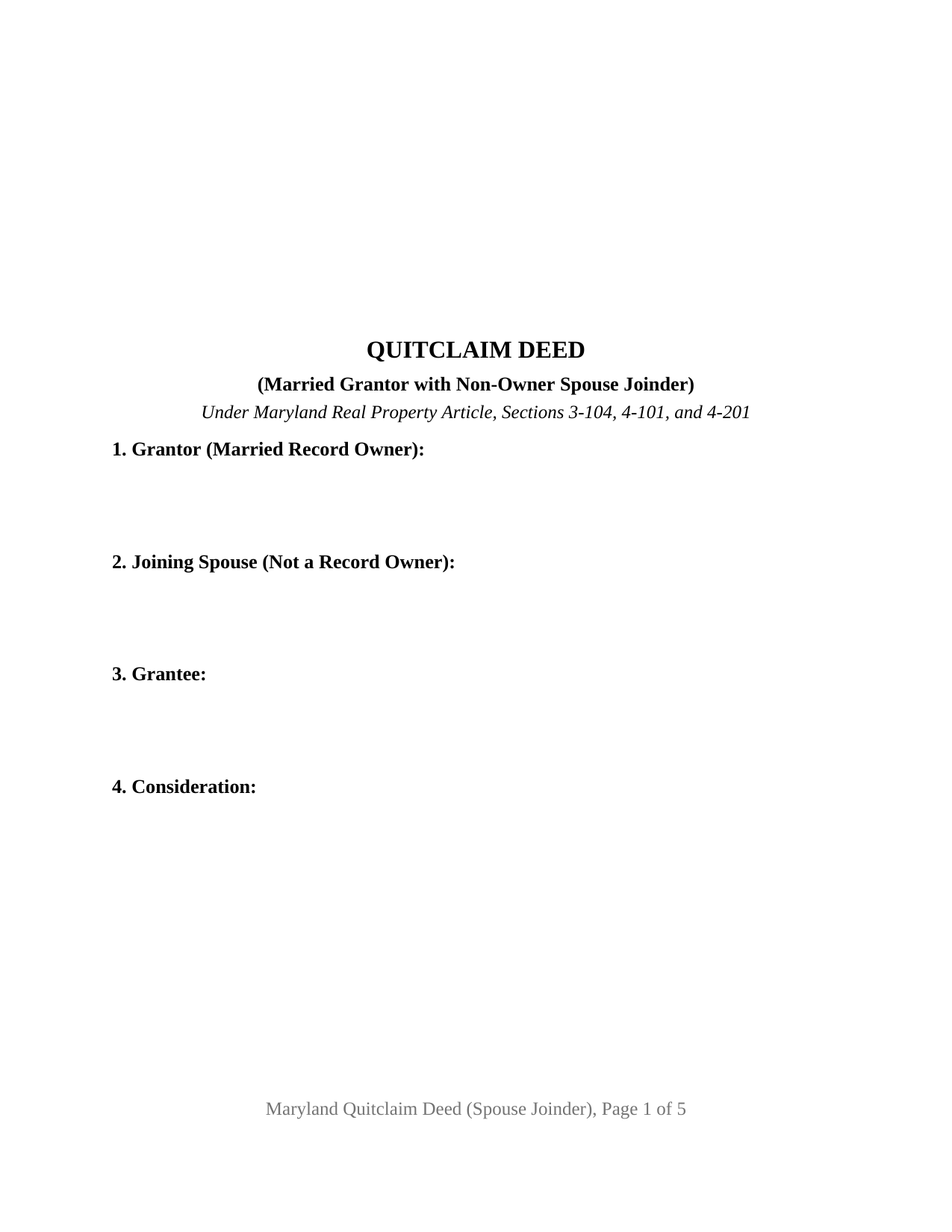
The second signature on this Maryland quitclaim deed belongs to someone who owns none of the property. One spouse holds the record title and releases it as the sole Grantor; the other signs as a Joining Spouse, giving up whatever right or claim the marriage might supply and nothing more. No Maryland statute asks for that second signature, which is why the form drafts it as operative language rather than a consent line: the spouse quitclaims on the record, in the owner's own release words.
A joinder that releases rather than consents
Maryland retired the old lifetime marital interests in land. Dower and curtesy are abolished under Estates and Trusts Article Section 3-202, and the State has no community property regime, so a parcel standing in one spouse's name alone can be conveyed by that spouse alone. What remains is a practical gap rather than a legal one: a title examiner reading a transfer out of a married person's sole name sees the marriage without seeing the answer to it, and an open marital question reads as a cloud whether or not it would ripen into a claim. Section 7 of this deed closes it on the face of the record, with the Joining Spouse remising, releasing, and forever quitclaiming every right, interest, and claim in the property, including any claim arising out of the marriage to the Grantor.
What a spouse can hold without holding title
Two doctrines explain why the release is worth recording. Surviving spouse protection runs through the elective share of Estates and Trusts Article, Title 3, Subtitle 4, measured against an augmented estate that includes qualifying lifetime transfers under Section 3-404(a)(1); Section 3-404(b) then reduces the estate subject to election by property whose disposition the surviving spouse consented to in writing during the decedent's lifetime. Family Law Article Section 8-208(a)(1) separately lets a court granting an annulment or divorce award one party sole possession and use of the family home regardless of how it is titled. This deed is a release of interest, not an estate planning waiver: Section 3-406(a) provides for waiver of the right of election by a signed writing, a separate instrument, and the guide names what a recorded joinder leaves open.
One owner, one joining spouse, and the blanks between them
The form recites exactly one married record owner signing personally and exactly one non-owner spouse joining as a releasing party, each with a printed name line and a dated signature block, plus an acknowledgment certificate for each signer and the certificate of preparation. Patterns presenting this configuration appear throughout the land records: a parcel taken in one name before the marriage and released to a relative, land that came to one spouse by inheritance during the marriage and is conveyed under a purchase contract, and a residence the couple occupies that the vesting deed left in one name. The form is not set up as a conveyance of property the record shows in both spouses' names, which Maryland presumes held as tenants by the entirety and which neither spouse may convey alone; it is not a release by an unmarried sole owner; and it recites personal-capacity signers rather than a trustee, personal representative, or attorney-in-fact.
Built to reach the land records intact
Maryland deeds need no seal and no subscribing witnesses: Real Property Article Section 4-101(b) provides that the absence of a seal or attestation does not affect validity, so acknowledgment before a notarial officer is the governing formality. The Section 3-104(f) preparation certificate occupies its own numbered section with a capacity blank and a signature line, printed names accompany the signatures under Section 3-104(d), and the instrument holds the 3 inch first page reserve and 1 inch side margins of Section 3-104(e)(1)(i)2 in 12 point type, a rule that gained teeth on October 1, 2025, when the clerk's authority to refuse a nonconforming instrument joined the treble recording charge. The deed reaches the Clerk of the Circuit Court with a Land Instrument Intake Sheet, the separate cover form carrying the consideration figure the taxes read from, any exemption citation, and the grantee's tax bill address.
The package holds the blank fillable deed configured for a married sole owner with a joining spouse, a completed example filling every blank with a Baltimore County transfer, and a plain-language guide covering each section, the marital interests behind the release, the vesting forms a Maryland grantee may take, notarization, and county recording. The contents are informational only and are not legal advice.
Important: County or Independent City-Specific Forms
Our quitclaim deed (married grantor with non-owner spouse joinder) forms are specifically formatted for each of the 24 county or independent cities in Maryland.
After selecting your county or independent city, you'll receive forms that meet all local recording requirements, ensuring your documents will be accepted without delays or rejection fees.