Maryland Transfer on Death Deed (Married Owners as Tenants by the Entirety, Primary and Alternate Beneficiaries)
County or Independent City Specific Legal Forms Validated as recently as November 5, 2026 by our Forms Development Team
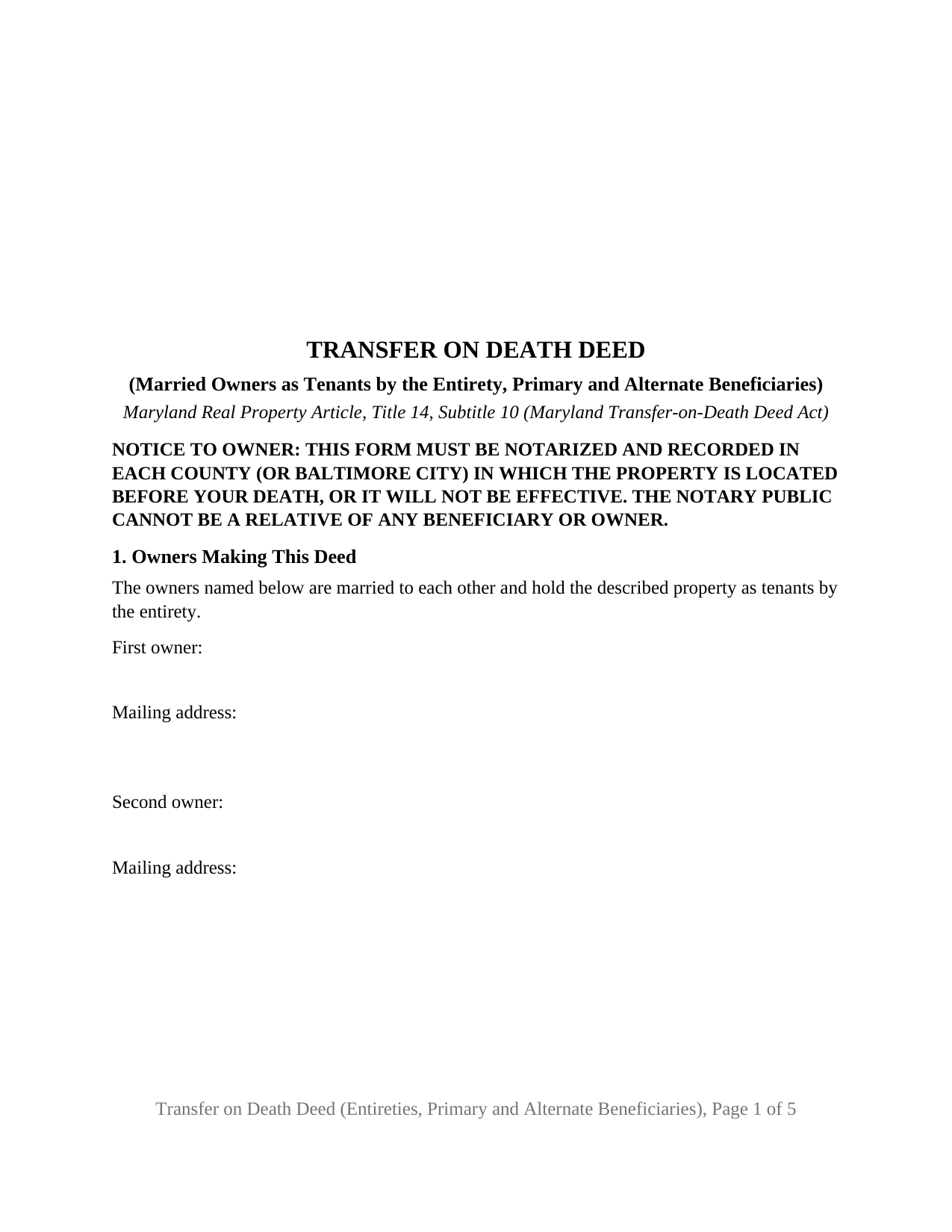
About the Maryland Transfer on Death Deed (Married Owners as Tenants by the Entirety, Primary and Alternate Beneficiaries)
How to Use This Form
- Select your county or independent city from the list
- Download the county or independent city-specific form
- Fill in the required information
- Have the document notarized if required
- Record with your county or independent city recorder's office
What Others Like You Are Saying
"my experience with this company: very responsive, communicative and gets the job done. Thank you"
"So far so good. I will be taking the report to the Marion County Clerks office this week to see if i…"
"I received prompt attention to the package I submitted. It was submitted promptly the recorders offi…"
"This service was easy, quick, and to the point. It was a lifesaver! Downloaded quickly and without i…"
"It was quick and easy to download the forms I need to modify a property deed. No problems n the leas…"
4.8/5 from 4,858 reviews. Read all
Two deaths stand between the day Maryland spouses who hold title by the entirety record a transfer on death deed and the day it operates. It waits through the first death, when the property belongs to the surviving spouse, and takes effect at the second; the longer that interval, the likelier a beneficiary named at the start is gone by the end. This form is the Maryland TOD deed built for that interval: two spouses holding as tenants by the entirety, both signing one deed under Real Property Article Title 14, Subtitle 10, with primary and alternate tiers of beneficiaries.
A designation measured from the second death
Section 14-1001(d) names a tenant by the entirety as a joint owner, and Section 14-1009(d) gives the property to the surviving joint owner at the first death and makes the deed effective on the death of the last surviving joint owner. Survival is measured against that death: Section 14-1009(a)(2) transfers the interest to a designated beneficiary who survives the transferor, and the interest of one who fails to survive lapses. A child who outlives one parent but not the other has failed to survive. The alternate tier is the deed's answer: the same subsection transfers the interest to a surviving alternate designated beneficiary where the primary does not survive, in the statutory form's own sentences.
What the entireties estate adds
Neither spouse alone can convey or sever an entireties estate, so each spouse is a transferor and both sign; the deed's operative section states that sequence. Under Section 14-1008(c) a deed by joint owners is revoked only by all living joint owners; a revocation is a separate instrument, recorded on its own and not included in this package. Where the beneficiaries are children or other relatives rather than either spouse, the divorce revocation rule the Act borrows from the Estates and Trusts Article has no spouse provision to reach; an absolute divorce instead ends the entireties estate and leaves the former spouses as tenants in common.
Two spouses, two tiers, one deed
Fixed text in the owner section recites that the two owners named are married to each other and hold the described property as tenants by the entirety, and a source of title section identifies the vesting deed. It carries two signature blocks beside the (SEAL) notation the statutory form prints, two acknowledgment certificates in the State Government Section 18-216(b) short form, and the party preparer certification Section 3-104(f) requires. Each tier receives a natural person, a trust through its trustee, or an entity; the Act's printed note gives multiple beneficiaries in a tier joint tenancy with rights of survivorship unless the deed indicates another form of ownership. It is not set up as a deed by one owner, by two owners not married to each other, by a pair whose vesting deed carries joint tenancy words, or by a trustee, entity, or attorney-in-fact. Spouses naming an adult child first and that child's children as alternates, and a childless couple naming one spouse's sibling first and a charity second, present the pattern this deed recites.
What the finance office reads
A signed Certification of Occupancy Status sits between the preparer certification and the acknowledgments, the section Maryland clerks know from the deed form Maryland Volunteer Lawyers Service publishes. The county finance office reads it to apply the Tax-Property Section 12-108(ii), 13-207(a)(27), and 13-414 exemption from recordation and transfer taxes for a deed of the transferor's primary or secondary residence, including the second-home branch the intake sheet cannot record; a tax-status line under the title announces the same status. Neither element is a statutory requirement; the exemption is.
Recording while both spouses are living
Under Section 14-1006 the deed has effect only once recorded, before the transferor's death, in the land records of the county, or Baltimore City, where the land lies; the enacted notice at the head of the deed says so. The Land Instrument Intake Sheet accompanies the deed as a separate form, since Section 3-104(g)(6)(ii) lets the clerk refuse a transfer on death deed presented without one, and in many counties the deed stops at the finance office before the clerk. The recording fee and land records surcharge still apply.
The package includes the fillable transfer on death deed, a completed example for a Washington County couple naming their two children as primary beneficiaries and a granddaughter as the alternate, and a plain-language guide covering each section, signing, and recording. The materials are informational and are not legal advice.
Important: County or Independent City-Specific Forms
Our transfer on death deed (married owners as tenants by the entirety, primary and alternate beneficiaries) forms are specifically formatted for each of the 24 county or independent cities in Maryland.
After selecting your county or independent city, you'll receive forms that meet all local recording requirements, ensuring your documents will be accepted without delays or rejection fees.