Maryland Transfer on Death Deed (Multiple Beneficiaries, Tenants in Common)
County or Independent City Specific Legal Forms Validated as recently as October 27, 2026 by our Forms Development Team
About the Maryland Transfer on Death Deed (Multiple Beneficiaries, Tenants in Common)
How to Use This Form
- Select your county or independent city from the list
- Download the county or independent city-specific form
- Fill in the required information
- Have the document notarized if required
- Record with your county or independent city recorder's office
What Others Like You Are Saying
"Had the paperwork that I needed. Was a quick and easy transaction."
"Ordered the quitclaim forms. Amazing value! Received everything I needed and then some. The forms we…"
"I like the basics. The one thing I would recommend changing would be, something that tells me I have…"
"Excellent Service! Please note that form Realty Transfer Tax Statement of Value does not print compl…"
"Great Price & Really Easy To Download"
4.8/5 from 4,836 reviews. Read all
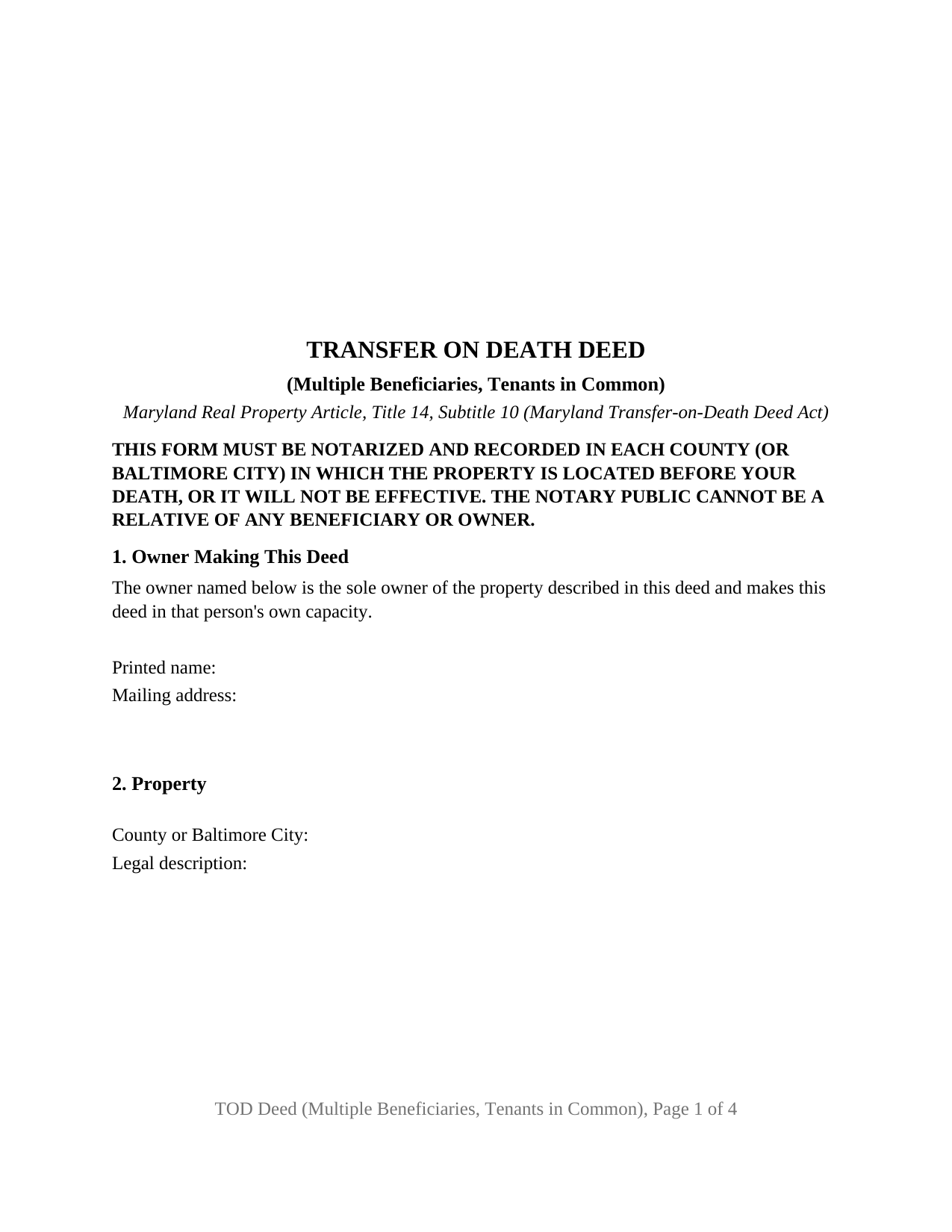
A Maryland transfer on death deed that names more than one beneficiary and says nothing about how they take hands the property to them as joint tenants with rights of survivorship, so the last beneficiary living ends up with all of it. This form takes the other path the Act allows. It names two or more primary beneficiaries as tenants in common and states the undivided share each one receives, so a parent can leave a house one-half to one child and one-fourth to each of two others. It is prepared under Real Property Article, Title 14, Subtitle 10, for one owner holding Maryland land alone.
Shares the deed states, not shares the statute assumes
Section 14-1003(b)(1) provides that a transfer on death deed designating multiple beneficiaries may transfer ownership under any form of tenancy indicated in the deed, and subsection (b)(2) supplies the survivorship default only where a deed indicates none. The deed in this package indicates one. Its fixed text provides that the primary beneficiaries take as tenants in common, each in the undivided share stated beside that beneficiary's name, and in equal undivided shares where no share is stated. Each share entry receives a fraction or a percentage. Each share is an undivided interest its beneficiary alone owns from the owner's death on, and it does not pass to the other beneficiaries when that beneficiary later dies.
What survival does to a stated share
Section 14-1009(a)(2) governs survival. A beneficiary who survives the transferor takes that beneficiary's interest at the transferor's death, the interest of a beneficiary who fails to survive lapses, and an alternate the deed names takes where the designated beneficiary does not survive. The same section makes the transfer subject to Estates and Trusts Section 4-403, Maryland's anti-lapse statute. The form carries the statutory alternate sentence, which takes effect in its own words if the primary beneficiary or beneficiaries do not survive the owner, and the guide describes how the lapse rule, anti-lapse statute, and alternate designation interact. A beneficiary deed, as this instrument is also searched, transfers under Section 14-1009(c) without covenant or warranty of title, subject to every mortgage and lien on the property at the owner's death.
One owner, four beneficiary rows, one certificate
The form recites exactly one record owner, the sole owner of the property, signing in that person's own capacity, and it carries one owner signature block with the (SEAL) notation the statutory form prints and one acknowledgment certificate in the short form of State Government Section 18-216(b). The deed fixes no marital status, and a spouse holding no record title has no signature line: Maryland has no community property regime, dower and curtesy are abolished, and Section 14-1007 provides that the deed affects no interest during the owner's life. Section 3 holds four beneficiary rows, each with a printed name, a mailing address if available, and an undivided share, receiving a natural person, a trust through its trustee, or an entity by its registered name. It is not set up as a deed by two or more owners, by a fractional co-owner, by a trustee, an entity, a personal representative, or an attorney-in-fact, or as a designation to beneficiaries who take with survivorship between them. An owner dividing the family home among adult children in unequal fractions, and an owner naming a relative and a charity in equal halves, present the pattern this deed recites.
Recording in the county where the land lies
Section 14-1006 makes recording the condition of effectiveness: the deed takes effect only when it has been recorded, while the owner is living, with the clerk of the circuit court for the county or Baltimore City in which the land sits, and the statutory notice saying so is printed at the head of the form. It carries the party-preparer certification that Section 3-104(f) makes a condition of recording. The Land Instrument Intake Sheet travels with the deed as a separate form, since Section 3-104(g)(6)(ii) lets the clerk refuse a TOD deed presented without one. Where the property is the owner's primary or secondary residence, the Tax-Property Article exempts the deed from recordation tax and from the State and county transfer taxes.
The package includes the fillable transfer on death deed as a PDF, a completed example for a Carroll County owner dividing a home among three children in unequal shares, and a plain-language guide covering each section, the share entries, signing, and recording. The materials are informational and are not legal advice.
Important: County or Independent City-Specific Forms
Our transfer on death deed (multiple beneficiaries, tenants in common) forms are specifically formatted for each of the 24 county or independent cities in Maryland.
After selecting your county or independent city, you'll receive forms that meet all local recording requirements, ensuring your documents will be accepted without delays or rejection fees.