Maryland Transfer on Death Deed (Sole Owner, Married)
County or Independent City Specific Legal Forms Validated as recently as October 27, 2026 by our Forms Development Team
About the Maryland Transfer on Death Deed (Sole Owner, Married)
How to Use This Form
- Select your county or independent city from the list
- Download the county or independent city-specific form
- Fill in the required information
- Have the document notarized if required
- Record with your county or independent city recorder's office
What Others Like You Are Saying
"Fairly easy to use. I had to really search to get some info. I had to use the Exhibit feature becaus…"
"They didn't have what I was looking for so they refunded my money immediately. Very easy to work wit…"
"Wonderful. Easier to fill out this form than I thought it would be."
"Thank you for the comprehensive forms - very much appreciated!"
"THE BEST SERVICE WAS ON TIME AS STATED DID ALL THE WORK NEED IN A VERY PROFESSIONAL MANNER GREAT FOL…"
4.8/5 from 4,836 reviews. Read all
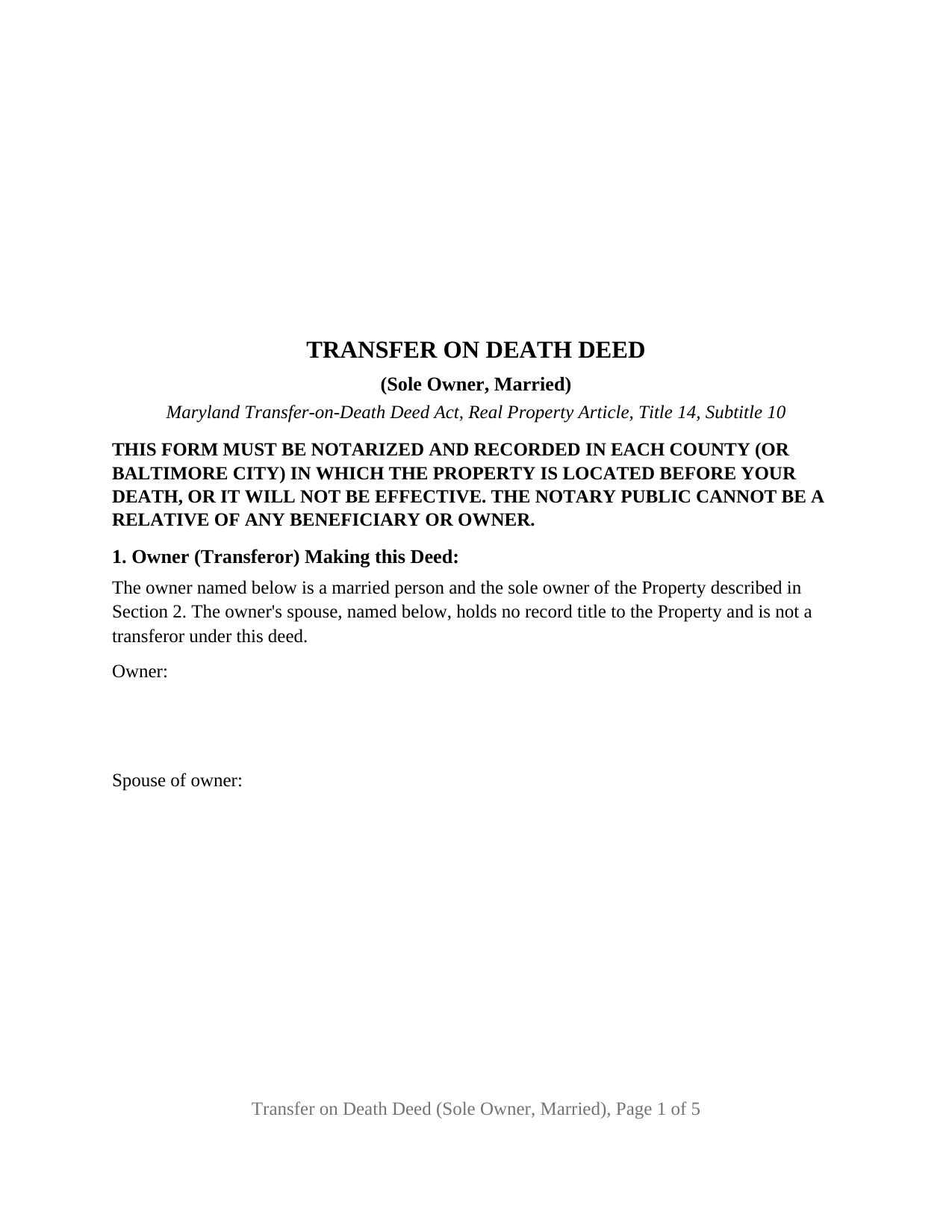
A Maryland transfer on death deed by a married owner who holds title alone carries one signature, the owner's, and the spouse signs nothing. This form prepares that deed, also searched as a beneficiary deed or TOD deed, under the Maryland Transfer-on-Death Deed Act, Real Property Article, Title 14, Subtitle 10, for a sole owner who is a married person and whose spouse holds no record title: the owner is named, the spouse is named, and the deed states on its face that the spouse is not a transferor.
Why the spouse does not sign in Maryland
Maryland gives a non-owner spouse no inchoate interest for a deed to release. Estates and Trusts Section 3-202 abolished dower and curtesy, Maryland has no community property regime, and a transfer on death deed in any event conveys nothing during life under Section 14-1007. A spouse holding no record title therefore has no signature line on this deed, and the acknowledgment certificate names one person. The fixed recital in Section 1 says so in the deed's own words, which separates this configuration from a deed by spouses holding as tenants by the entirety, an estate both must convey together.
Two ways the marriage still reaches the deed
Not signing is not the same as not mattering. Section 14-1009(a)(1) subjects the transfer at death to the surviving spouse's elective share under Estates and Trusts Title 3, Subtitle 4, which under Section 3-403 is one-third of the estate subject to election where the owner leaves issue and one-half where there is none, measured against an augmented estate that reaches nonprobate property. A spouse who is not the beneficiary may therefore elect against the designation. The same subsection applies Estates and Trusts Section 4-105(b)(4): where the deed names the spouse as beneficiary and the marriage later ends in absolute divorce or annulment, the provisions in favor of the spouse are revoked unless the deed or the decree provides otherwise, which the Act's own informational sheet describes as automatic revocation. The completed example shows the pattern that brings the second rule into view, an owner naming the spouse as primary beneficiary and a daughter as alternate.
What the deed recites and what it asks for
The form recites exactly one record owner, a married person and the sole owner of the property, with the spouse named as a person holding no record title. A deed by two owners of any kind, by an unmarried owner, by a trustee, an entity, a personal representative, or an attorney-in-fact, or by three or more owners is a different instrument from the one this recital describes. Property bought before the marriage and kept in one name, property one spouse inherited or received by gift, and property deeded to one spouse alone during the marriage are the title patterns that present it in the land records. The beneficiary sections carry the statutory form's own designation sentences and receive a natural person, a trust through its trustee, or an entity, with the Act's note that multiple beneficiaries take as joint tenants with rights of survivorship unless the deed indicates another form of ownership.
Signing, certifying, and recording
The owner signs beside the (SEAL) notation the statutory form prints and acknowledges the deed under the State Government Article short form, with a reserved area for the notary's stamp. The deed then carries the party-preparer certification that Section 3-104(f) makes a condition of recording, in the statutory form's words, with a capacity blank for owner, primary beneficiary, or alternate beneficiary. Recording before the owner's death in the land records of the county, or Baltimore City, where the property lies is the condition of effectiveness under Section 14-1006, and the form reproduces the statutory notice to that effect at its head; the Land Instrument Intake Sheet travels with the deed as a separate form, since the clerk may refuse a transfer on death deed presented without one. A deed of the owner's primary or secondary residence is exempt from recordation tax and from State and county transfer tax under the Act's tax amendments.
The package includes the fillable transfer on death deed as a PDF, a completed example filled in for a Frederick County fact pattern with a married sole owner naming the spouse as primary beneficiary and a daughter as alternate, and a plain-language guide covering each section, the spousal rules, signing, and recording. The materials are informational and are not legal advice.
Important: County or Independent City-Specific Forms
Our transfer on death deed (sole owner, married) forms are specifically formatted for each of the 24 county or independent cities in Maryland.
After selecting your county or independent city, you'll receive forms that meet all local recording requirements, ensuring your documents will be accepted without delays or rejection fees.