Maryland Transfer on Death Deed (Two Owners, Joint Tenants with Right of Survivorship)
County or Independent City Specific Legal Forms Validated as recently as November 5, 2026 by our Forms Development Team
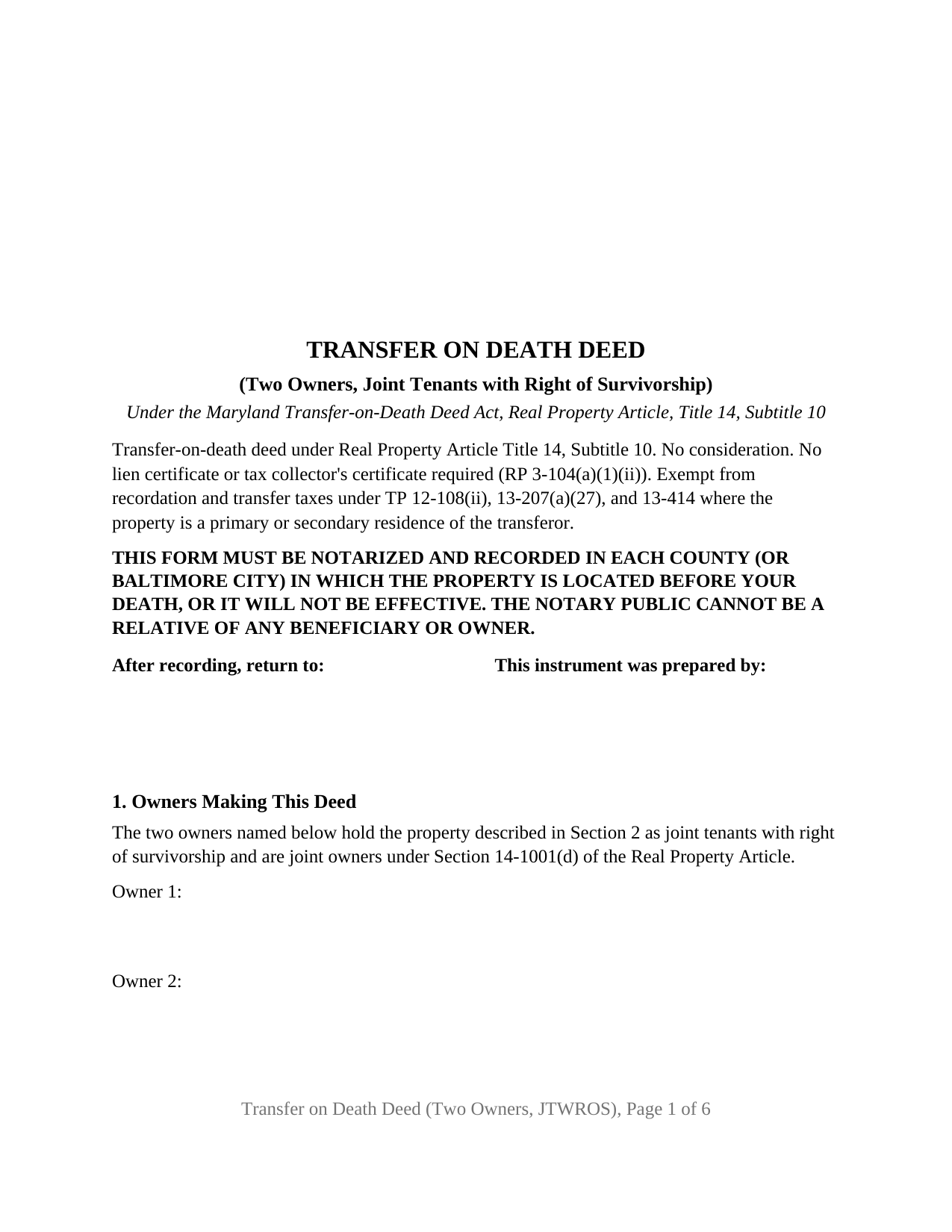
About the Maryland Transfer on Death Deed (Two Owners, Joint Tenants with Right of Survivorship)
How to Use This Form
- Select your county or independent city from the list
- Download the county or independent city-specific form
- Fill in the required information
- Have the document notarized if required
- Record with your county or independent city recorder's office
What Others Like You Are Saying
"I was impressed by the completeness of the package of forms PLUS instructions. Particularly helpful …"
"First Time User here. Simple and easy. Delivered Deed in excellent time. Sure beats going to the rec…"
"Excellent Service! Fast and friendly. Thank you will use again!"
"Great experience. No hassle. It kept me out of a government office."
"Deeds.com did a great job in explaining exactly what I'd need to file a deed transfer (quitclaim dee…"
4.8/5 from 4,847 reviews. Read all
Maryland does not presume a joint tenancy. Section 2-117 of the Real Property Article provides that no deed or other written instrument creates an estate in joint tenancy unless it expressly provides that the property is to be held that way, so two owners with survivorship between them hold under an instrument that says so. This Maryland transfer on death deed, also searched as a TOD deed or beneficiary deed, is built for that pair: two owners holding as joint tenants with right of survivorship, both signing one deed under Real Property Article, Title 14, Subtitle 10, naming who takes the property once both have died.
The vesting words decide the pattern
Section 14-1001(d) defines a joint owner as an individual who owns property concurrently with others with a right of survivorship, lists a joint tenant first, and excludes a tenant in common. The deed opens with fixed text reciting that the two owners hold as joint tenants with right of survivorship and are joint owners under that section, and its Source of Title section identifies the recorded instrument that vested title in them. A pair whose deed carries no survivorship words holds as tenants in common, and a grant to spouses is presumed to create an entireties estate; each is a different pattern from the one this deed recites.
Nothing moves until the last owner dies
Under Section 14-1007 the recorded deed affects no interest or right of either owner during life, including the right to transfer or encumber the property, so it neither severs the joint tenancy nor creates an interest in a beneficiary. At the first death, Section 14-1009(d) gives the property to the surviving owner with right of survivorship; on the death of the last surviving owner the deed takes effect, and the beneficiaries who survive that owner take under Section 14-1009(a)(2), subject to every mortgage and lien then of record and without covenant or warranty of title. The deed carries the statutory form's own operative sentences and then states the Section 14-1009(d) sequence in its own text. While both owners are living, Section 14-1008(c) lets them revoke only together; a revocation is a separate instrument, recorded on its own and not included in this package.
What this two-owner deed recites and carries
The form recites exactly two record owners holding as joint tenants with right of survivorship, both of whom sign beside the (SEAL) notation the statutory form prints. It carries two acknowledgment certificates in the short form of State Government Section 18-216(b), one for each owner, so the owners may acknowledge on different dates or before different officers; the party certification of preparation Section 3-104(f) makes a condition of recording; a header line stating the deed's tax status; and a Certification of Occupancy Status, the section the form published by Maryland Volunteer Lawyers Service carries and Maryland clerks are familiar with, signed by an owner so the finance office can apply the tax exemption at the counter. Two friends who purchased a condominium under a deed naming them as joint tenants with right of survivorship, an aunt and an adult nephew who took title to a house as joint tenants, and two cousins who bought a vacation property as joint tenants and not as tenants in common present the pattern this deed recites. It is not set up as a deed by one owner, by tenants in common, by spouses holding by the entirety, by three or more owners, or by a trustee, entity, personal representative, or attorney-in-fact.
Recording while both owners are living
Section 14-1006 makes recording the condition of effectiveness: the deed is effective if, before the transferor's death, it is recorded in the land records of the county, or Baltimore City, where the property is located, and the form's notice to that effect heads the deed. The Land Instrument Intake Sheet is a separate form that accompanies the deed; under Section 3-104(g)(6)(ii) a clerk may refuse to record a transfer on death deed that lacks one. Where the property is a primary or secondary residence of the transferor, Tax-Property Section 12-108(ii) exempts the deed from recordation tax, with matching State and county transfer tax exemptions.
The package includes the fillable transfer on death deed as a PDF, a completed example for a Calvert County fact pattern in which two joint tenants name a child of one and a niece of the other, and a plain-language guide covering each section, signing, and recording. The materials are informational and are not legal advice.
Important: County or Independent City-Specific Forms
Our transfer on death deed (two owners, joint tenants with right of survivorship) forms are specifically formatted for each of the 24 county or independent cities in Maryland.
After selecting your county or independent city, you'll receive forms that meet all local recording requirements, ensuring your documents will be accepted without delays or rejection fees.