Maryland Transfer on Death Deed
County or Independent City Specific Legal Forms Validated as recently as November 5, 2026 by our Forms Development Team
About the Maryland Transfer on Death Deed
How to Use This Form
- Select your county or independent city from the list
- Download the county or independent city-specific form
- Fill in the required information
- Have the document notarized if required
- Record with your county or independent city recorder's office
What Others Like You Are Saying
"Deeds.com made my experience recording a Deed in Weld County, CO so easy! The representative went ab…"
"Wonderful forms. It's nice that they were formatted perfectly for my county, it's real easy to miss …"
"Great service, very efficient and super fast."
"I was looking for the proper quit claim deed for my state. I found it on deeds.com along with instru…"
"The product I purchased looks great and I added Adobe to be able to copy it, but for some reason I c…"
4.8/5 from 4,858 reviews. Read all
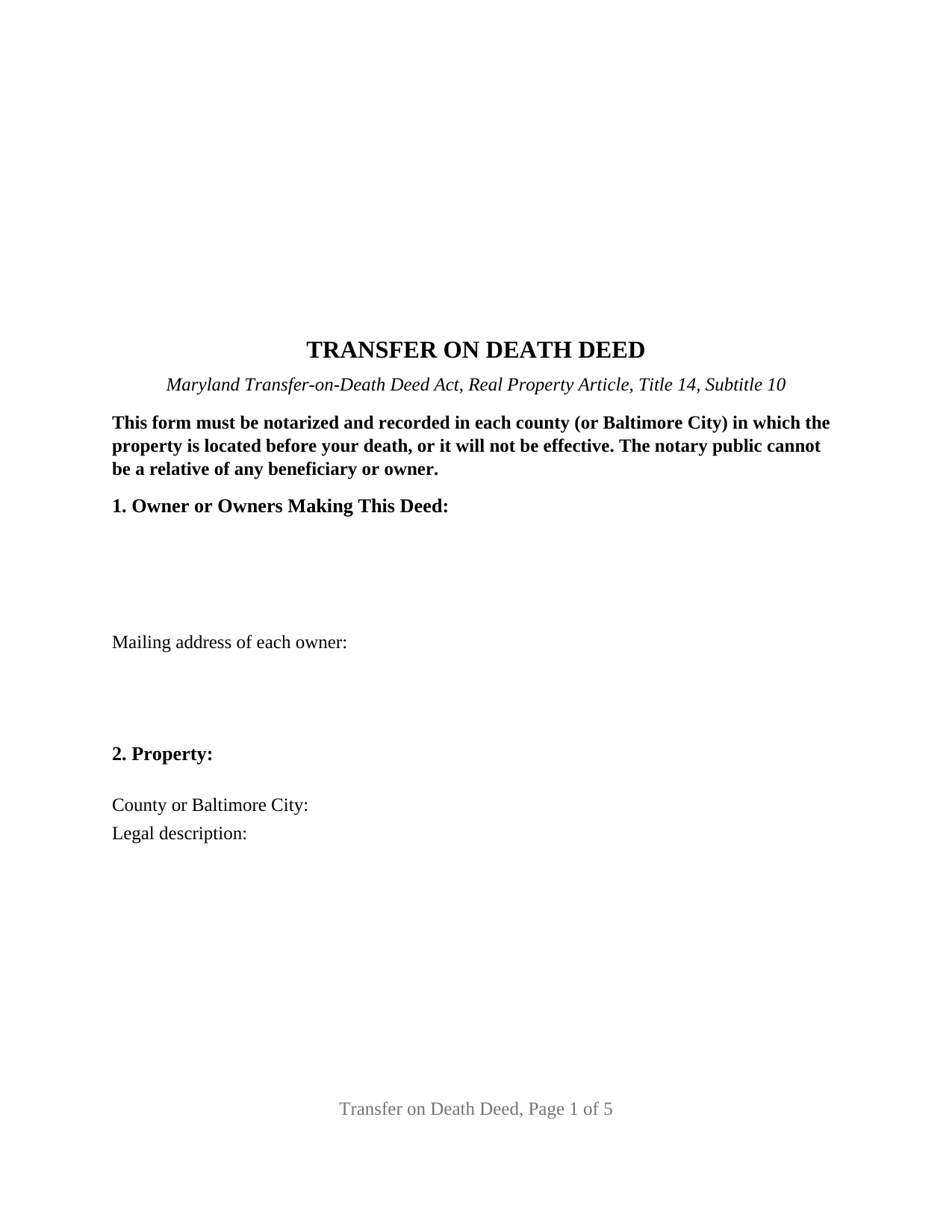
The Maryland transfer on death deed speaks in the first person. Its operative sentence, taken from the form the General Assembly wrote into Section 14-1011 of the Real Property Article, reads: at my death, I transfer my interest in the described property to the beneficiaries as designated above. Each signer transfers that signer's own interest and nothing else, so one instrument serves one owner or two owners holding a parcel together. This form is that instrument, prepared under Title 14, Subtitle 10 of the Real Property Article, in force since October 1, 2026, for one or two individual owners of Maryland real estate.
A deed that transfers each signer's own interest
A TOD deed, sometimes searched as a beneficiary deed, is nontestamentary under Section 14-1004. It passes nothing during life, stays revocable whatever it says, and at death transfers the signer's interest under Section 14-1009 to a designated beneficiary who survives, subject to every encumbrance then of record and without covenant or warranty of title. Where two owners hold with a right of survivorship, the Act supplies the order of events: the property belongs to the surviving joint owner at the first death, and the deed is effective on the death of the last surviving joint owner. Where two owners hold as tenants in common, each owner's undivided share passes at that owner's own death.
Beneficiaries the Act allows
A beneficiary under Section 14-1001 is a person, and the Real Property Article defines a person to reach an individual, a trustee, a fiduciary or representative of any kind, and any partnership, corporation, or other entity. The beneficiary sections receive a natural person, a trust through its trustee, or an entity by its registered name. Section 14-1003 lets a deed naming more than one beneficiary state the form of tenancy in which they take and, where it does not, conveys title to them as joint tenants with rights of survivorship, and the form prints the Act's note to that effect. An alternate section carries the designation that takes effect if no primary beneficiary survives.
What the clerk and the finance office look for on a Maryland TOD deed
The Act rewrote the recording statute for this instrument in two ways. Section 3-104(g)(6)(ii) now lets a clerk refuse a transfer on death deed that arrives without a Land Instrument Intake Sheet. And Section 3-104(f) still conditions recording on a certification of preparation, in one of two statutory forms: a certification by an attorney admitted to the Maryland Bar that the deed was prepared by or under the supervision of the attorney, or a certification by a party named in the deed that the party prepared it. The form prints both branches as a choice. Recording before the owner's death remains the condition of effectiveness under Section 14-1006, and the statutory notice to that effect heads the deed.
Beside those statutory conditions the deed carries two elements from the form Maryland Volunteer Lawyers Service publishes, the form Maryland clerks are familiar with: a tax-status line under the title and a signed Certification of Occupancy Status. The clerk and the county finance office read the marked occupancy box to apply the exemption from recordation and transfer taxes that Tax-Property Sections 12-108(ii), 13-207(a)(27), and 13-414 give a deed of the transferor's primary or secondary residence. Neither element is a statutory requirement; both are what the counter expects to see.
One form, one or two owners
The form carries an open owner block that receives one or two natural persons signing in their own capacity, with no preprinted vesting or status language, two owner signature blocks, and two acknowledgment certificates, one for each signer, so the owners may acknowledge on different dates or before different notarial officers. On a deed by one owner the second signature block and its certificate stay empty. The form is not set up as a deed by a trustee, an entity, a personal representative, or an attorney-in-fact, each of which signs in a representative capacity, or for three or more owners on one instrument; the Act defines a transferor as an individual, and the statutory form itself prints two owner lines.
The package includes the fillable transfer on death deed as a PDF, a completed example for a Howard County fact pattern with two owners, two beneficiaries, and an alternate, and a plain-language guide that walks through each section, the intake sheet, the tax exemptions and occupancy certification, and the format rules of Section 3-104. The materials are informational and are not legal advice.
Important: County or Independent City-Specific Forms
Our transfer on death deed forms are specifically formatted for each of the 24 county or independent cities in Maryland.
After selecting your county or independent city, you'll receive forms that meet all local recording requirements, ensuring your documents will be accepted without delays or rejection fees.