Maryland Transfer on Death Deed (Married Owners, Tenants by the Entirety)
County or Independent City Specific Legal Forms Validated as recently as November 5, 2026 by our Forms Development Team
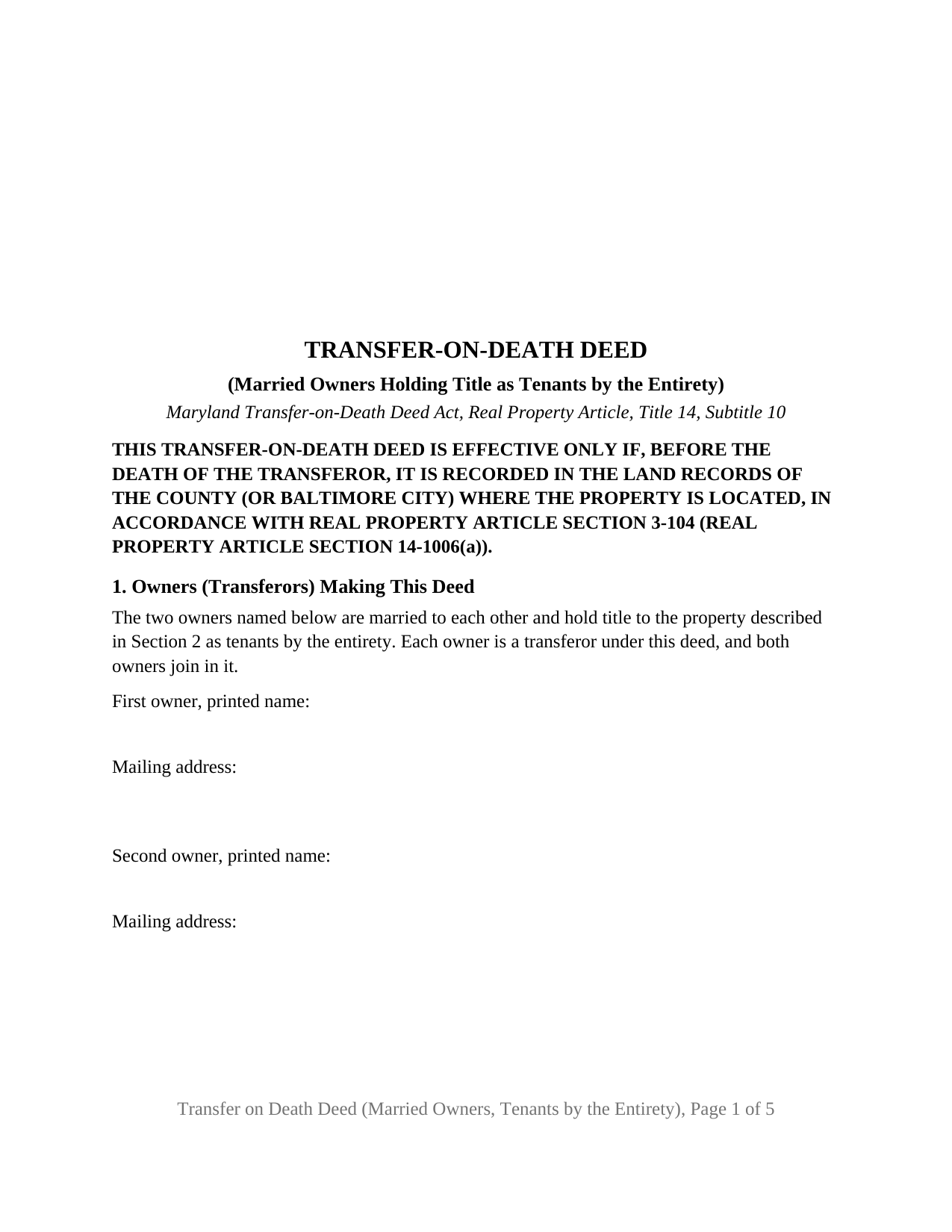
About the Maryland Transfer on Death Deed (Married Owners, Tenants by the Entirety)
How to Use This Form
- Select your county or independent city from the list
- Download the county or independent city-specific form
- Fill in the required information
- Have the document notarized if required
- Record with your county or independent city recorder's office
What Others Like You Are Saying
"it was a smooth superb timely experience"
"The forms were clear, concise and easy to understand. thank you"
"Quick and easy! Had my document submitted to the county and back in one day. Good rates as well!"
"Excellent service. Pay your fee, download the form and fill out according to specific instructions. …"
"Deeds.com had exactly the forms I needed! One of the easiest sites to navigate. Well worth the money…"
4.8/5 from 4,857 reviews. Read all
Maryland spouses who hold their home as tenants by the entirety already own it with survivorship between them, and since October 1, 2026 they can also name, in one recorded deed signed by both, who takes it after both are gone. This form prepares that Maryland transfer on death deed (in search language, a TOD deed or beneficiary deed) under Real Property Article, Title 14, Subtitle 10, for two owners married to each other and holding as tenants by the entirety.
An estate the spouses hold together
Tenancy by the entirety is the co-ownership Maryland reserves to married couples: each spouse holds the whole with the other, and neither alone can convey, encumber, or sever it. Under the Act, Section 14-1001(d) names a tenant by the entirety as a joint owner, and Section 14-1009(d) provides that when a joint owner dies survived by another, the property belongs to the survivor with right of survivorship, and the deed becomes effective on the death of the last surviving joint owner.
Two signatures, two certificates, one revocation rule
Each spouse is a transferor, so both sign, and the form carries a signature block and an acknowledgment certificate for each, so the acknowledgments may be taken on different days or before different officers. Under Section 14-1008(c), a transfer-on-death deed made by joint owners is revoked only if every living joint owner revokes it, so while both spouses are living neither can undo the designation alone; after the first death the survivor holds that power alone. A revocation is a separate instrument, recorded before death, prepared separately and not included in this package; a will cannot revoke the deed.
What this configuration recites
The form recites exactly two record owners, married to each other and holding as tenants by the entirety, as fixed deed text, and asks for the recording reference of the deed that vested title in them. A sole owner, two people not married to each other, a pair holding under express joint tenancy words, and a married owner whose spouse is not on the title each present a pattern this deed is not set up as; it has no attorney-in-fact signature and no third owner. A couple who bought during the marriage under a deed naming them as husband and wife or as tenants by the entirety, and a spouse who later added the other to title by a direct grant of an entireties estate under Section 4-108, present the pattern this deed recites.
A beneficiary is named by full legal name, a trust through its trustee, and an entity by its registered name. Where more than one beneficiary is named and the deed indicates no form of tenancy, Section 14-1003(b) passes title to them as joint tenants with rights of survivorship at the death of the last surviving owner, and the form prints that default. An optional alternate section names who takes if no primary beneficiary survives, and the deed transfers without covenant or warranty of title, subject to every mortgage and lien on the property at the second death.
Recording while both are living
Under Section 14-1006 the deed is effective only if it is recorded, before the transferor's death, in the land records of the county or Baltimore City where the property lies, and recording while both spouses are living settles that condition for both. The Act exempts a deed of the transferor's primary or secondary residence from recordation tax and from State and county transfer tax; recording fees still apply, and the clerk may refuse a transfer-on-death deed that arrives without a Land Instrument Intake Sheet, a separate form. The deed also carries the certification of preparation that Section 3-104(f) makes a condition of recording, with its two statutory alternatives.
Two further elements come from the transfer on death deed form Maryland Volunteer Lawyers Service publishes, which Maryland clerks are familiar with: a tax-status line under the title, and a Certification of Occupancy Status one spouse signs, marking whether the home is a principal residence, a secondary residence, or neither. The county finance office and the clerk read the marked box to apply the Tax-Property exemption; for a second home it is the only place the secondary-residence branch appears. No statute requires either element.
The package contains the fillable deed, a completed Baltimore County example for two spouses naming their children as beneficiaries, and a plain language guide covering each section, the entireties rules, signing, and recording. These materials are informational and are not legal advice.
Important: County or Independent City-Specific Forms
Our transfer on death deed (married owners, tenants by the entirety) forms are specifically formatted for each of the 24 county or independent cities in Maryland.
After selecting your county or independent city, you'll receive forms that meet all local recording requirements, ensuring your documents will be accepted without delays or rejection fees.