Maryland Transfer on Death Deed (Tenant in Common, Individual Ownership Interest)
County or Independent City Specific Legal Forms Validated as recently as November 5, 2026 by our Forms Development Team
About the Maryland Transfer on Death Deed (Tenant in Common, Individual Ownership Interest)
How to Use This Form
- Select your county or independent city from the list
- Download the county or independent city-specific form
- Fill in the required information
- Have the document notarized if required
- Record with your county or independent city recorder's office
What Others Like You Are Saying
"Thought it was great, no issues. Very convenient especially dealing with difficult municipalities an…"
"Quick and easy! I had previously prepared a Lady Bird deed, submitted it through Deeds.com and it wa…"
"Your service is sweet. It is self-explanatory and easy to download. I am excited about finding your …"
"Forms were not to hard to fill out, Will go to Douglas County Oregon Recorders office in a few weeks…"
"Really glad to find your site. Made filing so much easier."
4.8/5 from 4,857 reviews. Read all
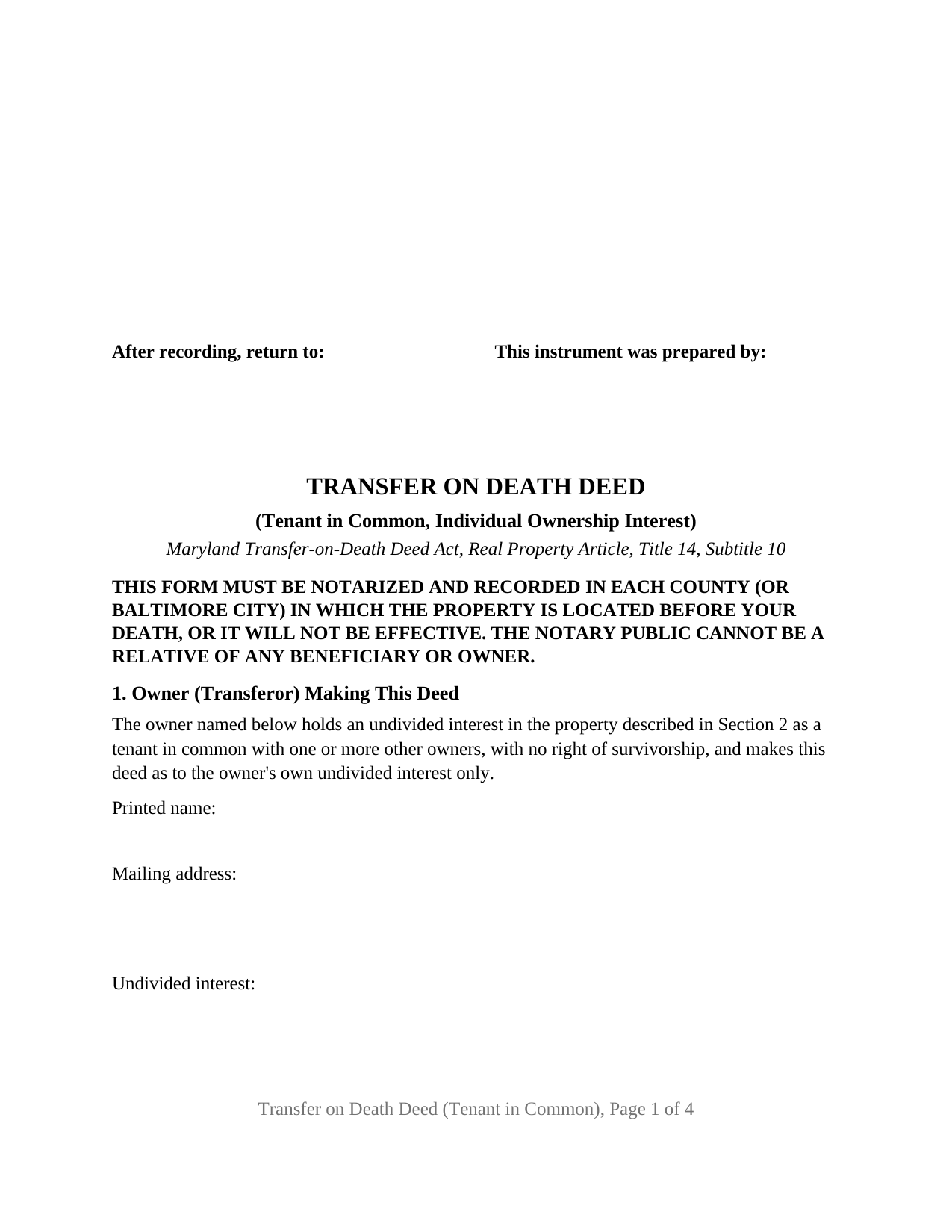
A Maryland owner who holds an undivided interest as a tenant in common can name who receives that interest at death without touching the co-owners' shares. This form prepares that transfer on death deed for one tenant in common signing alone as to that owner's own fractional interest, under Real Property Article Title 14, Subtitle 10, the Maryland Transfer-on-Death Deed Act.
An undivided interest that passes at its owner's own death
The Act draws a line that decides when a Maryland TOD deed operates. Section 14-1001 defines a joint owner as an individual who holds concurrently with others with a right of survivorship, a joint tenant or a tenant by the entirety, and subsection (d)(3) states that a joint owner does not include a tenant in common. For joint owners, Section 14-1009 postpones the deed to the death of the last surviving joint owner. A tenant in common stands outside that rule: there is no survivorship to wait for, a tenant in common's undivided share is already separately devisable and conveyable (tenancy in common being the default form for unmarried co-grantees under Real Property Section 2-117), and the deed transfers that share at the signing owner's own death to the beneficiary who survives. The deed recites that configuration in Section 1 and carries the statutory form's operative sentence word for word.
What the co-owners keep
Section 14-1007(1) provides that during the transferor's life the deed does not affect an interest or right of the transferor or any other owner, including the right to transfer or encumber the property. The other tenants in common do not sign, are not parties, and keep every right in their own shares; the deed says so in its own text. A beneficiary takes that undivided interest as a new tenant in common beside the existing co-owners, subject to every encumbrance then of record and without covenant or warranty of title, under Section 14-1009(b) and (c).
Patterns that hold a fractional interest
Tenancy in common is the Maryland default for a grant to two or more unmarried persons whose deed carries no survivorship wording, and the record shows it among heirs who took a parent's house together, relatives or friends who bought without survivorship language, former spouses whose entireties title became a tenancy in common on absolute divorce, and an individual who holds a fraction beside a trust or a company. A married owner who holds the fractional interest alone signs alone: Maryland recognizes no community property and no dower or curtesy, so a spouse who is not a record owner has no signature line, and the surviving spouse's elective share applies to the deed under Section 14-1009(a)(1)(ii).
One owner, one signature, one certificate
The form recites exactly one owner holding an undivided interest as a tenant in common and carries one owner signature block with the (SEAL) notation of the statutory form, one acknowledgment certificate in the State Government Section 18-216(b) short form, and the certification of preparation that Section 3-104(f) makes a recording condition, printed as the two statutory alternatives for an attorney or a party with a signature line for the certifier. It is not set up for two or more owners on one instrument, for an owner who holds with a right of survivorship, for a sole owner of the whole parcel, or for a trustee, entity, or attorney-in-fact signing in a representative capacity. The beneficiary sections receive a natural person, a trust through its trustee, or an entity, with an optional alternate, and the form prints the Act's note that multiple beneficiaries take as joint tenants with rights of survivorship where the deed indicates no other form of ownership.
Between the owner's signature and the notary line the deed carries a Certification of Occupancy Status, and under its title a tax-status line, two elements taken from the deed form Maryland Volunteer Lawyers Service publishes and Maryland clerks are familiar with. The owner marks whether the property is a principal residence, a secondary residence, or neither, and the clerk and the county finance office read that box to apply the Tax-Property exemption from recordation and transfer taxes for a primary or secondary residence of the transferor, the second-home branch included. No statute requires either element.
Recording before death, with the intake sheet
Under Section 14-1006 the deed is effective only if recorded before the owner's death in the land records of the county, or Baltimore City, where the property lies, and the form carries the statutory notice to that effect at its head. The Act lets a clerk refuse a TOD deed that arrives without a Land Instrument Intake Sheet, and it exempts a deed of the owner's primary or secondary residence from recordation tax and from State and county transfer tax; in many counties the county finance office reads the deed before the clerk records it.
The package includes the fillable transfer on death deed as a PDF, a completed example filled in for a Baltimore County owner of an undivided one-half interest, and a plain-language guide that walks through each numbered section, the intake sheet, and the tax exemptions. The materials are informational and are not legal advice.
Important: County or Independent City-Specific Forms
Our transfer on death deed (tenant in common, individual ownership interest) forms are specifically formatted for each of the 24 county or independent cities in Maryland.
After selecting your county or independent city, you'll receive forms that meet all local recording requirements, ensuring your documents will be accepted without delays or rejection fees.