Maryland Transfer on Death Deed (Primary and Alternate Beneficiaries)
County or Independent City Specific Legal Forms Validated as recently as November 5, 2026 by our Forms Development Team
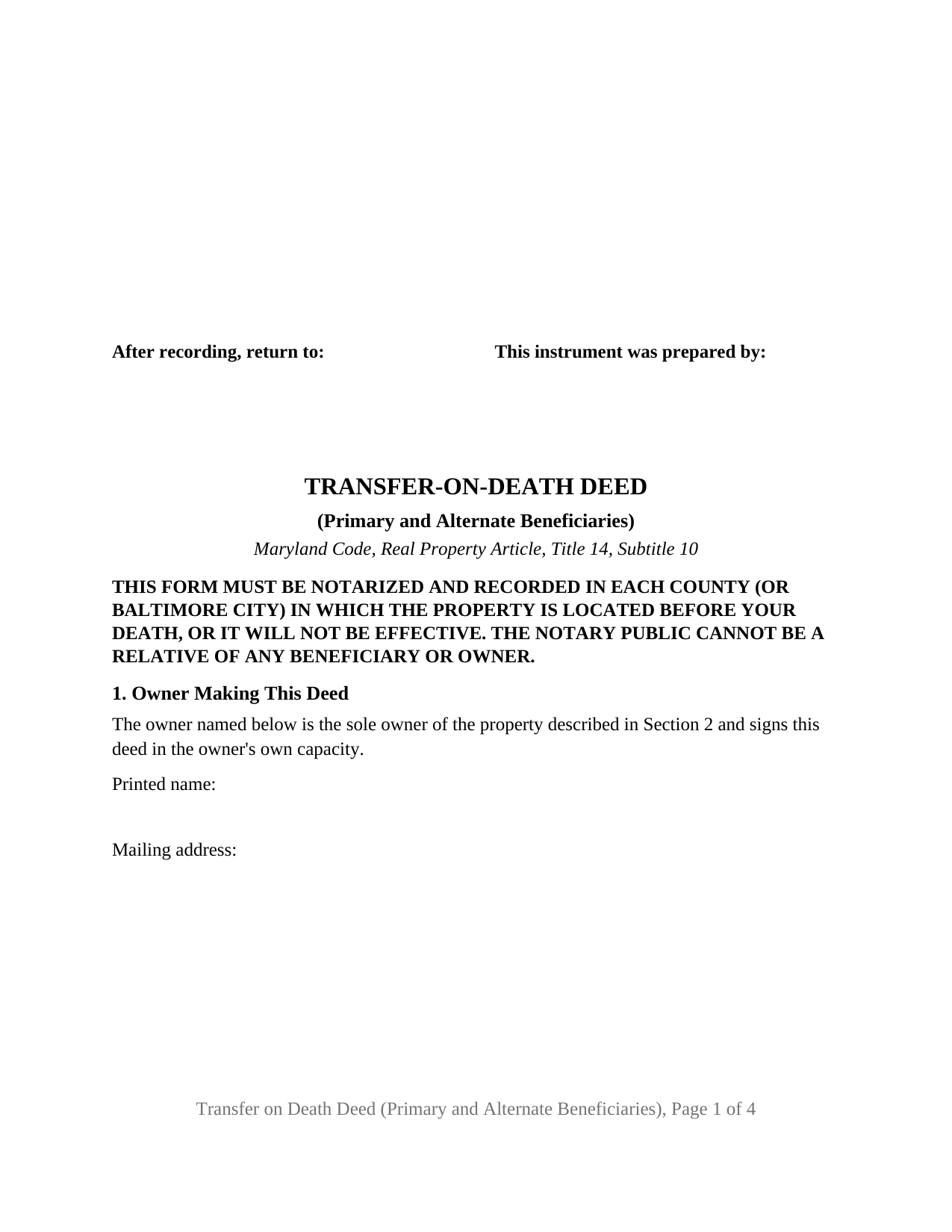
About the Maryland Transfer on Death Deed (Primary and Alternate Beneficiaries)
How to Use This Form
- Select your county or independent city from the list
- Download the county or independent city-specific form
- Fill in the required information
- Have the document notarized if required
- Record with your county or independent city recorder's office
What Others Like You Are Saying
"Am very happy with the wealth of forms that were available with my purchase! This site is an awesome…"
"Easy process considering not too technical savvy!"
"A lot of information to read over but downloading process was great and ill definitely use the servi…"
"It was easy to download the necessary "Death of Joint Tenant" forms. These easy to use int…"
"excellent experience and very prompt and detail . great service"
4.8/5 from 4,857 reviews. Read all
A Maryland transfer on death deed names who takes the property at the owner's death, and the Act decides what happens when that person dies first: under Section 14-1009(a)(2) of the Real Property Article, the interest of a designated beneficiary who fails to survive the transferor lapses. This form answers that rule inside the deed. Prepared under Real Property Article, Title 14, Subtitle 10, in force since October 1, 2026, it is a transfer on death deed by one owner who holds the property alone, designating a primary beneficiary or beneficiaries and an alternate beneficiary or beneficiaries who take if no primary beneficiary survives the owner.
Two tiers in the statutory form's own words
The designation sentences are those of the form the General Assembly wrote into Section 14-1011. Section 4 of the deed reads: I designate the following beneficiary or beneficiaries if the beneficiary or beneficiaries survive me. Section 5 reads: if my primary beneficiary or beneficiaries do not survive me, I designate the following alternate beneficiary if that beneficiary survives me. Under Section 14-1009(a)(2), the interest is transferred to a designated beneficiary who survives the transferor; where the designated beneficiary does not survive and the deed provides for an alternate, it is transferred to a surviving alternate designated beneficiary; and a deed may provide for successive alternates.
Several beneficiaries in one tier
Either tier may name more than one person, and the form's note in Section 4 states the rule: where the deed names multiple primary beneficiaries or alternate beneficiaries and does not indicate a different form of ownership, the property is transferred to them as joint tenants with rights of survivorship. Section 14-1003(b)(1) lets the deed indicate a different tenancy after the names. A beneficiary under the Act is a person, a term the Real Property Article defines to include an individual, a trustee, a fiduciary, and any corporation or other entity.
What the deed recites about its owner
The form recites exactly one owner, the sole owner of the described property, signing in that person's own capacity, with one signature block and one acknowledgment certificate in the State Government Section 18-216(b) short form. Marital status is not part of the recital: Maryland abolished dower and curtesy and has no community property regime, so a spouse who holds no record title is not a transferor on this deed, while the surviving spouse's elective share and the divorce revocation rule reach the transfer at death under Section 14-1009(a)(1). The form is not set up as a deed by two owners on one instrument, by a joint tenant or a tenant by the entirety whose co-owner survives, or by a trustee, an entity, a personal representative, or an attorney-in-fact. A parent who owns the home alone naming the children first and a grandchild as the alternate, and an owner naming one relative first and another second so that the designation does not fail with the first death, present the pattern this deed recites.
Recording while the owner is living
Section 14-1006 conditions the deed's effect on recording before the owner's death in the land records of the county, or Baltimore City, in which the property is located. A Land Instrument Intake Sheet goes with the deed as its own form, and Section 3-104(g)(6)(ii) lets the clerk refuse a transfer on death deed that arrives without it; the deed itself carries the party certification of preparation that Section 3-104(f) makes a condition of recording. Where the property is a primary or secondary residence of the owner, the Act's Tax-Property amendments exempt the deed from recordation tax and from State and county transfer tax, leaving the recording fee and the land records surcharge.
The deed also carries two elements that no statute names, taken from the transfer on death deed form published by Maryland Volunteer Lawyers Service and familiar to Maryland clerks: a line under the title stating the deed's tax status, and a Certification of Occupancy Status the owner marks and signs, stating whether the property is a principal residence, a secondary residence, or neither. The clerk and the county finance office read that box to apply the exemption.
The package includes the fillable transfer on death deed as a PDF, a completed example filled in for a Carroll County owner naming two children as primary beneficiaries and a granddaughter as the alternate, and a plain-language guide covering each section, the survival and lapse rules, signing, and recording. The materials are informational and are not legal advice.
Important: County or Independent City-Specific Forms
Our transfer on death deed (primary and alternate beneficiaries) forms are specifically formatted for each of the 24 county or independent cities in Maryland.
After selecting your county or independent city, you'll receive forms that meet all local recording requirements, ensuring your documents will be accepted without delays or rejection fees.