Ohio Memorandum of Trust
County Specific Legal Forms Validated as recently as October 22, 2026 by our Forms Development Team
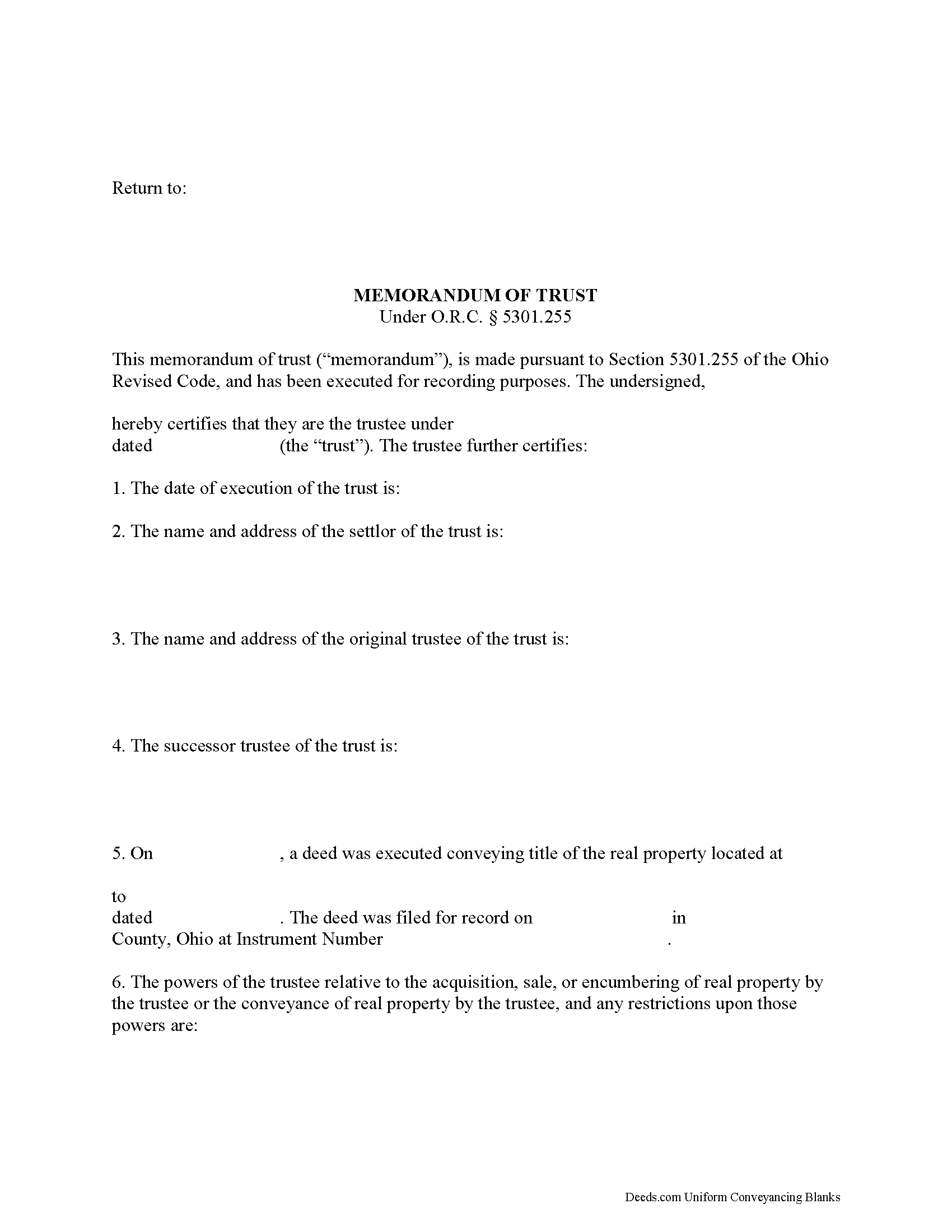
About the Ohio Memorandum of Trust
How to Use This Form
- Select your county from the list
- Download the county-specific form
- Fill in the required information
- Have the document notarized if required
- Record with your county recorder's office
What Others Like You Are Saying
"One of the most user-friendly services I have used. HIGHLY reccomended."
"I love whoever is behind this website. I bought the wrong form and I told them and they refunded me …"
"Site was excellent and saved a trip to the County office to pick up forms."
"Fast and easy to use. Easy to print."
"Easy, but it would be nice if there was an option for font size. It looks tiny, like 6 or 8."
4.8/5 from 4,847 reviews. Read all
Since June 16, 2026, an Ohio trustee who conveys real property held in a disclosed trust must have a memorandum of trust, or an instrument carrying the same content, of record in the county. This form prepares that memorandum under Ohio Revised Code Section 5301.255: the short, acknowledged instrument that puts the trustee's name and address, the date the trust was executed, and the trustee's powers over real property into the county records without recording the trust itself.
A memorandum that stands in for the trust instrument
A recorded Ohio deed into a trust usually says only that the grantee is a named Trustee of a named trust. Section 5301.255 answers the questions that deed leaves open. Division (A) fixes three required contents: the name and address of the trustee, the date of execution of the trust, and the powers specified in the trust relative to the acquisition, sale, or encumbering of real property by the trustee or the conveyance of real property by the trustee, with any restrictions upon those powers. Division (B) lets it also set forth the substance or text of other trust provisions, such as a successor trustee designation. Division (C) limits its reach: the memorandum constitutes notice only of the information contained in it.
Now required of record when a trustee conveys
Senate Bill 101 of the 136th General Assembly rewrote the recording sentence. Under the prior text the memorandum could be recorded; under the current text it shall be of record when any interest in real property is conveyed by the trustee of a disclosed trust, and in other circumstances it may be presented for recording in any county where real property subject to the trust is located. The Legislative Service Commission's analysis describes a disclosed trust as one identified in the record by more than the bare word Trustee or Agent. The same act added a four-year cure to Section 5301.071 for a trustee's deed recorded without a qualifying memorandum.
Describing the property, or not
Section 4 of the form is optional, and the choice changes the filing. A memorandum that describes specific real property, with the legal description copied from the deed into the trustee, the parcel number, and the prior deed reference, is recorded in the official records series Section 317.08(A)(17) names and travels with that parcel in the index. A memorandum that describes no property is recorded in the series Section 317.08(A)(23) names, alongside powers of attorney. A memorandum describing the property is also the one Section 5301.071(E)(1) looks for when an earlier deed named the trust itself as a party.
One or two trustees sign
The form recites nothing about the number of trustees or how they act. Section 2 is an open four-line block that receives one trustee, or two trustees, each with a mailing address, and the signature area carries a TRUSTEE block and a SECOND TRUSTEE block, each followed by its own acknowledgment certificate. A sole trustee's memorandum completes the first block and leaves the second blank; a memorandum of two cotrustees, two spouses serving together being the common pattern, completes both. The certificate is the Section 147.55(F) short form for a trustee, and the two certificates let cotrustees acknowledge on different days or before different officers. The form is not set up as a three-trustee instrument, a corporate trustee's officer execution, or an attorney-in-fact execution. The memorandum conveys nothing, so it carries no dower release and no spouse signature block.
Recording a notice instrument in Ohio
The memorandum is signed by the trustee and acknowledged under Section 5301.01, the execution rule that governs an Ohio deed, with no subscribing witnesses. It is not a deed of absolute conveyance, so the auditor stamps of Section 317.22 and the conveyance fee statement do not attach to it. The form is laid out to the Section 317.114 standard format, with the three-inch blank first-page margin, so the recorder's standardization surcharge does not apply. The certification of trust under Section 5810.13, furnished to a bank or title company in place of the trust, is a different instrument; the memorandum is the recorded one.
The package includes the fillable memorandum of trust form, a completed example filled in for a realistic Franklin County fact pattern with two cotrustees, and the guide that walks through every numbered section and the recording process. This description and the guide describe the form and the governing Ohio statutes in general terms; they are not legal advice.
Important: County-Specific Forms
Our memorandum of trust forms are specifically formatted for each of the 88 counties in Ohio.
After selecting your county, you'll receive forms that meet all local recording requirements, ensuring your documents will be accepted without delays or rejection fees.