South Carolina Quitclaim Deed (Reserving Life Estate)
County Specific Legal Forms Validated as recently as October 19, 2026 by our Forms Development Team
About the South Carolina Quitclaim Deed (Reserving Life Estate)
How to Use This Form
- Select your county from the list
- Download the county-specific form
- Fill in the required information
- Have the document notarized if required
- Record with your county recorder's office
What Others Like You Are Saying
"I loved using this process to record my deeds. it was fast and everytime I sent a message I received…"
"Thank you for your services...Attny office quoted a very large fee for the "TOD DEED" proc…"
"Great app works very well thank you very much"
"Great"
"Outstanding forms and service. Liked that the main deed forms were PDF so I could fill them out on m…"
4.8/5 from 4,829 reviews. Read all
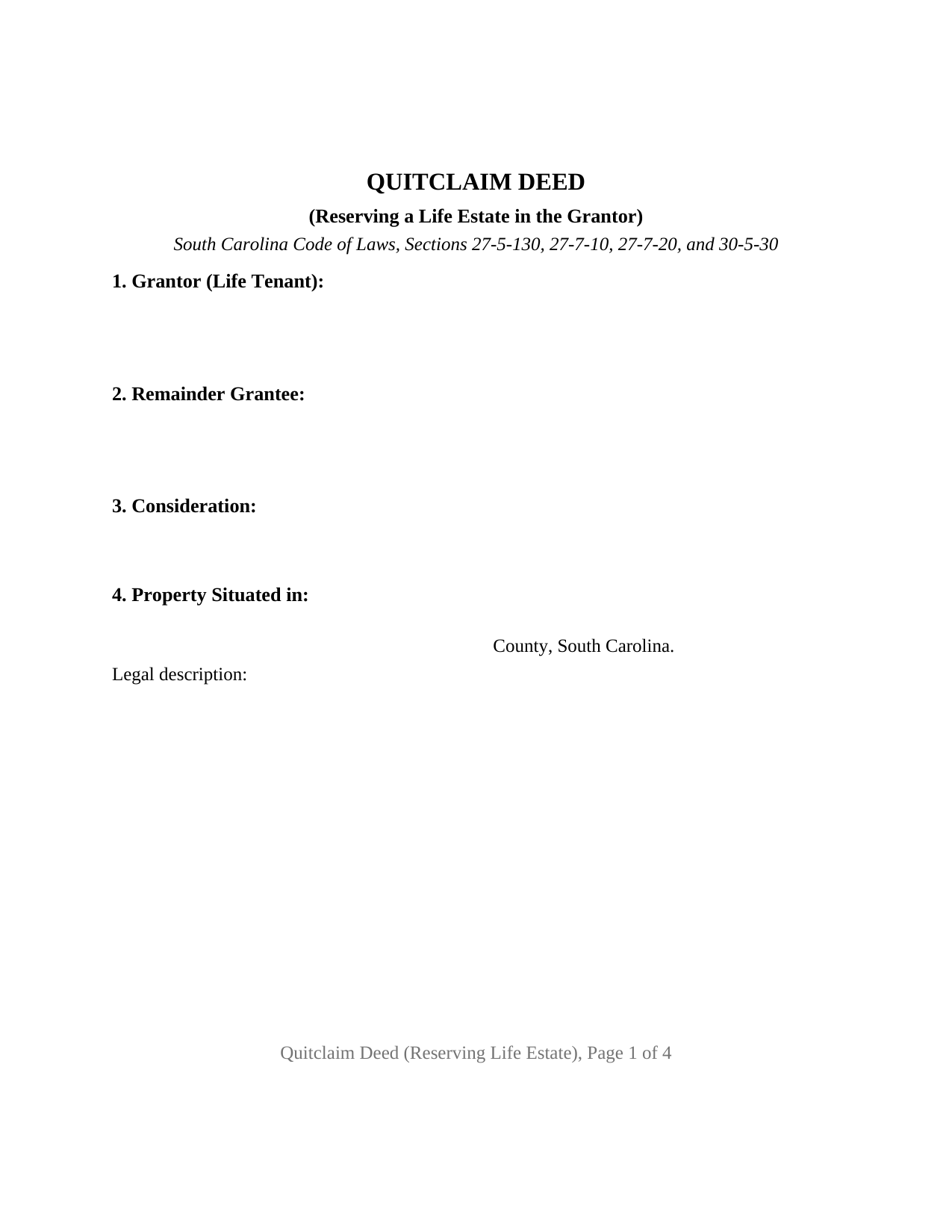
One signing, two estates. On this South Carolina quitclaim deed the grantor hands the remainder in the property to a named grantee and holds back a life estate, so possession and use stay put for the rest of the grantor's life while future ownership is settled on the record today.
A deed that says less than everything has to say so plainly
South Carolina reads a deed as passing all of it unless the paper says otherwise. Section 27-5-130(A) provides that every deed executed after December 31, 1993 passes to the grantee the entire interest of the grantor in the property described, unless the deed provides to the contrary. Subsection (D) is the provision a life estate deed has to answer: where conflicting language leaves it unclear whether a fee simple or a life estate was intended, the statute presumes a fee simple absolute, and only clear and convincing evidence displaces that presumption. So the reservation appears twice here, inside the operative sentence and again in a sentence subordinating conflicting language to it.
The reserved life estate configuration
Sections 1 and 2 name the grantor as life tenant and the remainder grantee, with the mailing address Section 30-5-35 asks for on a deed conveying land. Section 8 does the work: it remises, releases, and forever quitclaims the property, reserving and excepting to the grantor a life estate for the term of the grantor's natural life, and the habendum runs the remainder to the grantee and that grantee's heirs, successors, and assigns, subject to the reserved estate. Section 9 sets one signature line with printed name and date under the attestation line SIGNED, SEALED AND DELIVERED in the presence of, plus two witness blocks answering Sections 27-7-10 and 30-5-30(B); one certificate follows, because one person signs. A parent conveying the remainder in a homeplace to a child while keeping the right to live there for life, and an owner settling who takes a tract at death while keeping its use and income meanwhile, present the pattern this deed recites. One individual grantor reserves a life estate measured by that grantor's own life; two record owners signing together, a life estate measured by someone else's life, and an entity or fiduciary signer each follow a different pattern than the one printed here.
The remainder belongs to someone else the day it is recorded
This is a lifetime conveyance rather than a death-time designation. The remainder vests on delivery and the deed holds no power to pull it back, so a later change of course takes a conveyance from the remainder grantee, and a sale or mortgage of the whole fee takes the life tenant and the remainder grantee signing together. South Carolina supplies no statutory beneficiary deed for real property and no statutory enhanced life estate deed: S.49 and H.4264 of the 2025-2026 session proposed one of each, and neither was enacted.
Reappraisal waits for the life estate to end
Section 12-37-3150 defines the assessable transfer of interest that sends a parcel to reappraisal, and subsection (B)(2) excludes the portion of property subject to a life estate retained by the transferor, until that life estate expires or terminates. Section 12-37-265 holds the homestead exemption steady: an owner entitled to the Section 12-37-250 exemption who conveys the remainder and keeps a life estate still satisfies its ownership requirement. Under Section 12-37-610(A) the annual tax bill stays with whoever owns the property in fee, for life, or as trustee on the county deed records.
What the counter collects
Recording a deed costs fifteen dollars under Section 8-21-310. Deed stamps run under Section 12-24-10 at $1.85 for every $500 of value, a fraction counting as a whole increment, with value measured by Section 12-24-30(A) as the consideration paid or to be paid in money or money's worth. Section 12-24-40(1) exempts a deed whose value is one hundred dollars or less, where a nominal family transfer usually lands, and Section 12-24-70 asks for a value affidavit, a separate recorded document. A quit claim deed, also called a non-warranty deed, promises nothing about title, which is why the derivation clause of Section 30-5-35 passes it by.
The package holds three files: the fillable deed, a completed Anderson County example, and a plain language guide covering the nine sections, the ownership forms a remainder can be held in, the signing steps, and the recording and property tax sequence. These materials describe South Carolina law in general terms and are not legal advice.
Important: County-Specific Forms
Our quitclaim deed (reserving life estate) forms are specifically formatted for each of the 46 counties in South Carolina.
After selecting your county, you'll receive forms that meet all local recording requirements, ensuring your documents will be accepted without delays or rejection fees.