South Carolina Quitclaim Deed (Divorce)
County Specific Legal Forms Validated as recently as October 22, 2026 by our Forms Development Team
About the South Carolina Quitclaim Deed (Divorce)
How to Use This Form
- Select your county from the list
- Download the county-specific form
- Fill in the required information
- Have the document notarized if required
- Record with your county recorder's office
What Others Like You Are Saying
"Excellent service"
"This was just TOO easy to do and use!! Thank you so much for your service!"
"Forms were available for immediate download. Examples were helpful in completing form."
"Outstanding. I will definitely recommend your company."
"fast and easy to fill out forms."
4.8/5 from 4,836 reviews. Read all
A South Carolina family court can order this deed into existence. Section 20-3-660(A) of the South Carolina Code lets the court direct a party to execute and deliver any deed necessary to carry out its order of equitable apportionment, and where that party does not comply, the court may direct the clerk of court of the county holding the property to sign instead, with the same effect. This quitclaim deed answers such a direction: one spouse or former spouse releases whatever interest that person holds in South Carolina real property to the other, and names the court, the case number, and the order it is delivered under.
What the decree already did, and what it left undone
A South Carolina divorce reaches the title before any deed does. Section 27-7-40(a)(vii) severs a joint tenancy in real estate held by a husband and wife with no other joint tenants upon the filing of an order or decree dissolving their marriage, vesting the interest in both parties as tenants in common unless a court of competent jurisdiction orders otherwise. Section 62-2-507 works the same severance from the probate side, and under subsection (d) it does not reach a third party who paid value in good faith reliance on apparent survivorship title unless a writing declaring it has been recorded. What no decree changes is the names in the county index.
The divorce configuration
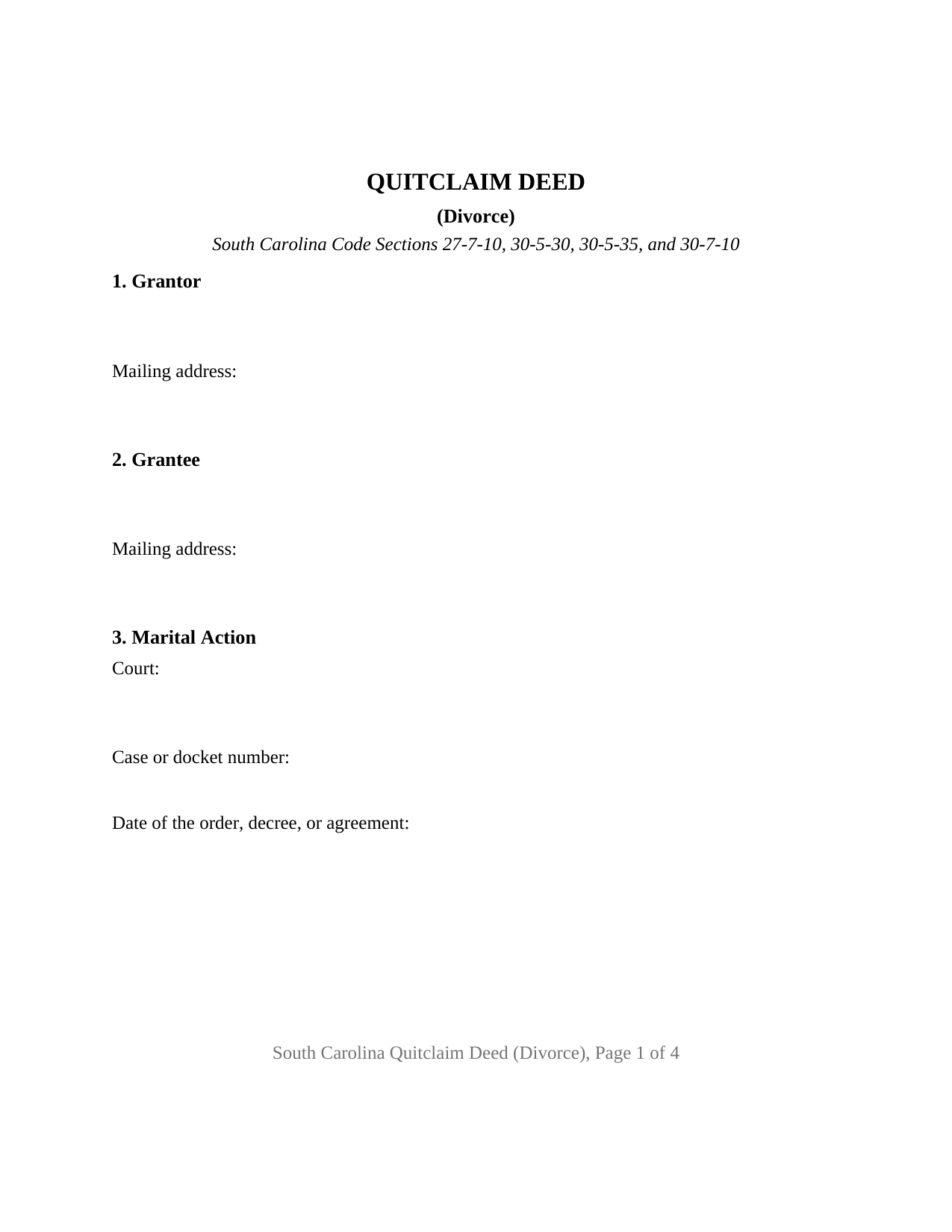
Sections 1 and 2 name the releasing party and the receiving party, each with a mailing address, the grantee's being the one Section 30-5-35 requires. Section 3 is the section this variant exists for: three blanks holding the court, the case or docket number, and the date of the order, decree, or agreement, so a later reader finds the proceeding the deed answers to without leaving the land records. Section 8 releases and then bounds itself, reciting that the released interest reaches any right, claim, or vested special equity arising by reason of the marriage or under Sections 20-3-610 through 20-3-630, with any survivorship right the grantor holds alongside the grantee, and stating that the deed neither amends the order identified in Section 3 nor releases the grantor from a note or mortgage on the land. Section 9 carries the attestation line, one signature, and two witness blocks, with one acknowledgment certificate. A former spouse clearing off the record so the parcel reads in the name of the party awarded it, and a departing owner signing on the day the other refinances under a settlement agreement, present the pattern this deed recites. The form recites one grantor and one grantee once married to each other; two record owners releasing together, an entity, and a fiduciary each follow a different pattern.
Deed stamps and the calendar
Deed stamps run under Section 12-24-10 at $1.85 for each $500 of the realty's value, beside the flat $15 Section 8-21-310 charges to record any deed. Paragraph (4) of Section 12-24-40 exempts a deed transferring realty in which no gain or loss is recognized by reason of Section 1041 of the Internal Revenue Code, and the federal timing rule is what makes the date in Section 3 matter: Section 1041(c) reaches a transfer occurring within one year after the marriage ceases or related to its cessation, and the temporary regulation presumes a transfer made under a divorce or separation instrument within six years to be so related. Paragraph (1) separately exempts a deed whose value is one hundred dollars or less, and the affidavit Section 12-24-70 calls for carries the exemption reason instead of an amount.
Two residences, one four percent ratio
The property tax side follows the household, not the deed. Section 12-43-220(c)(2)(iii) stops treating an owner-occupant's spouse as a household member once that spouse has filed for separate support and maintenance, lives in a different residence, and no longer cohabitates, and subitem (x) makes that applicant recertify each year until a divorce is granted.
Also written as a quit claim deed, and called a non-warranty deed in South Carolina practice, this instrument promises nothing about title, which is why the derivation clause of Section 30-5-35 passes it by while the grantee address requirement stays live. Section 30-9-30 asks for a return address on anything handed to the register of deeds. Three files come with the purchase: the blank fillable deed, a completed Richland County example, and a plain language guide covering the nine sections, the signing, and recording. These materials describe South Carolina law in general terms and are not legal advice.
Important: County-Specific Forms
Our quitclaim deed (divorce) forms are specifically formatted for each of the 46 counties in South Carolina.
After selecting your county, you'll receive forms that meet all local recording requirements, ensuring your documents will be accepted without delays or rejection fees.