South Carolina Quitclaim Deed (Married Grantor with Non-Owner Spouse Joinder)
County Specific Legal Forms Validated as recently as October 19, 2026 by our Forms Development Team
About the South Carolina Quitclaim Deed (Married Grantor with Non-Owner Spouse Joinder)
How to Use This Form
- Select your county from the list
- Download the county-specific form
- Fill in the required information
- Have the document notarized if required
- Record with your county recorder's office
What Others Like You Are Saying
"Easy process! Submit payment, fill out forms using the document guide provided, and print!"
"Very happy with the site and the deed document I received."
"Very informative and user friendly. Was able to get all information and forms needed without any pro…"
"This site is so easy to use. It is so convenient to have access to forms for all states. I’d recomme…"
"Found the forms I needed with no problem and easy to fill out thanks to the guide that is with it. B…"
4.8/5 from 4,828 reviews. Read all
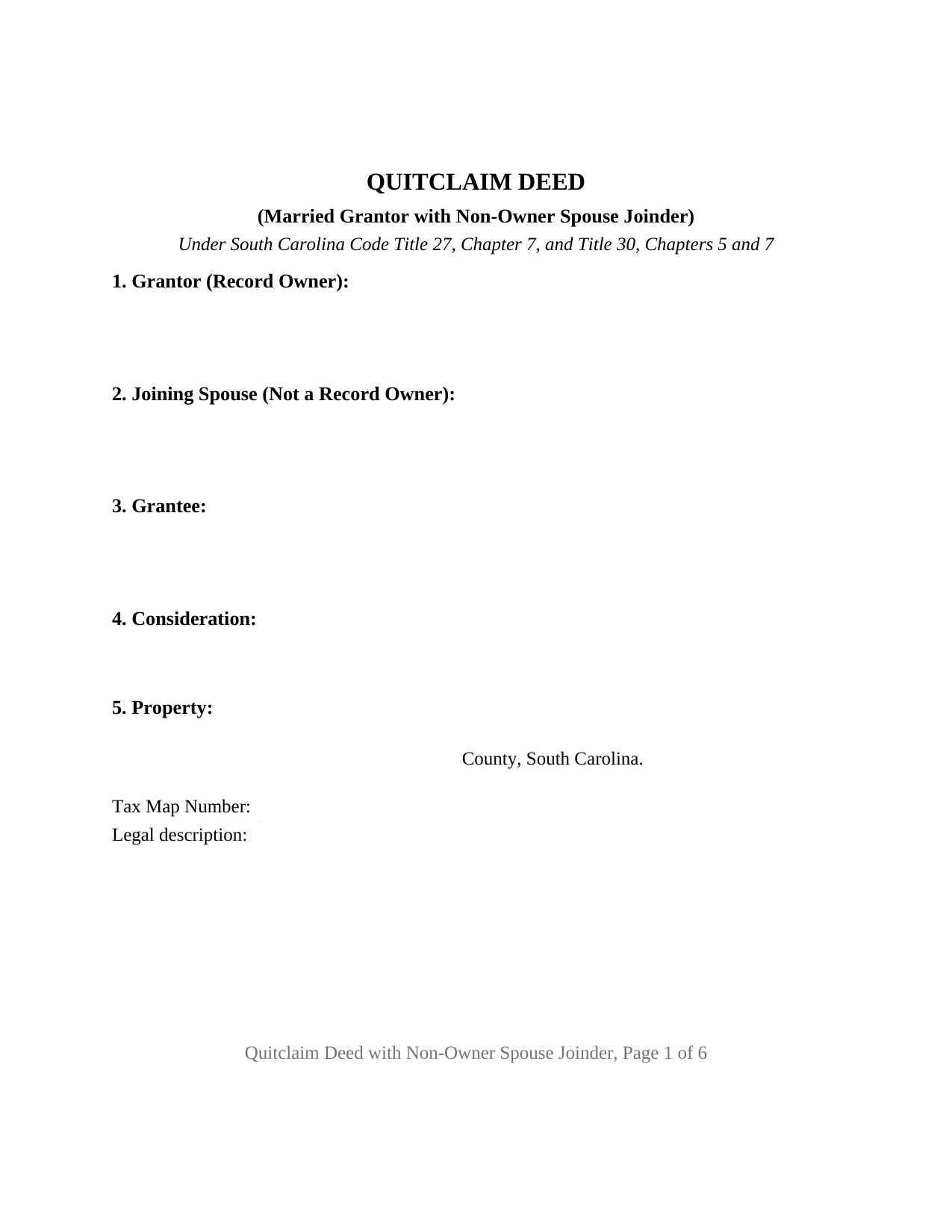
A South Carolina deed sometimes carries a signature the recording statutes never ask for. This quitclaim deed is built around that signature: one married record owner releases an interest in South Carolina real property, and the owner's spouse, who holds no record title to it, signs a joinder releasing any claim of that spouse in the same land. Each signer has a full execution set, and the deed states in its own text what the joining signature reaches.
What the joining signature is doing
The marital estates that once made this signature mandatory are gone: 1985 Act No. 120 abolished tenancy by curtesy, dower, and jointure, and no current South Carolina statute requires a spouse who holds no record title to join an ordinary lifetime deed of the other spouse. What survives sits outside the recording chapters. Under S.C. Code Sections 20-3-610 through 20-3-630 a spouse holds a vested special equity in marital property that a family court apportions in marital litigation, and a purchaser, a lender, or a title examiner reading a deed from a married sole owner can look for the other spouse's release of that kind of claim. Separation agreements and family court orders call for it by their own terms, and the joinder on this form is that release, collected by the deed and bounded by it.
One owner, one joining spouse, two executions
The configuration is the product. Section 1 names the individual who holds record title and Section 2 names the spouse who does not. Section 7 carries the quitclaim by the owner, remising, releasing, and forever quitclaiming whatever interest the owner holds to the grantee named in Section 3. Section 8 carries the spouse's release of all right, title, interest, claim, and demand in the property, whether arising by marriage, by operation of law, or otherwise, and then draws its own boundaries: the joinder reaches interests in the property only, it is not a waiver under Section 62-2-204 of the elective share, homestead allowance, or exempt property, and it conveys nothing of the owner's beyond what Section 7 releases. Sections 9 and 10 give each signer a signature line, a printed name and date, and two witness blocks, and one acknowledgment certificate follows each signature, so the two signings can happen weeks and miles apart. A married owner who took title alone selling a vacant parcel to a buyer who wants the spousal claim closed out, and a release given under a separation agreement, present the pattern this deed recites. The form recites exactly one record owner and one non-owner spouse; a release by two record owners, or by a sole owner with no joinder at all, follows a different signing pattern than the one printed here.
Witnesses, twice over
Because this deed carries two separate acts, it pairs two witness blocks with each signature rather than one pair for the page, so an execution completed on its own day arrives at the counter with its own attesting witnesses. Section 27-7-10 describes a release subscribed by two or more credible witnesses, and Section 30-5-30(B) describes acknowledgment in the presence of two witnesses. Above each signature stands the traditional attestation line, SIGNED, SEALED AND DELIVERED in the presence of, which is the clause Section 27-7-30 reads for sealed-instrument effect.
Deed stamps when a price is stated
A quitclaim deed, also written as a quit claim deed and known as a non-warranty deed, carries the ordinary deed recording fee when consideration changes hands. Section 12-24-10 sets it at one dollar and eighty five cents for each five hundred dollars, or fractional part of five hundred dollars, of the value of the realty, and Section 12-24-20 makes the grantor primarily liable. The completed example works the arithmetic on a stated price of thirty two thousand five hundred dollars: sixty five increments of five hundred dollars, one hundred twenty dollars and twenty five cents, beside the flat fifteen dollar charge Section 8-21-310 sets for recording any deed in the state. The value affidavit that Section 12-24-70 calls for is prepared and recorded separately and is not part of this package.
The download is three files: the blank deed as a fillable PDF, a completed example filled in on a Spartanburg County fact pattern, and a plain language guide covering each numbered section, the two-execution witness and notary mechanics, the co-ownership words South Carolina recognizes on the grantee line, and the recording sequence. These materials describe South Carolina law in general terms and are not legal advice.
Important: County-Specific Forms
Our quitclaim deed (married grantor with non-owner spouse joinder) forms are specifically formatted for each of the 46 counties in South Carolina.
After selecting your county, you'll receive forms that meet all local recording requirements, ensuring your documents will be accepted without delays or rejection fees.