South Carolina Quitclaim Deed (Trustee Grantor)
County Specific Legal Forms Validated as recently as October 16, 2026 by our Forms Development Team
About the South Carolina Quitclaim Deed (Trustee Grantor)
How to Use This Form
- Select your county from the list
- Download the county-specific form
- Fill in the required information
- Have the document notarized if required
- Record with your county recorder's office
What Others Like You Are Saying
"Deeds.com was fast and easy and I got everything I needed in one stop!"
"Ordered the forms I needed for my state and county and everything worked out perfectly. All the form…"
"I was very pleased and satisfied with the ease of use, expeditious turnaround and costs involved to …"
"I am so happy with this service. I can not tell you. In about 30 minutes my records were recorded. E…"
"This is the first time I use this site, and it was very easy and user friendly. I was able to fill o…"
4.8/5 from 4,833 reviews. Read all
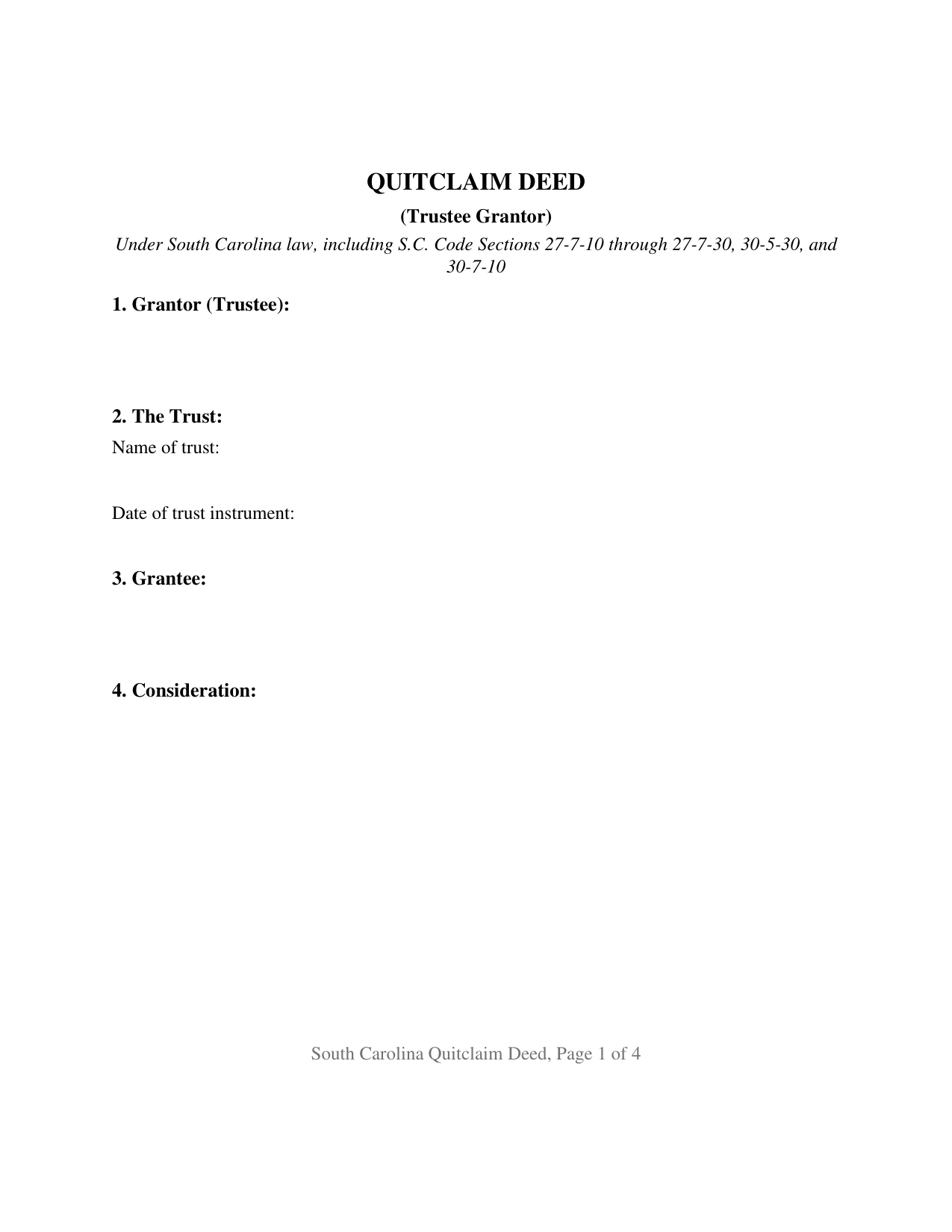
On this South Carolina quitclaim deed the land leaves a trust. One person signs as trustee, the deed names the trust and the date of its trust instrument, and what passes is whatever interest the trust holds, released without covenant or warranty of title and without personal warranty of the signer. The form carries one signature line, two witness blocks, and one acknowledgment certificate.
A signature made in an office
Trust real property moves on a trustee's signature, and the authority behind that signature sits outside the deed. S.C. Code Section 62-7-816 lists the specific powers of a South Carolina trustee, among them the power to acquire or sell property at public or private sale and the power, on termination of the trust, to wind up the administration and distribute trust property to the persons entitled to it, each subject to the terms of the trust instrument. This deed states the capacity claimed; the trust instrument and any appointment of a successor trustee are what confer the office. Section 62-7-1012 works the receiving side, protecting a person other than a beneficiary who deals with a trustee in good faith and for value without knowledge that the trustee is exceeding those powers, with no duty to inquire. A certification of trust under Section 62-7-1013(j), executed and acknowledged so it can be recorded where the property sits, is the separate document that carries that authority; it is not included here.
What the form recites
Sections 1 and 2 name the signer with the trustee capacity and identify the trust by name and by the date of its trust instrument, the two facts that also open a statutory certification of trust. Section 9 performs the release in the traditional words, remising, releasing, and forever quitclaiming all right, title, interest, claim, and demand the trust has in the property, and states that the signer acts solely as trustee and not individually. Section 10 pairs one signature line, whose printed name line holds the capacity, with two witness blocks answering the two witness practice South Carolina statutes and county recording offices describe for deeds, and one certificate for the one signer the deed recites. A successor trustee distributing a house to a beneficiary after the settlor has died, and a trustee releasing the trust's interest back to a living settlor, present the patterns this deed recites. The form recites exactly one signer holding the office of trustee; a deed executed by two cotrustees, and a deed signed by an owner in that owner's own right, each follow a signing pattern different from the one printed here.
Fair market value, not the recited price
The deed recording fee counties call deed stamps runs at one dollar and eighty five cents for each five hundred dollars of the realty's value, and on a deed leaving a trust the measure is not the figure the deed states: Section 12-24-30 provides that value means fair market value where realty is transferred as a distribution to a trust beneficiary. Under Section 12-24-10(B), one class of deed sits outside the chapter altogether: a deed transferring real property from a trust to a trust distributee upon the settlor's death, pursuant to the terms of the trust, is not subject to the chapter where a deed of distribution would have been the correct instrument had the property been probate property. The affidavit Section 12-24-70 calls for is recorded as its own document and is not included here.
Reappraisal follows the distribution
Section 12-37-3150 counts a conveyance by distribution from a trust among the assessable transfers of interest that send a parcel to reappraisal, then lifts the case where the distributee is the sole present beneficiary or that beneficiary's spouse. Recording the deed costs fifteen dollars under Section 8-21-310, and Section 30-7-10 dates its effect against later creditors and purchasers for value without notice from the day and hour of recording. A quit claim deed, also called a non-warranty deed, stays outside the derivation clause Section 30-5-35 asks of warranty deeds, so the prior instrument entry here is informational.
Three files come with the purchase: the blank fillable deed, a completed example worked on a Lexington County fact pattern where a successor trustee distributes a Chapin lot to a trust distributee, and a plain language guide covering the ten sections, the signing mechanics, the co-ownership words South Carolina recognizes on the grantee line, and recording. These materials describe South Carolina law in general terms and are not legal advice.
Important: County-Specific Forms
Our quitclaim deed (trustee grantor) forms are specifically formatted for each of the 46 counties in South Carolina.
After selecting your county, you'll receive forms that meet all local recording requirements, ensuring your documents will be accepted without delays or rejection fees.