South Carolina Quitclaim Deed (Interspousal)
County Specific Legal Forms Validated as recently as October 7, 2026 by our Forms Development Team
About the South Carolina Quitclaim Deed (Interspousal)
How to Use This Form
- Select your county from the list
- Download the county-specific form
- Fill in the required information
- Have the document notarized if required
- Record with your county recorder's office
What Others Like You Are Saying
"Amazing forms, nice to have something specific and not generic like some other sites. Getting the ot…"
"Excellent service & very easy to use."
"The Transfer on Death Deed paperwork was easy to complete, as it included a detailed guide and a com…"
"Very clear and complete. Good value."
"It would be helpful if the numbers on the instruction sheet were on the form. I was confused on page…"
4.8/5 from 4,831 reviews. Read all
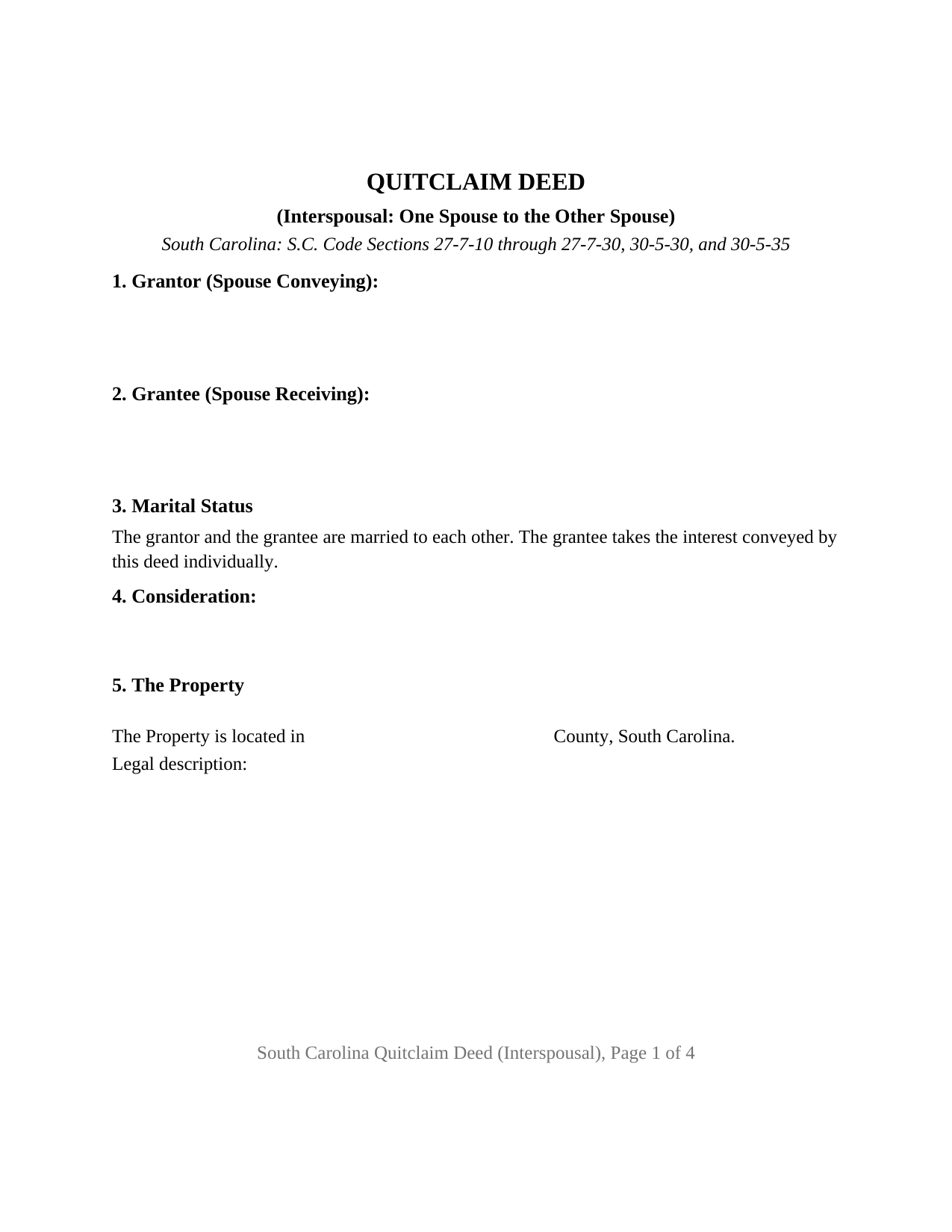
On this South Carolina quitclaim deed both parties stand inside the same marriage: one spouse signs as grantor, the other spouse is named as grantee, and whatever interest the signing spouse holds travels from one to the other. The form carries one grantor signature line, two witness blocks, and a single acknowledgment certificate, and it names the receiving spouse as the only grantee, with the mailing address Section 30-5-35 of the South Carolina Code requires.
Two owners who happen to be married
South Carolina gives spouses no shared estate to sit in. There is no community property here, tenancy by the entirety is unavailable under Section 27-7-40(c) and the case law reciting Davis v. Davis, and the old marital estates of dower, curtesy, and jointure ended by statute in 1985. Married people own South Carolina land the way any two people do, each holding a distinct interest. A spouse to spouse deed is therefore a working conveyance and not a formality: the interest moves, and survivorship between the two comes from words in a deed rather than from the marriage.
The interspousal configuration
Section 1 names the spouse conveying, Section 2 the spouse receiving, and Section 3 states that the two named parties are married to each other and that the grantee takes individually. Section 9 performs the conveyance in the traditional words, remising, releasing, and forever quitclaiming all right, title, interest, claim, and demand the grantor has in the property, with no covenant or warranty of title. Section 10 carries a signature line with printed name and date, two witness blocks answering the two witness practice South Carolina statutes and county register of deeds offices describe for deeds, and one certificate, because the deed recites one signer; the grantee signs nothing, taking without signing. Spouses who took title together and are moving the whole parcel into one name, and a spouse releasing whatever interest that spouse may hold in land recorded in the other spouse's name alone so the record shows a single owner, present the patterns this deed recites. The form recites exactly one grantor and one grantee married to each other; a release by two record owners, a release running to someone outside the marriage, and a conveyance by an entity or a trustee each follow a signing pattern different from the one printed here.
Deed stamps usually step aside
South Carolina charges a deed recording fee, the charge counties call deed stamps, of one dollar and eighty five cents per five hundred dollars of the realty's value under Section 12-24-10, with the grantor primarily liable. Two exemptions in Section 12-24-40 catch most transfers between spouses: paragraph (1), for a deed whose value is one hundred dollars or less, and paragraph (4), for a deed in which no gain or loss is recognized by reason of Section 1041 of the Internal Revenue Code, the federal provision reaching a transfer to a spouse and a transfer to a former spouse incident to the divorce. The affidavit of value that Section 12-24-70 calls for then states the exemption reason in place of an amount; that affidavit is prepared and recorded with the deed as its own document and is not included in this package.
The reassessment question
The same provision does a second job on the property tax side. Section 12-37-3150 defines the assessable transfer of interest, the event that subjects a parcel to reappraisal, and subsection (B)(1) excludes transfers not subject to federal income tax in listed circumstances, naming Section 1041 transfers between spouses or incident to divorce among them. Subsection (B)(15) separately excludes a transfer of a fractional interest between family members, a class that includes a spouse, for zero or de minimis consideration where both parties owned an interest before the transfer.
What reaches the record
Recording any deed costs fifteen dollars under Section 8-21-310, and Section 30-7-10 gives the recorded deed effect against later creditors and purchasers for value without notice from the day and hour it reaches the record. A quit claim deed also sits outside the derivation clause Section 30-5-35 asks of warranty deeds, so the prior instrument reference on this form is informational.
The download is the blank interspousal quitclaim deed as a fillable PDF, a completed example filled in on a Horry County fact pattern, and a plain language guide covering every numbered section, the witness and notary mechanics, the ownership forms South Carolina recognizes, and recording. These materials describe South Carolina law in general terms and are not legal advice.
Important: County-Specific Forms
Our quitclaim deed (interspousal) forms are specifically formatted for each of the 46 counties in South Carolina.
After selecting your county, you'll receive forms that meet all local recording requirements, ensuring your documents will be accepted without delays or rejection fees.