South Carolina Quitclaim Deed (Corrective)
County Specific Legal Forms Validated as recently as October 19, 2026 by our Forms Development Team
About the South Carolina Quitclaim Deed (Corrective)
How to Use This Form
- Select your county from the list
- Download the county-specific form
- Fill in the required information
- Have the document notarized if required
- Record with your county recorder's office
What Others Like You Are Saying
"Thank you fine Deeds Company. I hope all goes well for you and all your team!"
"Downloaded and used the Ladybird Warranty Deed for a county in Florida with no issues. Cost for the …"
"Good service could give a little more detail on where to location some of the information needed. Ov…"
"Got what I needed and it all was good according to the County Recorder."
"The document I purchased was perfect for what I needed done. Very easy to obtain the document. Websi…"
4.8/5 from 4,832 reviews. Read all
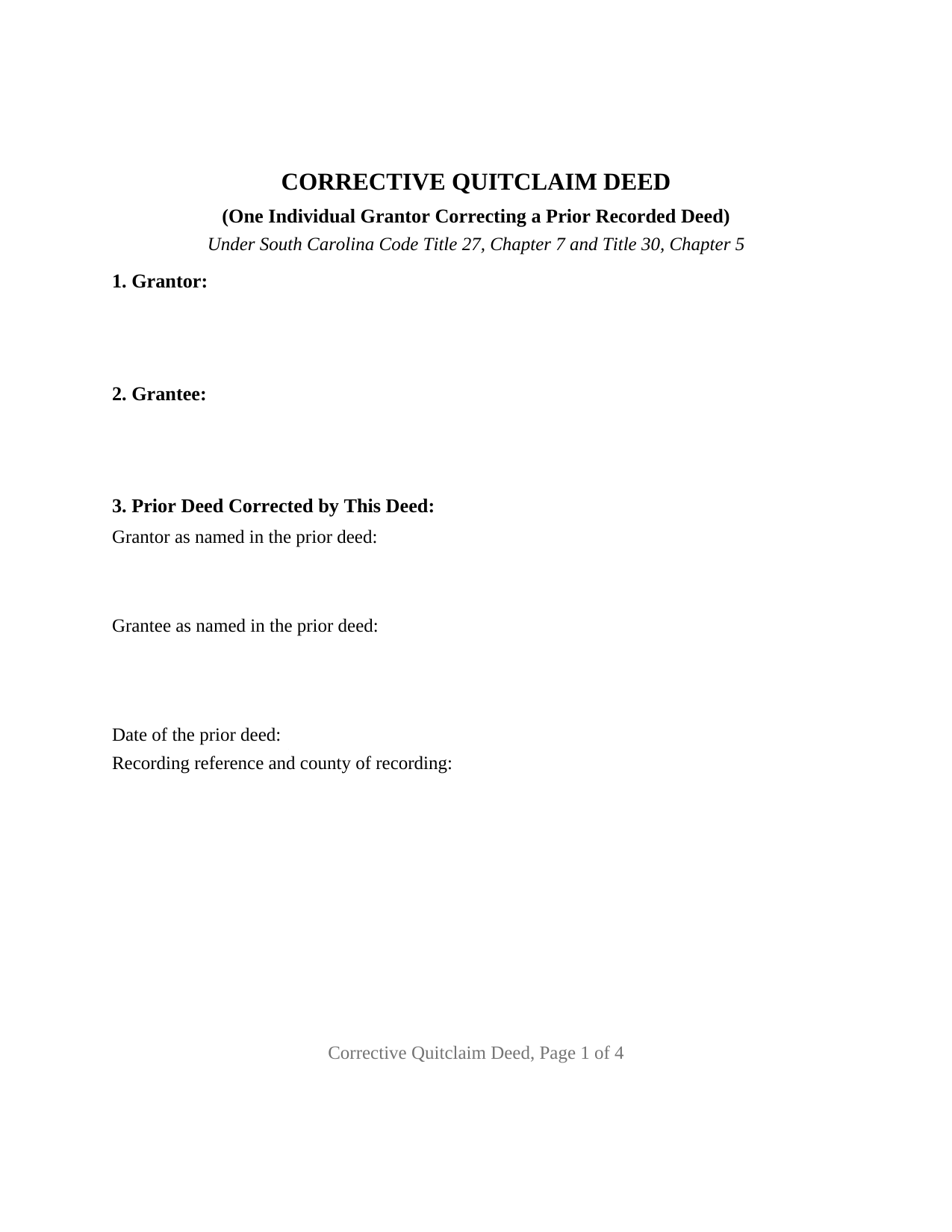
Most deeds move an interest. This one goes back over a deed that already did. A corrective quitclaim deed names the earlier instrument by its parties, date, and book and page, sets the text as that deed reads beside the same text as corrected, and releases whatever interest the grantor holds to the same grantee, without covenant or warranty of title. One individual signs it: the person named as grantor in the deed being corrected.
A correction arrives as its own document
A South Carolina register of deeds neither alters nor withdraws an instrument once it is recorded, so both papers stay in the index under the same names and are read together. No curative statute says otherwise. Title 30, Chapter 5 runs from Section 30-5-15 to Section 30-5-270 with no correction of errors section, and South Carolina enacted no scrivener's affidavit provision of the sort North Carolina carries at G.S. 47-36.1. The correction travels as an ordinary recordable deed, executed, acknowledged, and recorded like any other, taking its own day and hour under Section 30-7-10 while the earlier deed keeps its date.
The one paragraph in the Code that names this deed
The South Carolina Code names the instrument in one place, the fee statute. Section 12-24-40(12) exempts from the deed recording fee a deed that constitutes "a corrective deed or a quitclaim deed used to confirm title already vested in the grantee", as long as no consideration is paid or is to be paid. Both halves of this form's name sit in that paragraph, with the condition the exemption rests on, which is why the operative section states that nothing is paid for the deed. Section 12-24-70 still calls for an affidavit, carrying the exemption reason in place of a value, recorded as its own document. The flat fifteen dollar charge Section 8-21-310 sets for recording a deed applies either way.
What a correction reaches
The items that arrive on corrective deeds are clerical: a party name misspelled or missing a middle initial, a transposed digit in a plat cabinet or a book and page reference, an omitted marital status, a typographical slip inside the legal description. A change of a different order, one that adds or drops a party, enlarges or shrinks the estate, or describes other land, operates as a conveyance in its own right, and the record then reads as a second transfer rather than a repair.
The corrective configuration
Two sections carry the correction and the rest is an ordinary release. Section 3 identifies the prior deed by the grantor and grantee as that deed spells them, misspelling included, with its date and recording reference, because the point is to locate it in the index. Section 4 holds the parallel entries, as the prior deed reads and as corrected, so a later reader sees the difference without comparing pages. Section 8 performs the release and bounds it: the earlier deed is neither cancelled nor superseded, and no interest passes beyond what it passed. One signature line follows, with two witness blocks answering Sections 27-7-10 and 30-5-30(B), the attestation line Section 27-7-30 reads for sealed instrument effect, and one acknowledgment certificate, the deed reciting one signer. A grantor whose name reached the record with a letter wrong, and a plat reference recorded with two digits reversed, present the pattern this deed recites. The form recites exactly one individual grantor and one prior deed; a release by two record owners, a signature by an entity officer, an agent, or a fiduciary, and a deed carrying no correction at all each follow a different pattern than the one printed here.
Where the derivation clause would have been
Section 30-5-35 asks warranty deeds and mortgages for a derivation clause and leaves quitclaim and non-warranty deeds outside it, so the prior instrument entry here is doing correction work rather than answering that statute. What that section does require stays live: the grantee's mailing address. County intake lists add the tax map number, which has its own section, and the first page holds one and one half inches clear at top and bottom for the register's stamp.
Three files come with the purchase: the blank deed as a fillable PDF, a completed Berkeley County example where a misspelled grantee name is put right, and a plain language guide covering the nine sections, the prior deed and correction entries, the signing mechanics, and recording. These materials describe South Carolina law in general terms and are not legal advice.
Important: County-Specific Forms
Our quitclaim deed (corrective) forms are specifically formatted for each of the 46 counties in South Carolina.
After selecting your county, you'll receive forms that meet all local recording requirements, ensuring your documents will be accepted without delays or rejection fees.