South Carolina Quitclaim Deed (Corporation Grantor)
County Specific Legal Forms Validated as recently as September 23, 2026 by our Forms Development Team
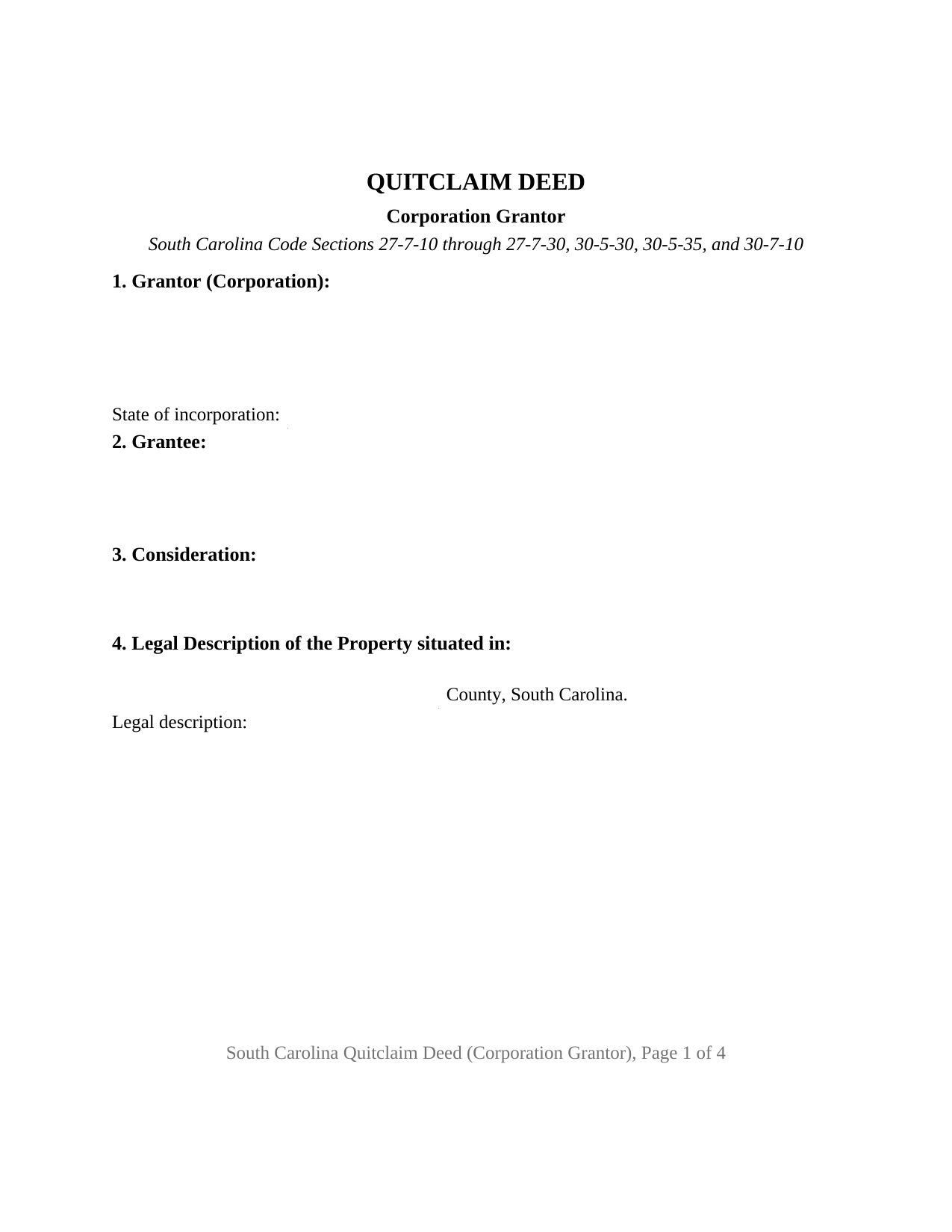
About the South Carolina Quitclaim Deed (Corporation Grantor)
How to Use This Form
- Select your county from the list
- Download the county-specific form
- Fill in the required information
- Have the document notarized if required
- Record with your county recorder's office
What Others Like You Are Saying
"Simple and fast!"
"My needs were met quickly and efficiently with very little wait. Deeds.com made it easy to understan…"
"We were extremely satisfied with DEEDS.COM. We spent countless hours trying to contact the Queens Co…"
"Very Good!"
"Using your site made gifting personal property (land) so quick and easy. The forms were presented re…"
4.8/5 from 4,836 reviews. Read all
This South Carolina quitclaim deed carries a blank most deeds do not: a line for the corporate action behind the conveyance. One corporation is the grantor, one officer signs in the office named beside that signature, two witnesses subscribe it, and one grantee takes whatever interest the corporation holds, released without covenant or warranty of title.
Where an officer's signature gets its force
South Carolina locates the power of the person holding the pen inside the corporation's own governance papers. Section 33-8-410 of the South Carolina Code gives each officer the authority set forth in the bylaws or, so far as the bylaws allow, the duties the board of directors prescribes. Section 33-3-102 supplies the capacity, giving a corporation the same powers as an individual to hold real property and to sell, convey, mortgage, exchange, and otherwise dispose of any part of it. That list treats the corporate seal as a power rather than a signing formality, so the deed answers to the general rules: acknowledgment or proof before an authorized officer under Section 30-5-30, and two witnesses.
The vote behind the deed
Corporate approval is what an examiner asks about an entity deed, and Chapter 12 of Title 33 splits it in two. Under Section 33-12-101 a corporation disposes of property in the usual and regular course of business, and encumbers even all of it, with no shareholder vote unless the articles of incorporation call for one. Section 33-12-102 reaches the other case, a disposition of all or substantially all of the corporation's property outside that ordinary course: the board proposes the transaction and puts it to the shareholders with its endorsement, and approval runs at two thirds of all votes entitled to be cast unless the articles set another figure, no lower than a majority. A parcel that is the corporation's principal asset therefore raises a question a lot held in inventory does not.
The corporation grantor configuration
Section 1 names the corporation, its mailing address, and the state of incorporation. Section 8 states that the signer acts in the stated office and not individually and that the bylaws or board authorize the conveyance, then takes the authorizing action itself, such as a board resolution adopted on a stated date. Section 10 repeats the corporate name above one signature line, adds printed name, date, and title entries, and carries two witness blocks, with one acknowledgment certificate following. A corporation releasing a parcel to the entity that survived a merger or a name change, so the record reads consistently with what the corporate filings already did, and a corporation closing out a doubtful interest in a tract it once used, present the pattern this deed recites. The form recites one corporation as grantor and one officer signing for it; two entities conveying together, an individual owner signing in that owner's own right, and a fiduciary signing in a trust capacity each follow a different pattern.
A corporation chartered somewhere else
The state of incorporation entry earns its place because an out of state corporation can sit in a South Carolina chain of title without registering here. Section 33-15-101(b) lists activities that are not transacting business in this State, and two reach land: owning real property, without more, and an isolated transaction completed within thirty days.
Deed stamps on a corporate release
South Carolina charges a deed recording fee, called deed stamps at the counter, at $1.85 for every $500 of the realty's value, a fraction of $500 counting as a full increment. The example works it out on a $47,500.00 price: 95 increments, $175.75, beside the flat $15 Section 8-21-310 charges to record a deed. Section 12-24-30 then substitutes fair market value where realty passes between an entity and its stockholder, partner, or owner, and Section 12-24-40 exempts a transfer arising from a statutory merger. The value affidavit Section 12-24-70 calls for is its own recorded document, not part of this package.
Also written as a quit claim deed, and known in South Carolina practice as a non-warranty deed, this instrument promises nothing about title, which is why Section 30-5-35 leaves deeds of the class outside its derivation clause while still requiring the grantee's mailing address. The download is three files: the blank corporation grantor quitclaim deed as a fillable PDF, a completed Dorchester County example, and a plain language guide covering the ten sections, the corporate authority entries, the signing mechanics, and recording. These materials describe South Carolina law in general terms and are not legal advice.
Important: County-Specific Forms
Our quitclaim deed (corporation grantor) forms are specifically formatted for each of the 46 counties in South Carolina.
After selecting your county, you'll receive forms that meet all local recording requirements, ensuring your documents will be accepted without delays or rejection fees.