South Carolina Quitclaim Deed (Individual Grantor by Attorney-in-Fact)
County Specific Legal Forms Validated as recently as October 13, 2026 by our Forms Development Team
About the South Carolina Quitclaim Deed (Individual Grantor by Attorney-in-Fact)
How to Use This Form
- Select your county from the list
- Download the county-specific form
- Fill in the required information
- Have the document notarized if required
- Record with your county recorder's office
What Others Like You Are Saying
"Extremely useful! The guide was excellent with the sample. Used and went exceptionally smoothly."
"Being able to buy the three documents together (directions, deed and example) made the process easy …"
"If my availability does not coincide with your business hours it should not prevent me from uploadin…"
"You had just the form I needed at a great price."
"Great bargain! Thanks. Easy to download forms. -Keith M"
4.8/5 from 4,832 reviews. Read all
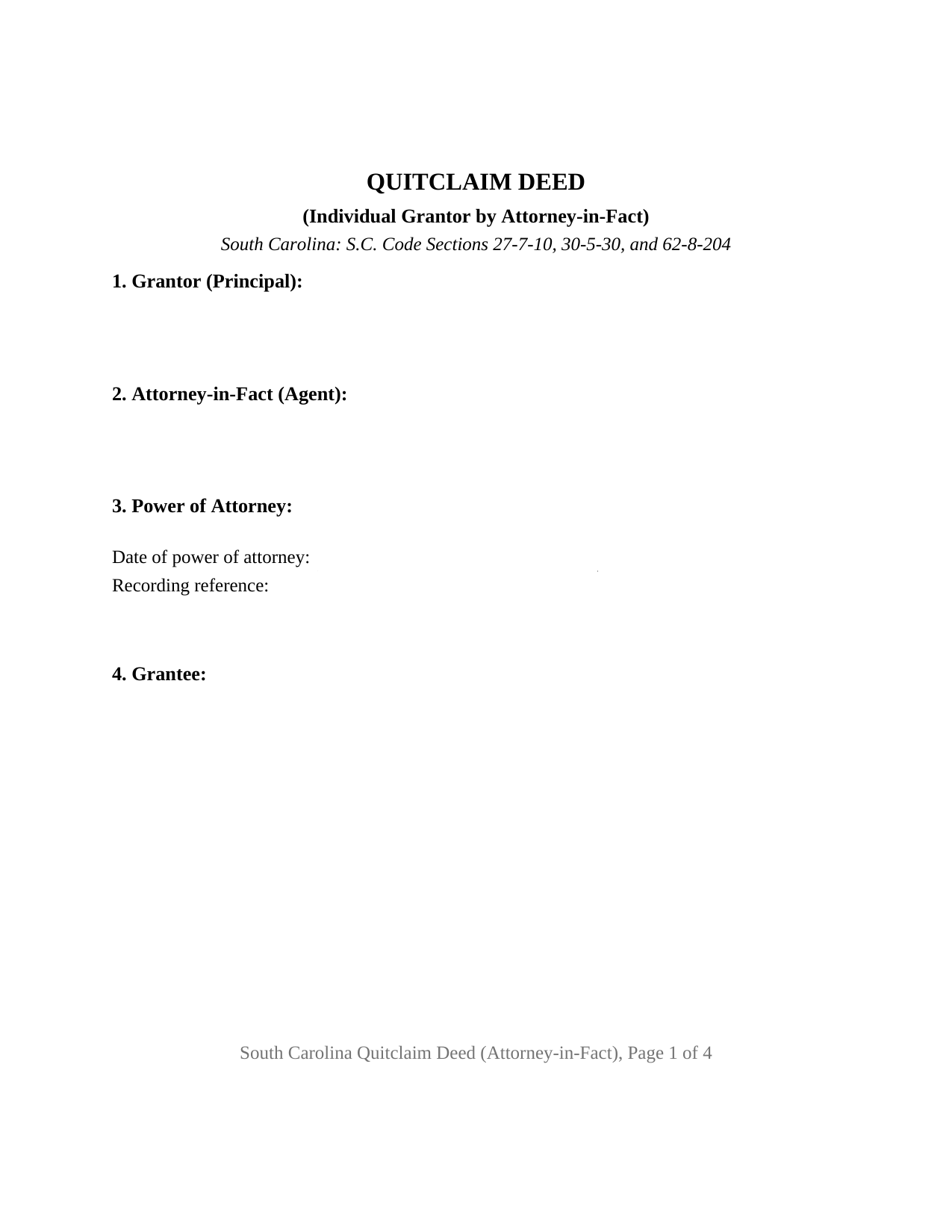
The signature on this South Carolina quitclaim deed belongs to someone who owns nothing. One individual record owner is named as Grantor, and an attorney-in-fact signs for that owner under a power of attorney the deed identifies by date and recording reference. The release is ordinary: whatever interest the owner holds passes to one named grantee, without covenant or warranty of title. The authority behind the pen is what this form is built to carry.
A statute that names this deed's own verb
South Carolina answers the authority question inside the Uniform Power of Attorney Act, Article 8 of Title 62, effective in 2017. Section 62-8-204 provides that, unless the document provides otherwise, language granting general authority as to real property lets the agent sell, exchange, convey with or without covenants, quitclaim, release, surrender, and encumber. The act this deed performs sits on that list by name. Section 62-8-201 then draws boundaries: an express grant is required before an agent may make a gift or create or change rights of survivorship, so a release for no consideration, or a grantee line carrying survivorship words, raises a question about the document's terms. Subsection (b) adds that only an ancestor, spouse, or descendant of the principal may create an interest in the agent, absent contrary terms.
Recording the authority, not only the deed
Two instruments reach the counter here, priced separately by Section 8-21-310: fifteen dollars for the deed, twenty five for the power of attorney. Section 62-8-109(c) explains why the second is there. After the principal's incapacity, an agent may exercise the granted authority only if the power of attorney has been recorded like a deed in the county where the principal then resides, or, for a principal living outside the State, in a county holding the principal's property. Until then the authority cannot be exercised. Section 62-8-105 gives that document formalities mirroring the deed's own: the principal's signature, attestation with the same formality and witnesses as a will, which Section 62-2-502 sets at two, and acknowledgment under Section 30-5-30.
The attorney-in-fact configuration
Sections 1 and 2 name the record owner and the agent with their mailing addresses, and Section 3 collects the power of attorney's date and its book, page, and county of recording. Section 8 performs the release, then recites the capacity: the attorney-in-fact signs solely in that office and not individually, the power of attorney reaches real property, the Grantor is alive, and neither the document nor the authority under it has been revoked. Section 9 carries one signature line whose printed name entry holds the signer's name and capacity, two witness blocks answering Sections 27-7-10 and 30-5-30(B), and one acknowledgment certificate. An owner who has moved out of state and cannot appear at a South Carolina closing, and an owner whose recorded durable document lets an agent act after incapacity, present the pattern this deed recites. The form recites one record owner and one agent signing for that owner; an owner signing personally, two co-owners together, a corporate officer, and a trust fiduciary each follow a different pattern.
When the authority ends
Section 62-8-110 lists the principal's death first among the events that end a power of attorney, a limit on this deed no recital can move, while sheltering anyone who acts in good faith without actual knowledge of a termination. Section 62-8-119 lets a party asked to accept an acknowledged power of attorney rely on it and request the agent's certification under penalty of perjury, on an optional statutory form prepared separately and not part of this package.
An exemption that points the other way
Deed stamps, which Section 12-24-10 measures at one dollar and eighty five cents per five hundred dollars of value, do not step aside because an agent signs. Section 12-24-40 exempts a deed running from an agent to that agent's principal where a notarized writing documents the agency, the reverse of the direction this deed travels. The example works that arithmetic on a stated eighteen thousand five hundred dollars.
A quitclaim deed, also searched as a quit claim deed or non-warranty deed, makes no promise about title, and Section 30-5-35 keeps such deeds outside its derivation clause while still calling for the grantee's mailing address. The purchase delivers three files: the blank fillable deed, an Aiken County completed example, and a plain language guide covering the nine sections, the power of attorney entries, the signing mechanics, and recording. Nothing here is legal advice; it describes South Carolina law in general terms.
Important: County-Specific Forms
Our quitclaim deed (individual grantor by attorney-in-fact) forms are specifically formatted for each of the 46 counties in South Carolina.
After selecting your county, you'll receive forms that meet all local recording requirements, ensuring your documents will be accepted without delays or rejection fees.