South Carolina Quitclaim Deed (Married Couple as Grantors)
County Specific Legal Forms Validated as recently as October 19, 2026 by our Forms Development Team
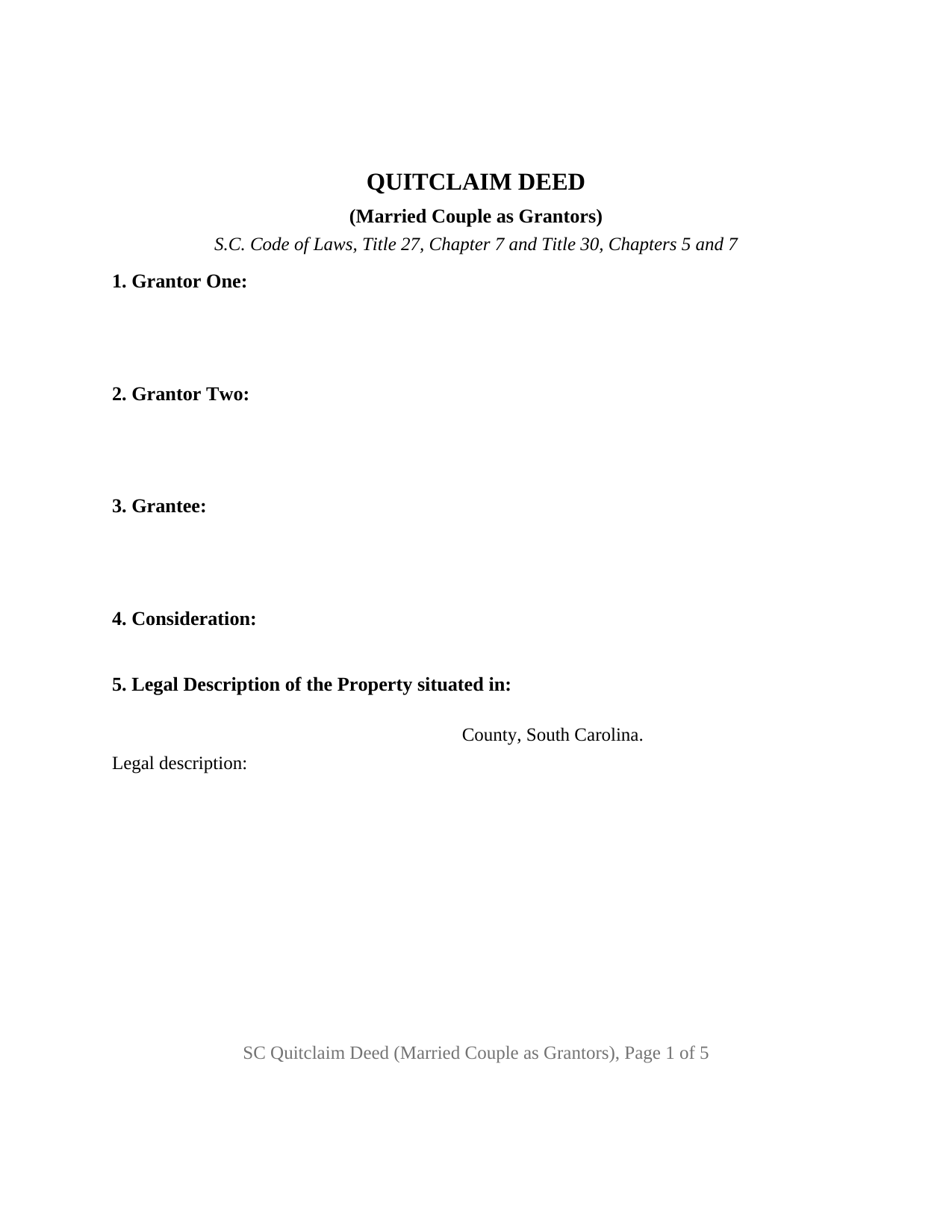
About the South Carolina Quitclaim Deed (Married Couple as Grantors)
How to Use This Form
- Select your county from the list
- Download the county-specific form
- Fill in the required information
- Have the document notarized if required
- Record with your county recorder's office
What Others Like You Are Saying
"It was so easy to use the site and got recording done in a day. Very happy with experience."
"Fast and easy service."
"Easy and quick to use!!"
"VERY EFFICIENT AND PLEASANT."
"TODD Form would not print surveyor degrees character (superscript "o") in Exhibit A. It al…"
4.8/5 from 4,829 reviews. Read all
South Carolina puts a name on a deed's signature line for one reason: record ownership. Marriage, by itself, adds nothing, and this quitclaim deed form is arranged around that fact, joining a married couple who both hold record title to South Carolina real property as the two grantors of a single release to one named grantee.
Both spouses sign as owners, not because they are married
South Carolina abolished dower, curtesy, and jointure in 1985, recognizes no community property, and, under S.C. Code Section 27-7-40(c), does not recognize tenancy by the entirety between spouses. So there is no marital-rights machinery to print: no dower waiver block, no joinder line for a spouse who is off the title. What the record does show is couples who took title together, as tenants in common or as statutory joint tenants, and a conveyance of the whole parcel therefore carries both owners' signatures. This form supplies exactly that execution set, along with a short recital that the two grantors are married to each other; the recital describes the signers, while the deed draws its force from their ownership.
The married-couple configuration
Sections 1 and 2 of the form identify the spouses by name and mailing address, and the operative section joins them in one release using the traditional quitclaim words, each spouse conveying in that spouse's own right. The execution set doubles what the state expects of a signing: a signature line for each spouse, a pair of witness blocks attached to each spouse's execution, and an acknowledgment certificate for each spouse, so the couple can sign at one sitting before a single notary or complete the two executions apart when work or travel separates them. A married couple moving a jointly titled house to an adult child, and spouses retitling real estate into the trustee of their revocable living trust, present the ownership pattern this deed recites. The form recites two grantors who are married to each other and one grantee; a sole owner's release, a conveyance by co-owners who are not spouses, and an entity's deed each follow a signing pattern different from the one printed here.
What the release does and does not say
A quitclaim deed, sometimes written as quit claim deed and also called a non-warranty deed, conveys the grantors' right, title, and interest, if any, with no covenant about what that interest is. South Carolina's recording law treats the instrument accordingly: the derivation clause required of warranty deeds does not apply, while the grantee's mailing address, the parcel's tax map number, and acknowledgment before an officer remain part of an ordinary recording package. The deed binds the parties when delivered; placing it on record with the county register of deeds gives it effect against later creditors and purchasers for value without notice from the day and hour of recording.
Deed stamps when spouses convey together
South Carolina's deed recording fee runs with the deed, not with the number of grantors, and a married couple's family transfer often records under one of the statutory exemptions, with the accompanying value affidavit stating the reason in place of a computed amount. The guide walks the fee arithmetic, the exemption categories, and the flat statewide recording charge, and the completed example shows the whole pattern end to end: a Charleston County couple releasing their jointly titled Mount Pleasant lot to their daughter, every field filled, both executions witnessed and acknowledged.
The download contains the fillable married-couple quitclaim deed, the Charleston County completed example, and a plain language guide covering every numbered section, the witness and two-certificate signing mechanics, and the recording and deed stamp sequence. These materials describe South Carolina law in general terms; they are not legal advice.
Important: County-Specific Forms
Our quitclaim deed (married couple as grantors) forms are specifically formatted for each of the 46 counties in South Carolina.
After selecting your county, you'll receive forms that meet all local recording requirements, ensuring your documents will be accepted without delays or rejection fees.