South Carolina Quitclaim Deed (Two Grantors)
County Specific Legal Forms Validated as recently as October 9, 2026 by our Forms Development Team
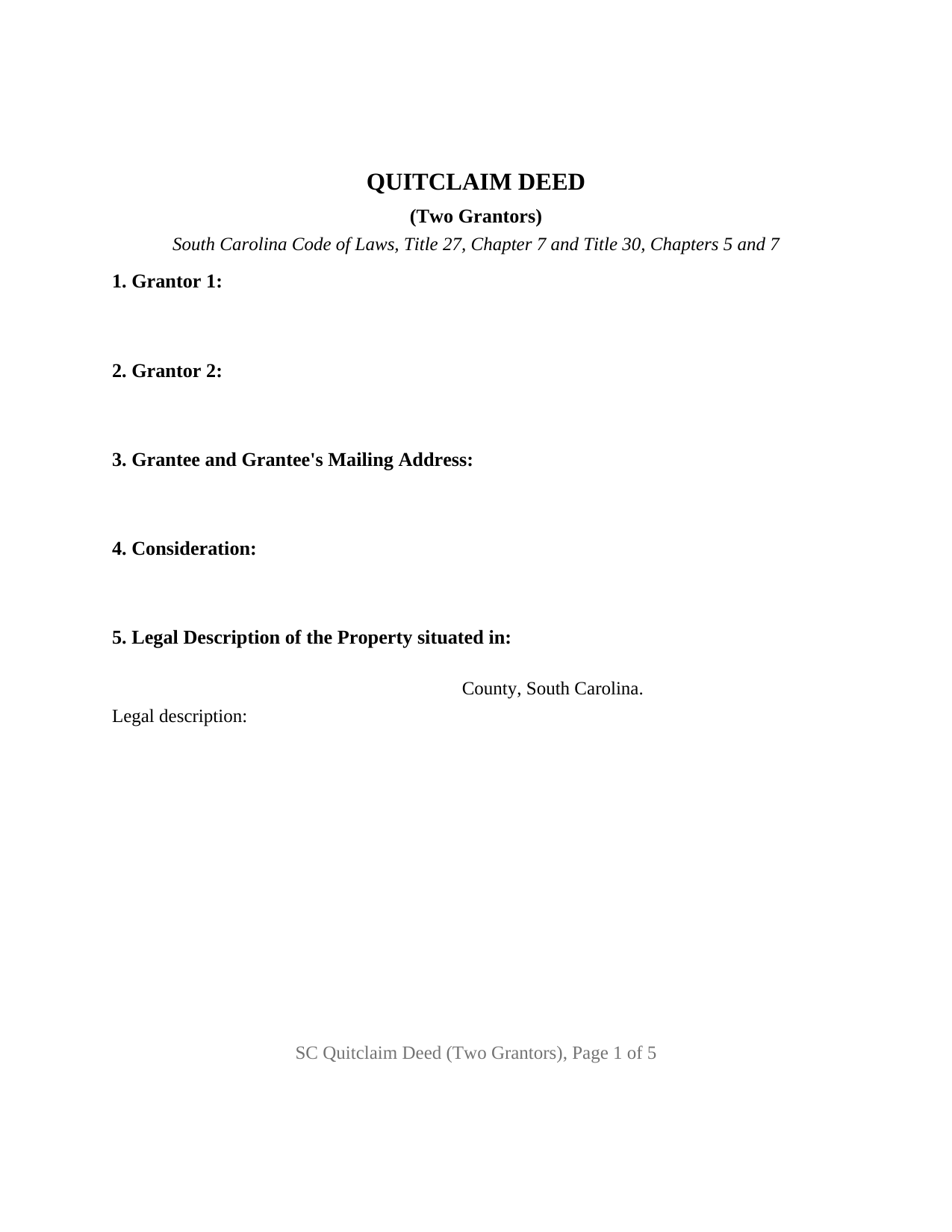
About the South Carolina Quitclaim Deed (Two Grantors)
How to Use This Form
- Select your county from the list
- Download the county-specific form
- Fill in the required information
- Have the document notarized if required
- Record with your county recorder's office
What Others Like You Are Saying
"I love this company!! Excellent customer service and quick!! Thank you"
"Thanks for your expedite process"
"that is what I was looking for thanks"
"Searched online 3 hours until I found Deeds.com, afterwards smooth sailing definitely 5 stars"
"THE PROCESS WENT VERY SMOOTH AND EASY"
4.8/5 from 4,828 reviews. Read all
This South Carolina quitclaim deed is configured for two grantors: two record owners of the same parcel who each give up their right, title, and interest to one named grantee on a single instrument. The form carries a signature line for each grantor, two witness signature blocks for each grantor's execution, and its own acknowledgment certificate for each grantor, so the pair can sign together in one ceremony or complete their signings on different dates, in different counties, before different notaries.
Two owners, one deed
The two-grantor configuration is the architecture of this form. Sections 1 and 2 identify the two owners by name and mailing address, the operative section joins them in a single release using the traditional words remise, release, and forever quitclaim, and the habendum runs to one grantee and that grantee's heirs, successors, and assigns. Two heirs releasing inherited fractional shares to a single family member, and co-owners consolidating a jointly held parcel under one name, present the pattern this configuration serves. The form recites exactly two individual grantors conveying in their own right; a deed executed by a sole owner, by three or more owners, or by an entity officer, trustee, or attorney-in-fact follows a different signing pattern than the one printed here.
Executions that can travel
South Carolina deed execution runs on witnesses as well as a notary. Each grantor signs before two witnesses, and county recording offices across the state publish that the notary may stand as one of the two, so each signing needs only the grantor, one additional witness, and the officer. The witness blocks on this form are paired with each grantor, and the two acknowledgment certificates let each execution be proved on its own: South Carolina law does not require a separate certificate for each signer, but the two-certificate layout means a grantor in Columbia and a grantor in Charlotte never have to appear in the same room. Acknowledgment or proof of execution remains the gateway to the record under S.C. Code Section 30-5-30, whichever way the signings happen.
Lighter intake for a non-warranty deed
A quitclaim deed, also searched as a quit claim deed or non-warranty deed, promises nothing about title, and South Carolina's recording statute reflects that posture: Section 30-5-35 leaves quitclaim and non-warranty deeds outside its derivation clause, so the source-of-title reference on this form is optional and informational. The statute still calls for the grantee's mailing address, which the grantee section collects, and county intake lists add the parcel's tax map number, which has its own numbered section. Both stamp bands, at the top and bottom of the first page, stay clear at a full one and one half inches so the register's recording information has a place to land.
One value affidavit covers both grantors
South Carolina's deed recording fee, the charge counties call deed stamps, attaches to the deed rather than to each signer, so a two-grantor release records with a single affidavit of value under Title 12, Chapter 24, signed by one responsible person connected with the transaction. Family releases of the kind that arrive on two-grantor quitclaim deeds frequently qualify for a statutory exemption, and the affidavit then states the exemption reason in place of a value; the guide walks through the fee calculation, the exemption categories, and the statewide fifteen dollar recording charge that applies either way.
The purchase delivers three pieces: the fillable two-grantor quitclaim deed, a completed example prepared on a Richland County family-transfer fact pattern showing every section filled in, and a plain language guide covering each numbered entry, the witness and acknowledgment mechanics for two signers, and the recording and deed stamp steps. The materials describe South Carolina law in general terms and are not legal advice.
Important: County-Specific Forms
Our quitclaim deed (two grantors) forms are specifically formatted for each of the 46 counties in South Carolina.
After selecting your county, you'll receive forms that meet all local recording requirements, ensuring your documents will be accepted without delays or rejection fees.