Virginia Warranty Deed
County or Independent City Specific Legal Forms Validated as recently as October 12, 2026 by our Forms Development Team
About the Virginia Warranty Deed
How to Use This Form
- Select your county or independent city from the list
- Download the county or independent city-specific form
- Fill in the required information
- Have the document notarized if required
- Record with your county or independent city recorder's office
What Others Like You Are Saying
"It was very easy to set up the account but then everything is very costly. I didn't see any publicat…"
"Quick assistance with same day recording. The tech identified barriers to successful Recordation suc…"
"AMazing service. Fast and affordable."
"This service is fantastic! Took a few tries to scan the document correctly, but their patience and q…"
"Great products, quick downloads, the "guides" are extremely helpful. Overall 5 stars!"
4.8/5 from 4,828 reviews. Read all
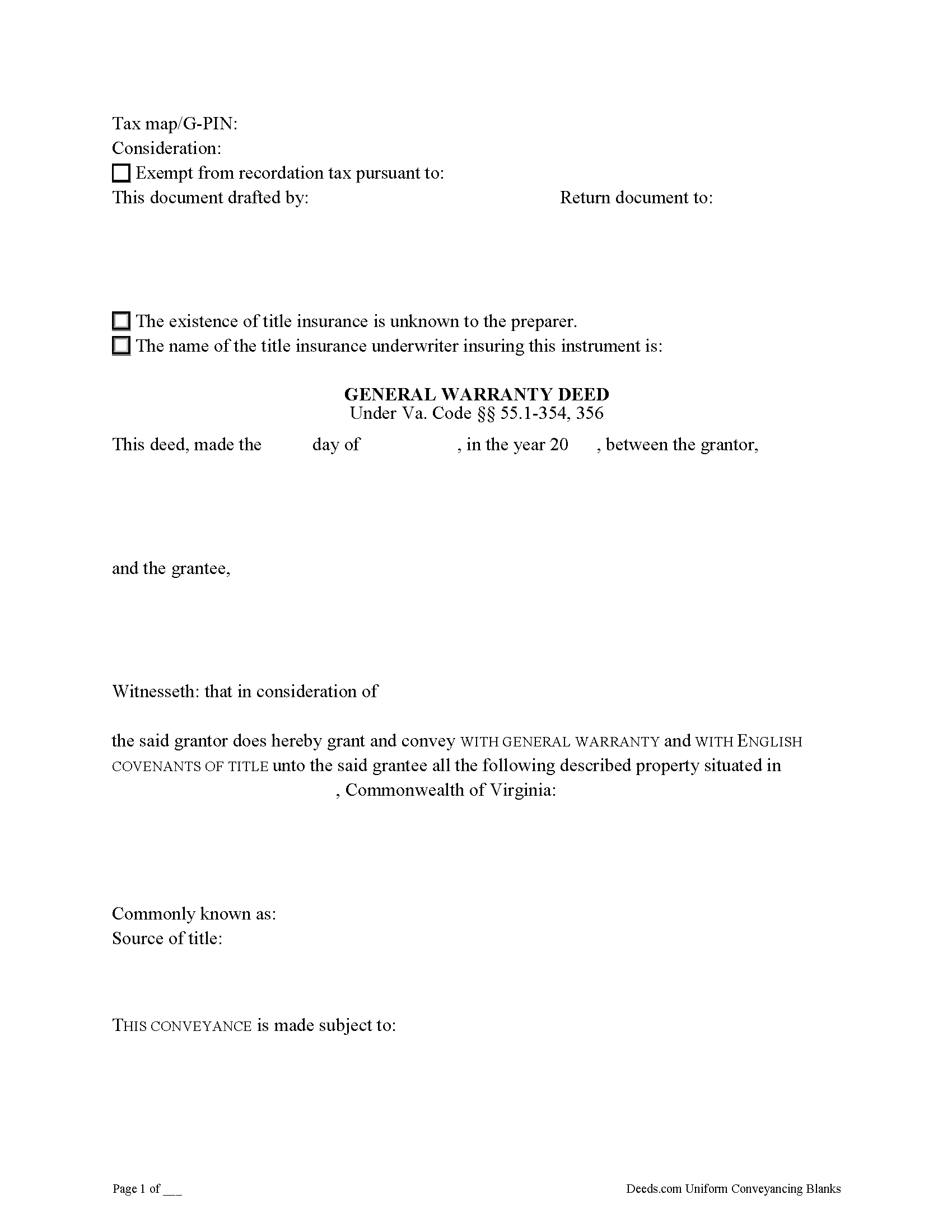
Virginia decides how a deed works from the words written into it, so this general warranty deed leaves the words to the parties. It is the base Virginia warranty deed: a present conveyance of real property between individuals, with open party blocks that take one or two names on each side, no preprinted marital status, no preprinted co-ownership label, and the granting and covenant language that makes the instrument a general warranty deed under the Code of Virginia.
Why the grantee block is left open
How two grantees will hold Virginia land is settled by the phrase that follows their names, and the statutory defaults surprise people. Section 55.1-134 abolished survivorship as an automatic feature of joint ownership, and Section 55.1-135 provides that the words jointly, joint tenants, and joint tenancy mean a joint tenancy without survivorship, so the familiar phrase alone leaves each share passing through its owner's estate. Survivorship arrives only when the deed manifests it, in language such as as joint tenants with the right of survivorship as at common law. Spouses take the entireties estate only where the deed designates them as tenants by the entirety or tenants by the entireties under Section 55.1-136; being married is not enough. Absent effective language, two grantees hold as tenants in common. A form that preprinted any one of these choices would decide the question for the filler, so this one prints none of them and the guide sets out each recognized form, the words that create it, and what happens at an owner's death.
What the warranty answers for, and what the deed carves out
The granting sentence conveys with general warranty, and a following sentence states the covenant of Section 55.1-354 in the statute's own words, binding the grantor against the claims and demands of all persons. That promise is read against the exceptions section, which is where recorded declarations, plat easements, and reserved interests are listed, and against two quieter rules of Virginia conveyancing that the form is drafted around: Section 55.1-310, under which title the grantor later acquires passes to the grantee, and Section 55.1-311, under which the vendor's equitable lien for unpaid purchase money is abolished unless it is expressly reserved on the face of the deed. The exceptions section also carries the general subject-to-covenants-of-record provision that Section 55.1-300 permits, phrased to stay clear of the specific restrictive covenant references that section prohibits.
One or two individuals on either side
The deed recites natural persons signing in their own right. Section 1 takes one or two grantor names with the status words the parties use, Section 2 takes one or two grantee names with any vesting designation, and the instrument closes with a GRANTOR signature block and a SECOND GRANTOR block, each with its own acknowledgment certificate in the Section 55.1-621 short form for an individual, so signers may appear before different notaries on different dates. Where a single owner conveys, the second block and its certificate stay blank. The four count patterns that result, one or two owners of record conveying to one or two new owners, are the ordinary shape of a residential Virginia conveyance between individuals. Deeds executed by a corporation or limited liability company, by a trustee or personal representative, by an attorney in fact, or by three or more owners recite offices and capacities this form does not carry.
The page one the clerk reads first
Above the title sit the entries Virginia law places on a deed's first page: the preparer statement, the title insurance underwriter, the parcel identifier, the consideration, the actual value of the property conveyed, the line for a claimed recordation tax exemption, and the return address. The parcel identifier is worth a moment, because Section 17.1-252 requires it in localities with unique parcel systems and the formats differ from clerk to clerk, Chesterfield County publishing a fifteen digit tax identification number while Henrico County uses a ten digit parcel number.
A Virginia deed reaches the world only when it is recorded with the clerk of the circuit court for the county or city where the land lies, which is what Section 55.1-407 rewards with priority over later purchasers and lien creditors. The download contains the general warranty deed as a fillable PDF, a completed example filled at full capacity for a Chesterfield County sale, and a plain language guide covering every section, the vesting choices, notarization, and the recordation and grantor taxes; the materials are informational and are not legal advice.
Important: County or Independent City-Specific Forms
Our warranty deed forms are specifically formatted for each of the 132 county or independent cities in Virginia.
After selecting your county or independent city, you'll receive forms that meet all local recording requirements, ensuring your documents will be accepted without delays or rejection fees.