Apache County Disclaimer of Interest Form
Last validated August 20, 2026 by our Forms Development Team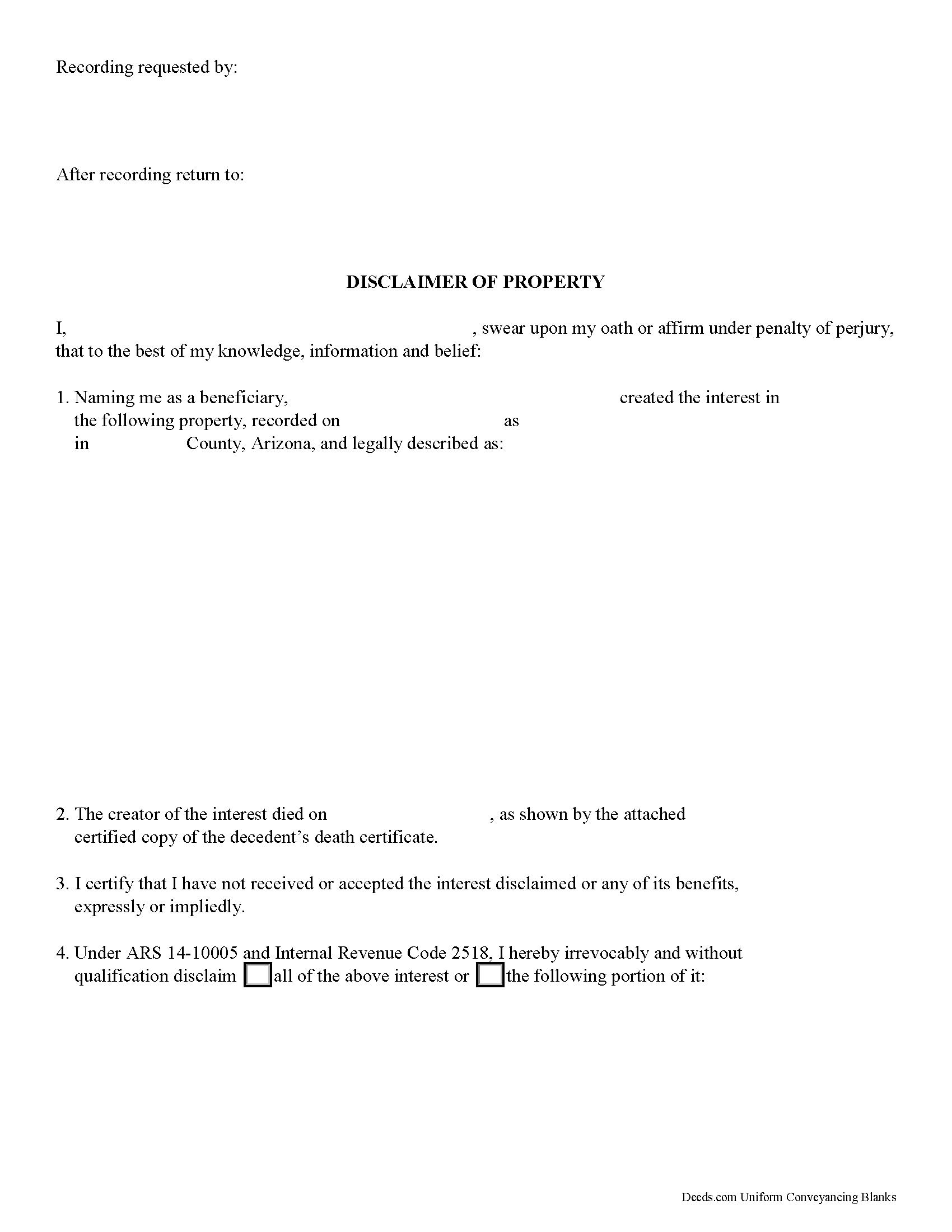
Apache County Disclaimer of Interest Form
Fill in the blank form formatted to comply with all recording and content requirements.
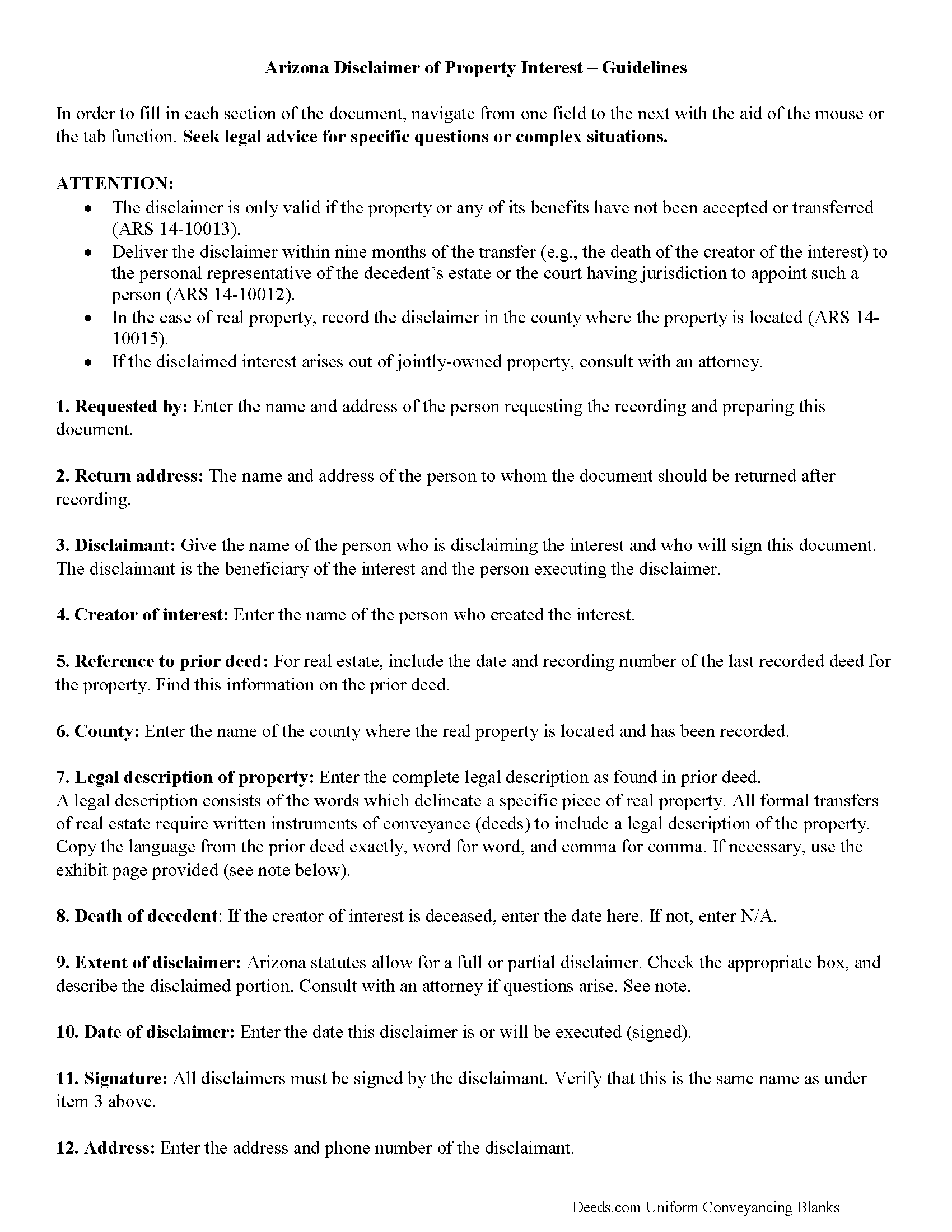
Apache County Disclaimer of Interest Guide
Line by line guide explaining every blank on the form.
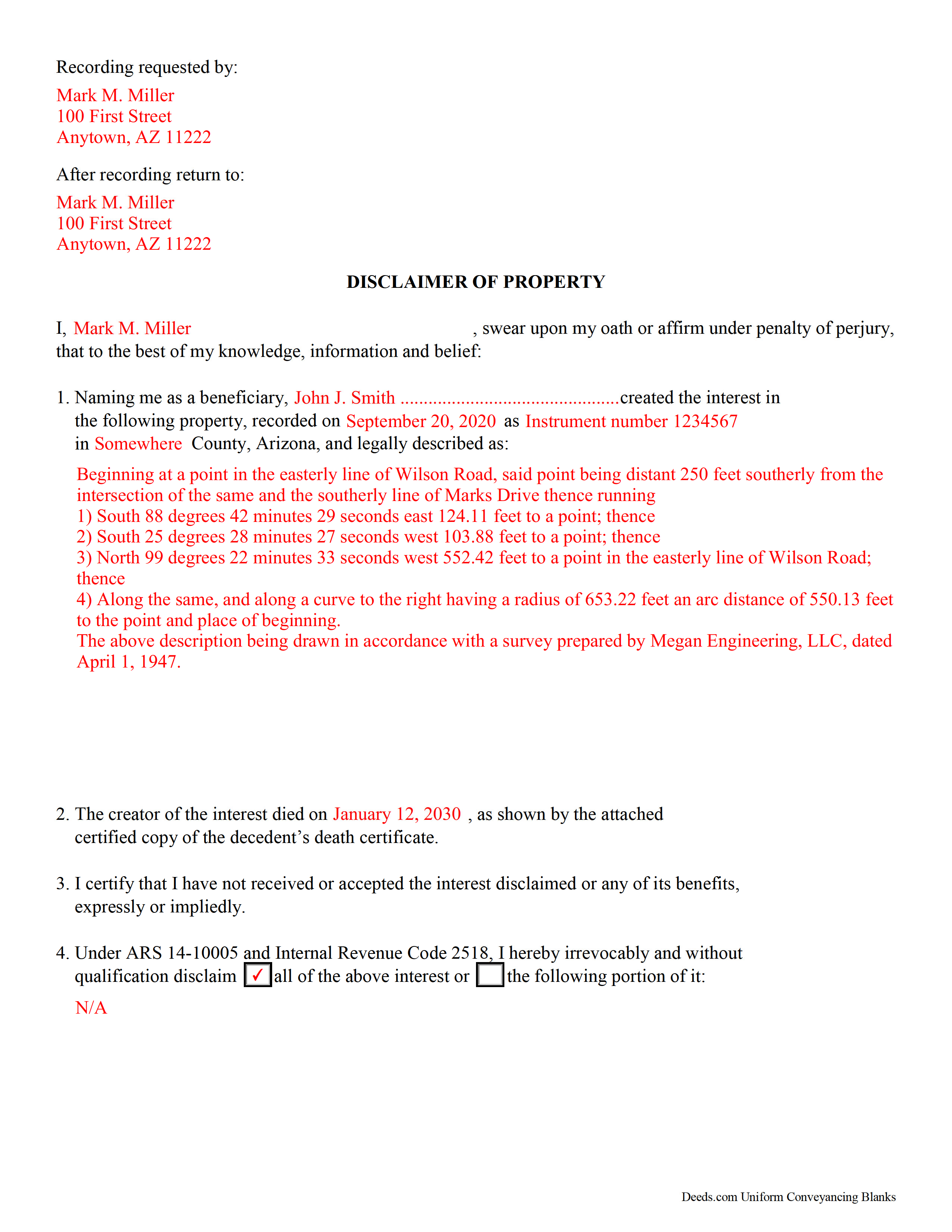
Apache County Completed Example of the Disclaimer of Interest Document
Example of a properly completed form for reference.
All 3 documents above included • One-time purchase • No recurring fees
Immediate Download • Secure Checkout
Additional Arizona and Apache County documents included at no extra charge:
Where to Record Your Documents
County Recorder Office - County Annex Bldg
St. Johns, Arizona 85936
Hours: Monday through Thursday 6:30am - 5:30pm. Closed Fridays
Phone: 928-337-7515
Recorder's Sub Office
Springerville, Arizona
Hours: Mon, Tue 8:00 - 5:00, Wed 9:00 - 12:00
Phone:
Recording Tips for Apache County:
- Recording fees may differ from what's posted online - verify current rates
- Recorded documents become public record - avoid including SSNs
- If mailing documents, use certified mail with return receipt
Cities and Jurisdictions in Apache County
Properties in any of these areas use Apache County forms:
- Alpine
- Chambers
- Chinle
- Concho
- Dennehotso
- Eagar
- Fort Defiance
- Ganado
- Greer
- Houck
- Lukachukai
- Lupton
- Many Farms
- Mcnary
- Nazlini
- Nutrioso
- Petrified Forest Natl Pk
- Red Valley
- Rock Point
- Round Rock
- Saint Johns
- Saint Michaels
- Sanders
- Springerville
- Teec Nos Pos
- Tsaile
- Vernon
- Window Rock
Hours, fees, requirements, and more for Apache County
How do I get my forms?
Forms are available for immediate download after payment. The Apache County forms will be in your account ready to download to your computer. An account is created for you during checkout if you don't have one. Forms are NOT emailed.
Are these forms guaranteed to be recordable in Apache County?
Yes. Our form blanks are guaranteed to meet or exceed the applicable formatting requirements used for recording in Apache County, including margin requirements, font requirements, and other layout standards. This guarantee applies to formatting, not to the legal sufficiency of information entered by the user or the suitability of a form for a particular transaction.
Can I reuse these forms?
Yes. You can reuse the forms for your personal use. For example, if you have multiple properties in Apache County you only need to order once.
What do I need to use these forms?
The forms are PDFs that you fill out on your computer. You'll need Adobe Reader (free software that most computers already have). You do NOT enter your property information online - you download the blank forms and complete them privately on your own computer.
Are there any recurring fees?
No. This is a one-time purchase. Nothing to cancel, no memberships, no recurring fees.
How much does it cost to record in Apache County?
Recording fees in Apache County vary. Contact the recorder's office at 928-337-7515 for current fees.
Questions answered? Let's get started!
The Arizona Disclaimer of Interest is the instrument a beneficiary uses under the Arizona Uniform Disclaimer of Property Interests Act at ARS 14-10001 et seq. to refuse all or part of an interest in property the beneficiary would otherwise receive — typically an inheritance, a survivorship interest, a beneficiary deed transfer, or a distribution from a trust. A valid disclaimer causes the disclaimant to be treated as though they had predeceased the decedent or never received the interest, with the property passing to whoever would have taken if the disclaimant had not existed. The timing is unforgiving: under ARS 14-10005, the disclaimer must be made before the beneficiary has accepted the interest or exercised dominion over it, and for tax-qualified disclaimers under federal law, it must be delivered within nine months of the interest-creating event. Once executed, a disclaimer is irrevocable — the decision cannot be undone — which is why the drafting and timing matter.
When the Arizona Disclaimer of Interest Is Used
Disclaimers are used in several common scenarios. Estate tax planning is one driver: a surviving spouse may disclaim a portion of the decedent's estate to route it directly to the children or to a credit-shelter trust, reducing the combined estate tax exposure at the second death. Asset protection is another: a beneficiary facing creditor pressure may disclaim an inheritance to prevent it from becoming reachable by creditors, though the effectiveness of this strategy depends heavily on timing relative to creditor claims and on specific state and federal rules. Beneficiary correction is a third: when a decedent's plan has become outdated (an intended charitable beneficiary no longer exists, a named individual has become unsuitable, an unequal distribution no longer fits family circumstances), a disclaimer can redirect property to beneficiaries who would take by default under the will, trust, or intestacy statute. Disclaimers are also used in blended-family situations to route property to stepchildren or former spouses in ways the original plan did not contemplate, and in Medicaid-eligibility situations where accepting an inheritance would disqualify a beneficiary from benefits (though Medicaid-driven disclaimers are scrutinized under separate federal rules that may treat the disclaimer as a transfer for purposes of eligibility).
The "No Acceptance" Rule Under ARS 14-10013
A fundamental constraint on disclaimers is that they are not available if the beneficiary has accepted the interest. Under ARS 14-10013, a beneficiary who has accepted an interest — by taking possession, receiving a distribution, exercising ownership rights, or pledging the interest as collateral — has lost the ability to disclaim it. The policy is that disclaimers must be true refusals, not retroactive regret; once a beneficiary has treated property as their own, they cannot later pretend they never received it.
What counts as "acceptance" is sometimes subtle. Taking physical possession of a bequeathed item is acceptance. Receiving a check from a trust distribution and depositing it is acceptance. Making demands on a fiduciary for an accounting or for specific distributions is typically acceptance as to the interest demanded. Residing in inherited real property for an extended period can constitute acceptance. Signing documents that treat the interest as the beneficiary's own — deeds, contracts, tax returns reflecting ownership — is acceptance. By contrast, mere passage of time without action typically does not constitute acceptance; a beneficiary can take several months (up to the statutory disclaimer period) to evaluate whether to disclaim without that passage of time being treated as acceptance, provided no affirmative steps toward ownership have occurred. When a beneficiary is uncertain whether particular actions might foreclose the disclaimer option, erring on the side of doing nothing while the disclaimer decision is being evaluated is the safer approach.
Content of the Disclaimer — ARS 14-10005(C)
The disclaimer is a written instrument with specific content requirements. Under ARS 14-10005(C), the document must describe the interest being disclaimed with sufficient specificity to identify what is refused, declare the disclaimant's intent to disclaim the interest (either in whole or in the defined portion being refused), and be signed by the disclaimant. For a disclaimer affecting real property, the description should include the property's legal description, the source of the disclaimant's interest (the will, the trust, the beneficiary deed, the joint tenancy, or the intestacy statute), and enough detail that the relationship between the disclaimer and the source of the interest is clear. Partial disclaimers need particular precision — disclaiming "half" or "a 25 percent interest" or "all but the homestead exemption" is meaningful only if the resulting fractions or categories are defined with enough specificity that the outcome is unambiguous.
The Nine-Month Timing Rule
ARS 14-10012 and related provisions, together with federal tax law under Internal Revenue Code Section 2518, establish the timing framework for disclaimers. A qualified disclaimer under federal law — which is the standard most Arizona practitioners target to preserve tax benefits — must be made within nine months of the transfer that creates the interest. For interests arising on death, the nine-month period runs from the date of death. For interests arising from a beneficiary designation that was already in place when the disclaimant had capacity to disclaim (for example, the disclaimant was born named as a beneficiary of an irrevocable trust), the period can run from when the disclaimant reached the age at which they could have exercised the interest, or from events later in the chain, depending on the specific circumstances.
Arizona state law may permit a longer disclaimer period for non-tax purposes in certain circumstances, but the nine-month federal deadline is usually controlling because the disclaimant typically wants the tax consequences to flow through properly. A disclaimer executed after the nine-month period may still be effective under state property law — redirecting the interest to whoever takes by default — but may not qualify for the federal tax treatment, which can be a material difference for significant-value interests. Timing should be evaluated as of the triggering event, not the date the disclaimant learned about it: inheritance can be delayed in reaching the beneficiary, but the clock started running at death regardless.
Who Takes After the Disclaimer
A disclaimer does not let the disclaimant choose who receives the property — it simply redirects the property according to the rules that would have applied if the disclaimant had predeceased the decedent or never received the interest. For a disclaimed devise under a will, the property passes to the residuary beneficiary if the devise was specific, or to the alternate devisees if the will names them, or to the intestacy heirs if no alternate is specified. For a disclaimed inheritance under the intestacy statute, the property passes to the next heirs in the statutory order, which typically means to the disclaimant's descendants. For a disclaimed beneficiary deed transfer, the property passes to any successor beneficiaries named in the deed, or back into the decedent's probate estate if no successor is named. For a disclaimed distribution from a trust, the property passes according to the trust's default provisions for when a beneficiary is unavailable.
The disclaimant needs to think carefully about where the property actually ends up before executing the disclaimer. A disclaimer intended to benefit the disclaimant's children will succeed if the children are the takers by default, but will fail (and send the property somewhere unintended) if the document's default provisions direct property elsewhere. Reviewing the will, trust, or beneficiary deed to confirm where disclaimed property actually goes is a required step before signing.
Special Considerations for Jointly Owned Property
Disclaimers of interests in jointly owned property have particular complexity. When a joint tenant dies and the surviving joint tenant wishes to disclaim, the analysis involves whether the disclaimer can reach all or part of the survivor's interest or whether the survivor's interest is already considered "accepted" by virtue of the joint tenancy itself. Federal tax law has developed specific rules for qualified disclaimers of joint interests that distinguish between interests that pass by right of survivorship (potentially disclaimable within nine months of the joint tenant's death) and interests in property the disclaimant already owned during the joint tenancy (often treated as already accepted at the time of joint tenancy creation). Arizona community property creates additional layers, because the community property and community property with right of survivorship vestings have their own rules for which half-interest passes at the first death and how it can be disclaimed. Disclaimers in joint-ownership contexts almost always warrant specific legal advice, because the wrong assumption can produce an ineffective disclaimer or unexpected tax consequences.
Filing and Recording Requirements
ARS 14-10012 requires filing the disclaimer with the probate court — typically the court in the county where the estate is being administered, or where the estate would be administered if no probate is currently open. For disclaimers of real property interests, ARS 14-10015 requires the disclaimer to be acknowledged as a deed would be and recorded with the county recorder in the county where the property is located. This dual filing-and-recording requirement distinguishes disclaimers of real property from disclaimers of other interests (which are typically only filed with the probate court), and the recording requirement is what puts the disclaimer into the chain of title so future purchasers and title examiners can see the redirection.
The disclaimer should also be delivered to the fiduciary or other party currently holding custody or possession of the property — the personal representative of an estate, the trustee of a trust, the escrow agent holding a beneficiary deed closing, or the other party to a joint tenancy. Delivery to the fiduciary is what starts the clock on the property moving to the alternative recipient, and it also eliminates any argument that the fiduciary was unaware of the disclaimer and could proceed with a distribution to the disclaimant.
Irrevocability
Once executed and delivered, a disclaimer is irrevocable. A disclaimant cannot change their mind on learning new information, discovering the property was more valuable than expected, or reconsidering the estate plan. The property has passed to the alternative recipient, and the disclaimant's only recourse is to request that recipient voluntarily transfer the property back — which is entirely at that recipient's option and which, if it occurs, is treated as a new gift from that recipient to the disclaimant for tax purposes, not a retroactive reversal of the disclaimer. The irrevocability rule exists because the disclaimant's choice has third-party consequences; alternative recipients are entitled to rely on the disclaimer and to make their own planning decisions based on what they now own.
Execution and Acknowledgment
For a disclaimer affecting real property, the instrument must be signed by the disclaimant and acknowledged before a notary public, with the execution requirements tracking those of a deed under ARS 33-401. Arizona does not require subscribing witnesses. When the disclaimant is an individual, the signature is straightforward. When the disclaimant is a fiduciary disclaiming on behalf of an incapacitated beneficiary, additional authority may be required — disclaimers by guardians, conservators, or attorneys-in-fact are permitted under Arizona law but typically require specific authorization from the governing instrument or from a court order, because a disclaimer is a decision with significant consequences and the ordinary presumption is that the beneficiary's fiduciary is obligated to accept property on the beneficiary's behalf rather than refuse it.
Formatting and Recording
ARS 11-480 sets the formatting requirements for every recordable instrument: legible type of at least ten points, white paper no larger than 8.5 by 14 inches, a caption identifying the document (for example, "Disclaimer of Interest"), a top margin of at least two inches on the first page reserved for the recorder's stamp, and minimum half-inch margins elsewhere. Record the disclaimer with the county recorder in the county where the real property is located, and file the same disclaimer (or a certified copy) with the probate court as required by ARS 14-10012. Confirm current recording fees and accepted forms of payment with the county recorder and probate court in advance.
What's Included in the Download Package
The Arizona Disclaimer of Interest package includes the disclaimer form drafted around the Arizona Uniform Disclaimer of Property Interests Act at ARS 14-10001 et seq. with the content required by ARS 14-10005 and execution formalities suitable for recording under ARS 14-10015, detailed guidelines covering the Arizona-specific drafting, timing, and dual filing requirements, and a completed example showing how the form should look for a typical disclaimer of a real property interest. All files are available for instant download after purchase.
Important: Your property must be located in Apache County to use these forms. Documents should be recorded at the office below.
This Disclaimer of Interest meets all recording requirements specific to Apache County.
Our Promise
The documents you receive here are guaranteed to meet or exceed the applicable Apache County recording format requirements. If there is a rejection caused by our formatting, we will correct the issue or refund your payment. This guarantee applies to document formatting only and does not extend to information entered by the user, the selection of the form, or the legal effect of the completed document.
Save Time and Money
Get your Apache County Disclaimer of Interest form done right the first time with Deeds.com Uniform Conveyancing Blanks. At Deeds.com, we understand that your time and money are valuable resources, and we don't want you to face a penalty fee or rejection imposed by a county recorder for submitting nonstandard documents. We constantly review and update our forms to meet rapidly changing state and county recording requirements for roughly 3,500 counties and local jurisdictions.
4.8 out of 5 - ( 4774 Reviews )
Andre W.
June 24th, 2020
I was very please with their professionalism and dedication. The young lady that was working with me was AWESOME. i could not thank her enough.
Thank you!
Brenda B.
January 6th, 2019
Excellent transaction.
Thank you Brenda.
Jose S.
February 7th, 2021
Thank you so very much I live in Texas but I Owned a home in Indiana with your help I could never get those paper that I need to change the ownership in Indiana. You have a great site.
Thank you!
William C.
September 9th, 2020
Good service, great price, the website is a bit hard to maneuver in places.
Thank you for your feedback. We really appreciate it. Have a great day!
Tommy P.
March 16th, 2019
This was simple! Thank you!
Thank you!
Cynthia H.
September 5th, 2021
Thank you for having these forms so reasonable and easy to access. I only WISH I would have looked here 1st, spent way to much valuable time trying to get help with this deed. This was so EASY and quick... THANK YOU THANK YOU Highly Recommend
Thank you!
William A B.
May 20th, 2020
Good service...deed release form as required.
Thank you!
Desiree T.
September 4th, 2020
In a world where "immediate satisfaction" takes too long, Deeds provided exceptionally satisfying service. Answered all of my questions quickly, and had my document recorded within one day. Thank you so much!
We appreciate your business and value your feedback. Thank you. Have a wonderful day!
WJ H.
December 6th, 2021
The Quit Claim Deed for the state of Ohio worked for me, saving me the cost of an attorney doing it. O.K., maybe that wouldn't have amounted to more than a few hundred dollars, but anywhere I thought I could save money (and learn something new on top of it) is something I want to do. That said, be forwarned. While I'm not an attorney I'm not averse to spending many hours researching the lingo found in this kind of form and thoroughly understanding exactly how everything has to be filled in. I should add that my ex-wife and I remain friends and she was the one giving me the property/house (thus, technically I filled out the forms on her behalf). Because there was no personal conflict, it made it easier to undertake. Lastly, what others have said about the county office where you must file a Quit Claim Deed not being helpful, that's true in the sense that they do not want to be instructing non-attorneys on filling out the necessary forms. I did take a preliminary draft set of the forms to the county office but was VERY CAREFUL about explaining that I only needed a couple of questions answered about procedure for submitting the final documents. They were helpful once I made it clear I wasn't asking them for "legal advice". And their help was critical as the final submittals requires stopping at three different offices (MapDocuments, Auditor and finally the Recorder's office). So I say thank you to Deeds.com. Their service for the Quit Claim Deed was invaluable.
We appreciate your business and value your feedback. Thank you. Have a wonderful day!
Cheryl S.
April 30th, 2021
quick response
Thank you!
Tiffany P.
May 7th, 2019
Very quick and gave me exactly what I needed! I would have had to go down to the courts and take off work to get this info otherwise.
Thank you for your feedback. We really appreciate it. Have a great day!
JAN F.
July 7th, 2026
One day start to finish and so easy to complete.
Happy we could assist. Thank you for sharing your experience.
Dee S.
October 24th, 2023
Great service and so quick at responding!
We are motivated by your feedback to continue delivering excellence. Thank you!
Stephen H.
December 12th, 2022
Great experience. Rapid service, no unexpected problems, and reasonable pricing. I will definitely use Deeds.com again.
Thank you for your feedback. We really appreciate it. Have a great day!
Shannon D.
November 4th, 2020
Extremely easy site to use. We had our document e-recorded the same day and we didn't have to make a trip downtow!
Thank you!