Arkansas Beneficiary Deed (Sole Owner, Multiple Beneficiaries (Equal Shares))
County Specific Legal Forms Validated as recently as November 9, 2026 by our Forms Development Team
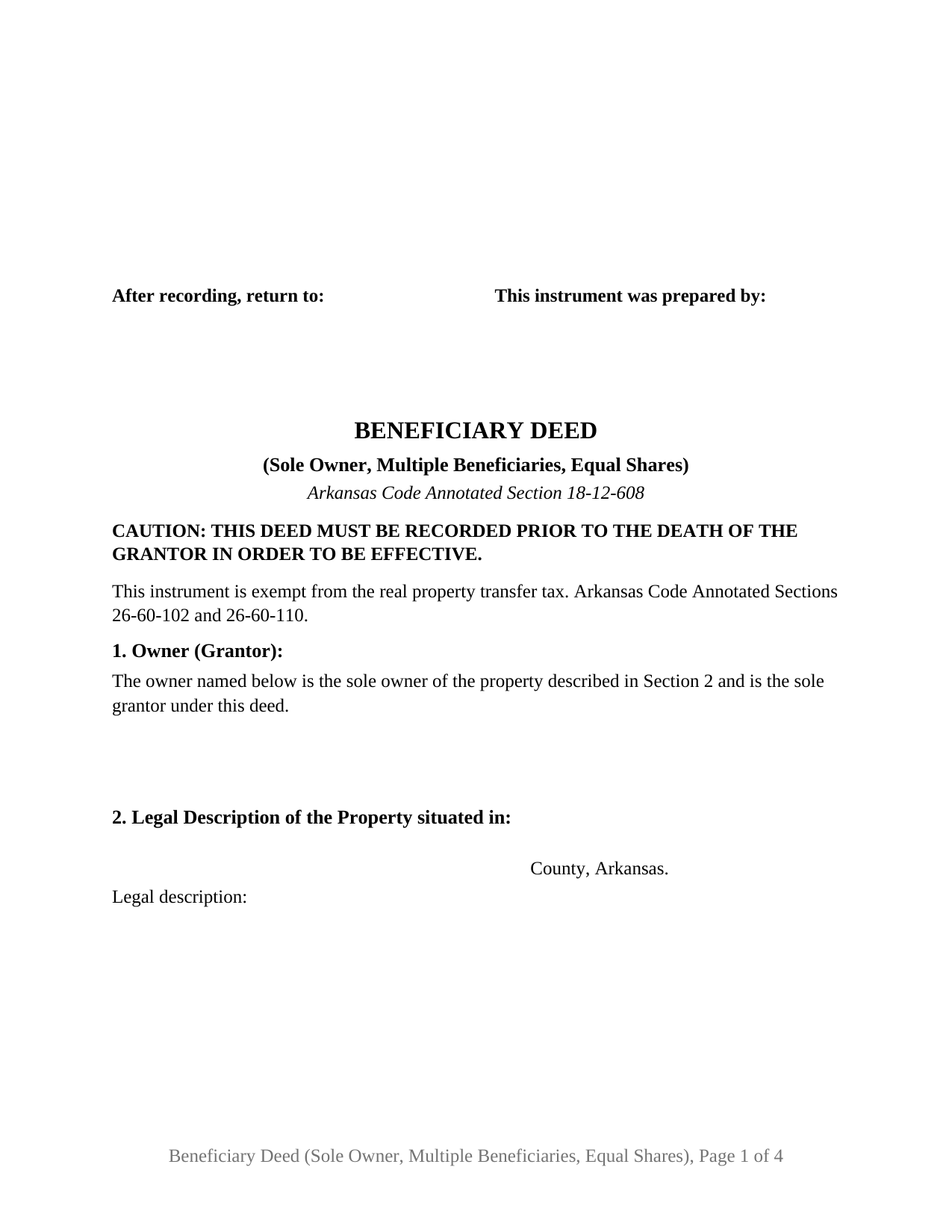
About the Arkansas Beneficiary Deed (Sole Owner, Multiple Beneficiaries (Equal Shares))
How to Use This Form
- Select your county from the list
- Download the county-specific form
- Fill in the required information
- Have the document notarized if required
- Record with your county recorder's office
What Others Like You Are Saying
"I was able to get all the Forms I required and it was straight forward and easy. Thank you , Walt R."
"good format, helpful instructions"
"Very Happy. Forms saved me from making some very silly mistakes had I done them on my own."
"Completed in 1 day and no problems filing a deed in another county. Price was less than the gas I wo…"
"excellent transaction...very informative prior to purchase.."
4.8/5 from 4,847 reviews. Read all
One Arkansas owner, several people waiting to inherit, and a wish to leave each of them the same share without a probate case: that is the pattern this Arkansas Beneficiary Deed recites. It is written for a sole owner of Arkansas real property who names two or more grantee beneficiaries to take the property at the owner's death in equal undivided shares as tenants in common, under Arkansas Code Annotated Section 18-12-608.
Equal shares, settled in advance
Arkansas lets a beneficiary deed name multiple grantees, and Section 18-12-608(a)(2)(B) leaves the tenancy among them to the deed: joint tenants with right of survivorship, tenants in common, tenants by the entirety, or any other tenancy valid in the state. A deed that names several people and says nothing more falls back on the general rule of Section 18-12-603, under which a grant to two or more persons without an express declaration of joint tenancy creates a tenancy in common. This deed does not leave that result to a default. Its Section 5 states, as fixed deed text, that the grantee beneficiaries named below are two or more in number and take in equal undivided shares as tenants in common. Three names in the box means three undivided one-third interests at the owner's death; four names means four one-quarter interests. Each beneficiary's share is that beneficiary's own, to keep, sell, or leave to that beneficiary's own heirs, and no beneficiary's share passes automatically to another beneficiary by survivorship.
What happens when a beneficiary dies first
Section 18-12-608(a)(3) permits an owner to name successor grantees and requires the deed to state the condition on which a successor's interest vests, offering the failure of the original grantee to survive the grantor as its example. The statute supplies no rule of its own for a named grantee who dies before the owner where the deed is silent. This deed supplies one in fixed text: the share of a grantee beneficiary who does not survive the owner passes to the grantee beneficiaries who do survive, in equal undivided shares, and where no named grantee beneficiary survives, the property passes to the successor grantee beneficiary or beneficiaries named in an optional Section 6. The condition on which a successor's interest vests, the failure of every named grantee beneficiary to survive the owner, is written into the deed as the statute directs. An owner who leaves Section 6 blank has a complete deed; the entry None designated records that the section was considered.
The sole owner configuration
The form recites exactly one owner, identified in Section 1 as the sole owner of the described property and the sole grantor under the deed, with one signature block, two witness blocks, and one acknowledgment certificate. A widowed parent who holds the family home alone and names the children, a single owner of inherited farmland naming nieces and nephews, and an owner of a rental house naming adult children in equal shares present the pattern this deed recites. The form is not set up as a deed for two record owners, for spouses holding as tenants by the entirety, for co-owners holding as joint tenants with right of survivorship, for a single grantee beneficiary, for unequal shares, for a trustee of a trust as grantee, or for an owner signing through an attorney-in-fact; each of those is a different recital and a different signature structure. Marital status is not recited. Arkansas retains dower and curtesy and a homestead joinder statute, Sections 28-11-301, 28-11-201, 18-12-402, and 18-12-403, and the guide describes how those provisions sit beside a deed that conveys nothing during the owner's life and carries no signature block for a non-owner spouse.
Why recording before death is everything
A beneficiary deed is valid only if it is recorded before the death of the owner in the office of the county recorder of the county where the land lies, under Section 18-12-608(c)(1). The statutory form prints that warning in capital letters, and this deed carries the sentence verbatim: CAUTION: THIS DEED MUST BE RECORDED PRIOR TO THE DEATH OF THE GRANTOR IN ORDER TO BE EFFECTIVE. Until that death the deed transfers nothing. Section 18-12-608(a)(1)(B) provides that no legal or equitable interest vests in a grantee before the owner dies, that the owner keeps every power of ownership, and that the eventual transfer is subject to the mortgages, leases, liens, and other encumbrances on the property at the owner's death. The deed stays revocable by an instrument of revocation or a later beneficiary deed, each executed and recorded before death, and it cannot be revoked or amended by the owner's will. An instrument of revocation is prepared and recorded separately and is not included in this package.
Built for the Arkansas recorder's counter
The first page opens with the return address block and the preparer statement Section 14-15-403 places on the face of the first page, in the statute's own words, This instrument was prepared by, followed by the title, the statutory caution, and the statement that the instrument is exempt from the real property transfer tax, the Section 26-60-110 statement that lets a recorder accept an exempt beneficiary deed without a transfer tax affidavit. The page geometry follows Section 14-15-402(b)(1): letter-size paper, a two and one-half inch space at the top of the first page for the recorder's file mark, half-inch minimum margins kept at a full inch on the sides, and two and one-half inches at the bottom of the last page. The acknowledgment certificate reproduces the individual form Section 16-47-107(b) prints, through the words appeared the within named and the IN TESTIMONY WHEREOF clause, so an Arkansas notary completes a certificate in the wording the code itself supplies. Since Act 752 of 2025 took effect on August 5, 2025, a deed presented in person or by mail is accompanied by the grantor's photo identification, a requirement the guide walks through with the counties' published practice.
What the package contains
This Arkansas beneficiary deed, searched for by many owners as a transfer on death deed or TOD deed, comes as a fillable PDF form with an unrecorded instructions cover page, a completed example filled in for a Pulaski County fact pattern with three named beneficiaries and a successor, and a guide that walks through every numbered section, the signing and witness steps, the Section 16-47-107 acknowledgment, the marital-rights statutes, and the recording process county by county. The form, example, and guide describe the instrument and the governing statutes in general terms and are not legal advice.
Important: County-Specific Forms
Our beneficiary deed (sole owner, multiple beneficiaries (equal shares)) forms are specifically formatted for each of the 75 counties in Arkansas.
After selecting your county, you'll receive forms that meet all local recording requirements, ensuring your documents will be accepted without delays or rejection fees.