Arkansas Beneficiary Deed (Sole Owner, Trust Beneficiary)
County Specific Legal Forms Validated as recently as November 9, 2026 by our Forms Development Team
About the Arkansas Beneficiary Deed (Sole Owner, Trust Beneficiary)
How to Use This Form
- Select your county from the list
- Download the county-specific form
- Fill in the required information
- Have the document notarized if required
- Record with your county recorder's office
What Others Like You Are Saying
"The deed itself was easy. I did notice that although the website says that the deed would exempt the…"
"Wonderful fast service, quick thoughtful responses on chat! Files download easily too, great pruces"
"Easy to navigate! Will use your services again!"
"The forms were easy to acquire and easy to use"
"Excellent find (Deeds.com) from a google search, first hit. This was exactly what we were looking fo…"
4.8/5 from 4,847 reviews. Read all
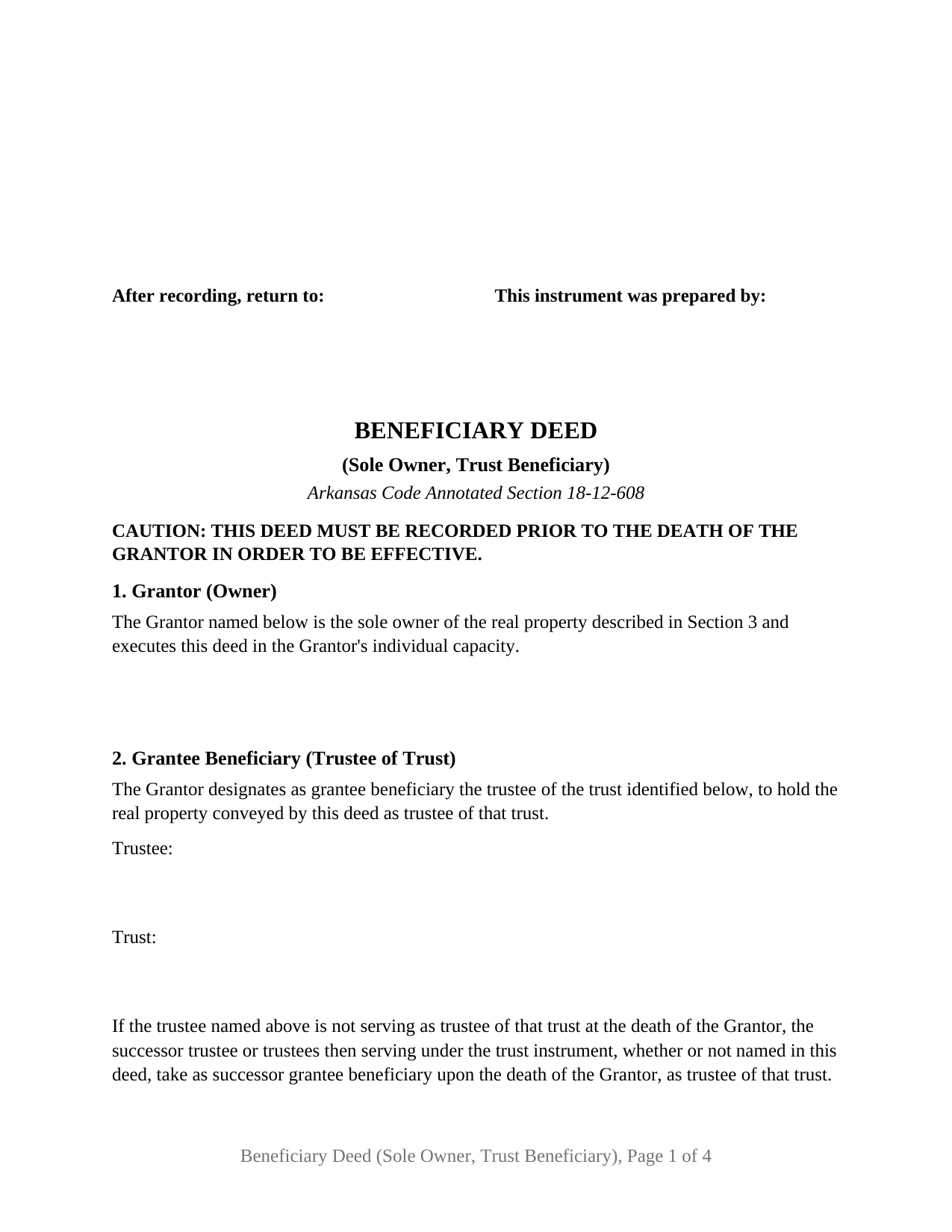
One Arkansas owner, one trust, and a deed that does its work only at death: this Arkansas beneficiary deed is configured for a sole owner who designates the trustee of a trust as the grantee beneficiary under Arkansas Code Annotated Section 18-12-608. The owner signs alone, the trustee takes at the owner's death as trustee of the named trust, and the successor trustee then serving under the trust instrument steps into the designation without a second deed.
A trustee as the one who takes at death
Arkansas wrote the trust case into its beneficiary deed statute. Section 18-12-608(c)(2) provides that a beneficiary deed may transfer an interest in real property to a trustee of a trust estate even if the trust is revocable, and may include one or more unnamed successor trustees as successor grantees. That sentence is the spine of this configuration. Section 2 of the deed identifies the trustee by name and mailing address, identifies the trust by name and by the date of its instrument, and designates the trustee as grantee beneficiary to hold the property as trustee of that trust. A fixed sentence then carries the successor trustee then serving under the trust instrument as successor grantee beneficiary, and states the condition on which that interest vests, as Section 18-12-608(a)(3)(B) requires: the named trustee is not serving at the owner's death.
Naming the trust, and not only the trustee, is deliberate. Under Section 18-12-604 the word trustee after a grantee's name, without other language showing a trust, vests title in the grantee and gives no notice that a trust exists. The deed's trust blank and its designation sentence are the other language that section calls for.
Nothing moves until the owner dies
A beneficiary deed, called a transfer on death deed or TOD deed in other states, conveys an ownership interest effective on the owner's death and expressly states that it is not to take effect until then. During life the owner keeps every right of ownership: the property can be sold, mortgaged, or leased, and the deed can be revoked by a recorded instrument, prepared and recorded separately and not included in this package. No legal or equitable interest vests in the trustee before the owner dies, and when the transfer does take effect it is subject to the mortgages, liens, leases, and other encumbrances then affecting the property. This deed carries the statutory form's caution, opening, and consideration clause word for word, and restates the form's operative sentence for a single grantor: for a non-monetary, intangible consideration, of value to the Grantor, I hereby convey to the grantee beneficiary named in Section 2 effective on my death the real property described in Section 3. The deed then states, in the words the statute's definition uses, that it is not to take effect until the death of the Grantor.
Recorded before death, or not a deed at all
Section 18-12-608(c)(1) makes recording before the owner's death, in the county where the property is located, a condition of validity, and the statutory caution printed at the top of the deed says so in capital letters. The deed is exempt from the Arkansas real property transfer tax under Section 26-60-102, and Section 5 prints the exemption statement Section 26-60-110 prescribes so the recorder reads the exemption from the face of the instrument. Since August 5, 2025, Act 752 of 2025 has asked a grantor presenting a deed in person or by mail to supply government-issued photo identification; the guide describes that step and its exceptions, along with the fifteen dollar first page recording fee and the page format rules of Section 14-15-402.
The sole owner, trust beneficiary configuration
The form recites exactly one record owner, described as the sole owner of the property and as signing in the owner's individual capacity, and exactly one grantee beneficiary, the trustee of the identified trust. It carries one grantor signature block, two subscribing witness blocks under Section 18-12-104, and one acknowledgment certificate in the individual form Section 16-47-107(b) prints. An owner who created a revocable living trust and serves as its trustee, with the home to pass into the trust at death and no lifetime deed into the trust, presents the pattern this configuration recites; the completed example shows exactly that, with the owner as trustee and the successor trustee taking under the trust instrument. The form is not set up as a deed by two owners holding by the entirety or with right of survivorship, for which Section 18-12-608(b) states its own rules, nor for a natural person or several beneficiaries taking in shares, nor for an owner signing through an attorney-in-fact. It fixes no marital status; the owner block carries the status recital that appears on Arkansas deeds, and the guide describes the dower, curtesy, and homestead statutes that bear on a married owner's land.
What arrives with the deed
The package includes the fillable Arkansas beneficiary deed, a completed example filled in for a realistic Pulaski County fact pattern, and the guide that walks through every numbered section, the witness and acknowledgment blocks, and the recording process. This description and the guide describe the form and the governing Arkansas statutes in general terms; they are not legal advice.
Important: County-Specific Forms
Our beneficiary deed (sole owner, trust beneficiary) forms are specifically formatted for each of the 75 counties in Arkansas.
After selecting your county, you'll receive forms that meet all local recording requirements, ensuring your documents will be accepted without delays or rejection fees.