Arkansas Beneficiary Deed (Sole Owner, One Individual Beneficiary)
County Specific Legal Forms Validated as recently as November 9, 2026 by our Forms Development Team
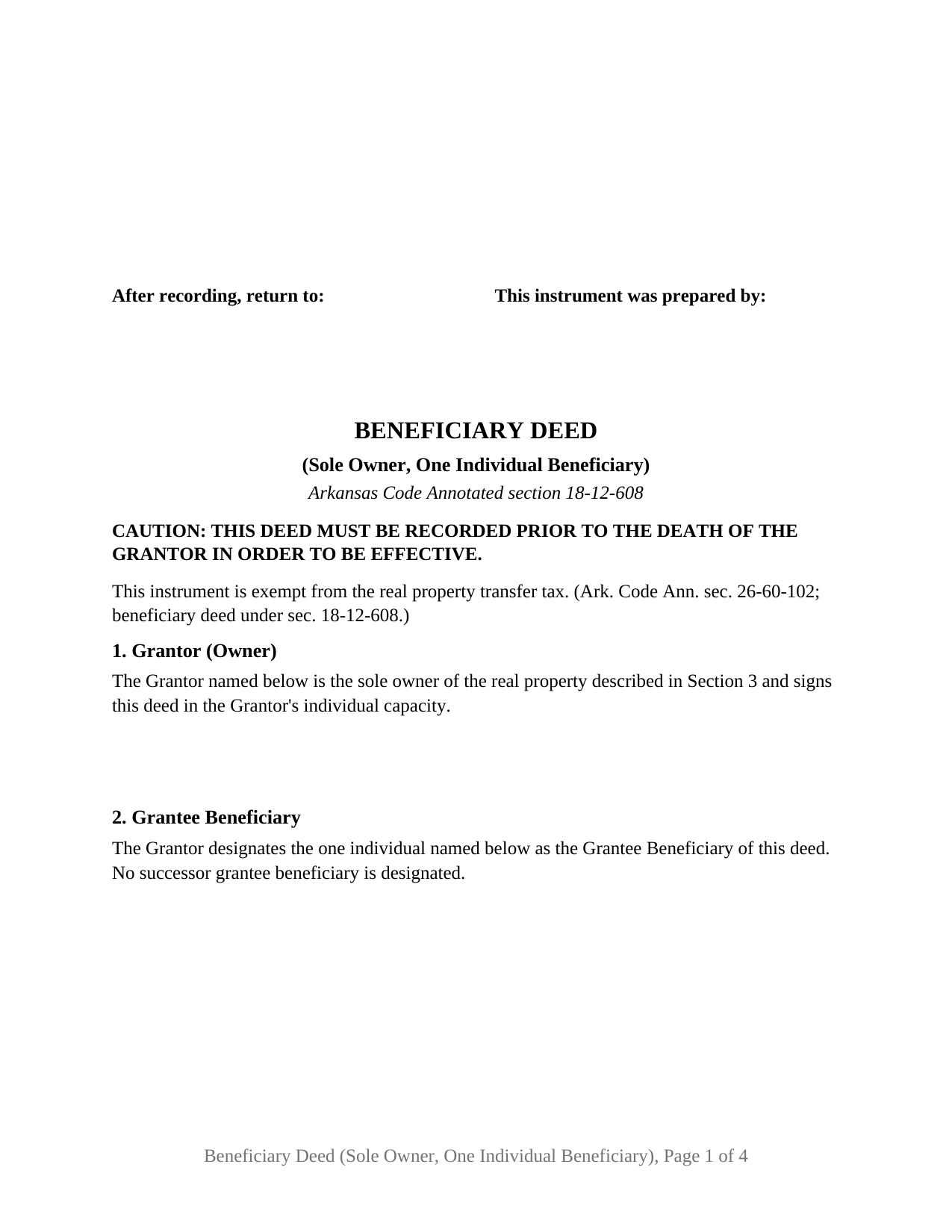
About the Arkansas Beneficiary Deed (Sole Owner, One Individual Beneficiary)
How to Use This Form
- Select your county from the list
- Download the county-specific form
- Fill in the required information
- Have the document notarized if required
- Record with your county recorder's office
What Others Like You Are Saying
"I LOVE that very concise directions and a sample completed deed were included. They were incredibly …"
"Quick, easy everything that i was looking for and then some."
"Service was top-notch....fast, accurate, cost-effective."
"Just as promised My quitclaim deed went through the county recorders office with no problem."
"This is the first time I use this site, and it was very easy and user friendly. I was able to fill o…"
4.8/5 from 4,847 reviews. Read all
One Arkansas property owner, one named individual, and a deed that waits until the owner's death: this Arkansas beneficiary deed is configured for a sole owner of record who designates a single individual as grantee beneficiary under Arkansas Code Annotated section 18-12-608. The owner signs alone, the named individual signs nothing, and the deed transfers the property at death without probate while leaving the owner's title untouched during life.
One name on each side of the deed
The form recites exactly one grantor, the sole owner of the described real property, signing in an individual capacity, and exactly one grantee beneficiary, an individual identified by full legal name and mailing address. Section 18-12-608 allows an owner to name several grantees, to give them a tenancy among themselves, to name successor grantees, or to name the trustee of a trust; this deed uses none of those options and says so on its face, stating that no successor grantee beneficiary is designated. That fixed recital is what makes the configuration a single-beneficiary instrument rather than a form left open to be filled several different ways. A parent passing a home to one child, an owner leaving a rental to a sibling, and an unmarried owner naming a partner present the one-owner, one-beneficiary pattern this deed recites.
What Arkansas means by a beneficiary deed
Arkansas uses the term beneficiary deed for the instrument other states call a transfer on death deed or TOD deed. The statute defines it as a deed without current tangible consideration that conveys an ownership interest in real property at the owner's death to a designated grantee, and that expressly states it is not to take effect until the owner's death. This form carries that express statement in its operative section, together with the statutory form's own words: for a non-monetary, intangible consideration, of value to the grantor, the grantor conveys to the grantee beneficiary, effective on the grantor's death, the described real property. During the owner's life nothing vests in the beneficiary. The owner remains free to sell, mortgage, or lease the property, and the beneficiary takes at death subject to every mortgage, lien, lease, and other matter then affecting the title.
A deed that is valid only if recorded before death
The single most consequential rule in section 18-12-608 is the recording condition: a beneficiary deed is valid only if it is recorded before the owner's death in the county where the property is located. The statutory form prints a caution in capital letters to that effect, and this deed prints the same caution directly beneath its title. The deed is revocable for the owner's whole life by a recorded instrument, and a will does not revoke or alter it; where more than one beneficiary deed is recorded for the same property, the one last signed before death controls. A signed and notarized deed left in a drawer transfers nothing.
Execution the Arkansas way
Arkansas execution runs more formal than many states. Section 18-12-104 describes the execution of a conveyance in the presence of two disinterested witnesses, and sections 18-12-201 and 18-12-206 make the grantor's acknowledgment, or proof by subscribing witnesses, the condition of recording. The deed therefore carries one signature block for the grantor, two witness blocks, and one acknowledgment certificate written in the words of the individual acknowledgment form in section 16-47-107(b), the form Arkansas law deems sufficient for recording. The venue lines of the certificate reflect wherever the owner actually appears before the officer, and the certificate's own wording admits an officer outside Arkansas who is qualified to take acknowledgments.
Built for the recorder's counter
The first page carries two items Arkansas recording law looks for. Section 14-15-403 places the preparer's name and address on the face of the first page, and the deed prints that statement in the statute's own form at the top right. Section 26-60-102 exempts a beneficiary deed from the Arkansas real property transfer tax, and the deed prints the exemption statement section 26-60-110 describes, so the recorder can see the exemption on the instrument itself rather than through a transfer tax affidavit. The page geometry follows section 14-15-402: letter size paper, the two and one half inch reserve at the top of the first page for the recorder's file mark, side and bottom margins above the half inch the statute sets as a minimum, and the two and one half inch reserve at the bottom of the last page. Since August 5, 2025, under Act 752 of 2025, a deed presented to the recorder in person or by mail is received only with the grantor's photo identification, shown in person or, for a mailed deed, included as a photocopy, with exceptions for deeds presented by attorneys, title agents, lenders, and real estate professionals; the guide describes that step and the county practices around it.
What the recitals do and do not settle
The deed recites that the grantor is the sole owner and fixes no marital status. Arkansas retains dower and curtesy under section 28-11-301 and voids an instrument affecting a married person's homestead that the spouse has not joined under section 18-12-403, rules written for lifetime conveyances; the guide describes how those sections read against a beneficiary deed, which vests nothing until death, and notes that this form carries no signature line for a spouse who is not an owner of record. The deed also conveys without covenant or warranty of title, and it uses the word convey rather than the phrase grant, bargain and sell, to which Arkansas attaches statutory title covenants.
The package contains the fillable beneficiary deed as a PDF, a completed example filled in for a realistic Pulaski County fact pattern, and a guide that walks through each numbered section, the witness and acknowledgment blocks, and recording. This description and the guide describe the form and the governing Arkansas statutes in general terms; they are not legal advice.
Important: County-Specific Forms
Our beneficiary deed (sole owner, one individual beneficiary) forms are specifically formatted for each of the 75 counties in Arkansas.
After selecting your county, you'll receive forms that meet all local recording requirements, ensuring your documents will be accepted without delays or rejection fees.