Arkansas Beneficiary Deed (Joint Owners with Right of Survivorship - Last Survivor)
County Specific Legal Forms Validated as recently as November 9, 2026 by our Forms Development Team
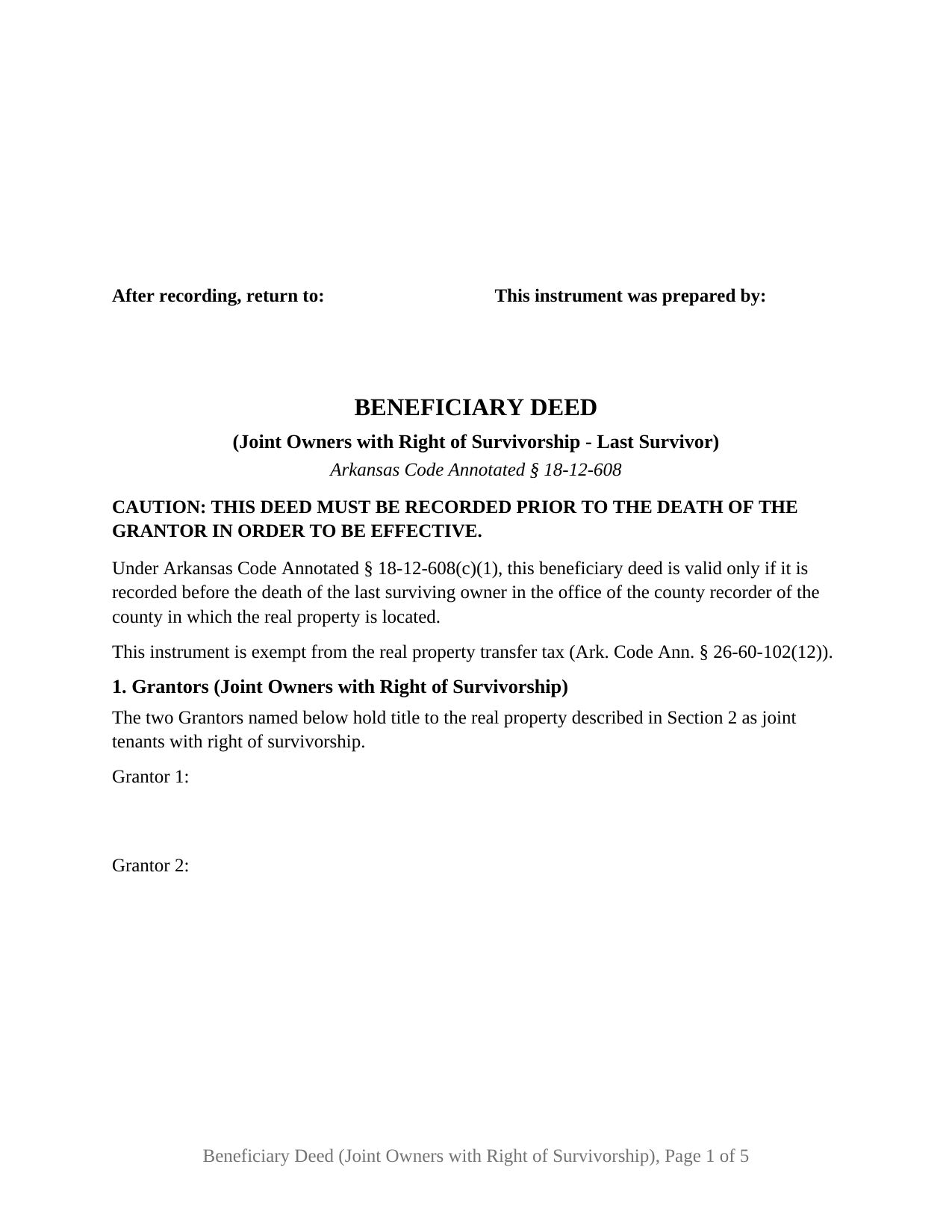
About the Arkansas Beneficiary Deed (Joint Owners with Right of Survivorship - Last Survivor)
How to Use This Form
- Select your county from the list
- Download the county-specific form
- Fill in the required information
- Have the document notarized if required
- Record with your county recorder's office
What Others Like You Are Saying
"I accidentally ordered the wrong deed package. Was looking for a quit claim deed and got a trustee d…"
"Excellent find (Deeds.com) from a google search, first hit. This was exactly what we were looking fo…"
"Very helpful and fast."
"EASY DOWNLOAD AND PRINT AND / OR SAVE TO YOU PC WHICH SHOULD BE DONE BEFORE FILLING OUT. AFTER I act…"
"Your customer service person was very professional and polite and helpful."
4.8/5 from 4,849 reviews. Read all
Two Arkansas co-owners who hold title as joint tenants with right of survivorship can name, in a single recorded deed, who receives the property after both of them have died. This Arkansas beneficiary deed is configured for exactly that pattern: two owners sign one instrument as Grantor 1 and Grantor 2, the deed recites their survivorship title, and it states, in the words Arkansas Code Annotated § 18-12-608(b)(1) uses, that the deed is not to take effect until the death of the last surviving owner.
A deed that waits for the second death
While either owner lives, the survivorship already in the title does the work. At the first death the property belongs to the surviving joint tenant, and the beneficiary deed transfers nothing at that point. The deed operates at the death of the last surviving owner, when the grantee beneficiary or beneficiaries named in it take the property without probate. Arkansas calls this instrument a beneficiary deed; it is the same device other states call a transfer on death deed or TOD deed, and it has been part of Arkansas law since 2005.
Nothing changes during the owners' lives. Under § 18-12-608(a)(1)(B), no legal or equitable interest vests in a grantee beneficiary until the owner's death, the owners keep every power to sell, mortgage, or lease, and the beneficiary takes subject to whatever liens and encumbrances exist at the last death. The deed remains revocable, and a will cannot revoke, alter, or amend it.
The statement Section 18-12-608(b)(1) asks for
Arkansas wrote a specific rule for property held with a right of survivorship. A beneficiary deed of such property transfers the interest at the last surviving owner's death when it is made by all of the then-surviving owners and expressly states that it is not to take effect until the death of the last surviving owner. The one-owner statutory form in § 18-12-608(g) says only that the conveyance is effective on the grantor's death; this deed carries that form's caution and consideration recital and adds the last-surviving-owner statement the co-owner rule describes, printed as fixed text rather than left to a blank. Section 18-12-608(b)(2) supplies the consequence of a missing signature: a deed signed by fewer than all owners is valid only if the last surviving owner is one who signed it. The form carries a signature block for each owner, and the guide describes that rule in full.
Two signatures, two certificates, two witnesses
Each Grantor signs under a separate heading, and the form carries a separate acknowledgment certificate for each, so the two owners may acknowledge on different dates, before different officers, or in different states; that is the form's design, and the certificates carry the individual acknowledgment wording of § 16-47-107(b). Arkansas execution runs formal: § 18-12-104 describes execution before two disinterested witnesses, and the deed carries two witness blocks with printed name lines. The preparer statement § 14-15-403 places on the face of the first page sits at the top of page one, where the statute puts it.
Recording before the last death
Recording is a validity condition, not a formality. Under § 18-12-608(c)(1) a beneficiary deed is valid only if it is recorded before the death of the owner or the last surviving owner in the county where the property is located, and the deed prints that condition on its first page beneath the statutory caution. A beneficiary deed is exempt from the Arkansas real property transfer tax under § 26-60-102(12), and the form carries the exemption statement § 26-60-110 supplies so the recorder reads the exemption from the face of the instrument. The page geometry follows § 14-15-402: two and one-half inches reserved at the top of the first page and at the bottom of the last, letter size paper, and twelve point type. Since August 5, 2025, a deed presented in person or by mail is accompanied by the grantor's photo identification under Act 752 of 2025, a step the guide walks through along with the county checklists that go beyond the statute.
The configuration this deed recites
The deed recites two record owners holding as joint tenants with right of survivorship, both signing in their own names as natural persons. Siblings who inherited a house under a deed with survivorship words, a parent and an adult child who took title as joint tenants, and unmarried partners whose vesting deed declares the joint tenancy under § 18-12-106 present the title this deed recites. Spouses whose deed conveys to them as husband and wife hold by the entirety at common law, a different title that this form does not recite, even though § 18-12-608(b)(1) treats the two estates alike. A sole owner, tenants in common, three or more owners, and owners signing as trustees, through an attorney-in-fact, or as an entity follow different patterns that this form is not set up as. The grantee beneficiary section accepts natural persons by name and address, a trust through its trustee under § 18-12-608(c)(2), and more than one beneficiary with any tenancy designation the chapter permits, and an optional successor section carries the statute's own vesting condition for a beneficiary who does not survive the last owner.
The package includes the fillable beneficiary deed as a PDF with an instructions cover page, a completed example filled in for a Pulaski County fact pattern with two joint tenants naming two beneficiaries and a successor, and the guide that walks through every numbered section, the witness and acknowledgment blocks, the marital and homestead rules, and the recording process county by county. This description and the guide describe the form and the governing Arkansas statutes in general terms; they are not legal advice.
Important: County-Specific Forms
Our beneficiary deed (joint owners with right of survivorship - last survivor) forms are specifically formatted for each of the 75 counties in Arkansas.
After selecting your county, you'll receive forms that meet all local recording requirements, ensuring your documents will be accepted without delays or rejection fees.