Arkansas Beneficiary Deed (Sole Owner, Primary and Successor Beneficiary)
County Specific Legal Forms Validated as recently as November 9, 2026 by our Forms Development Team
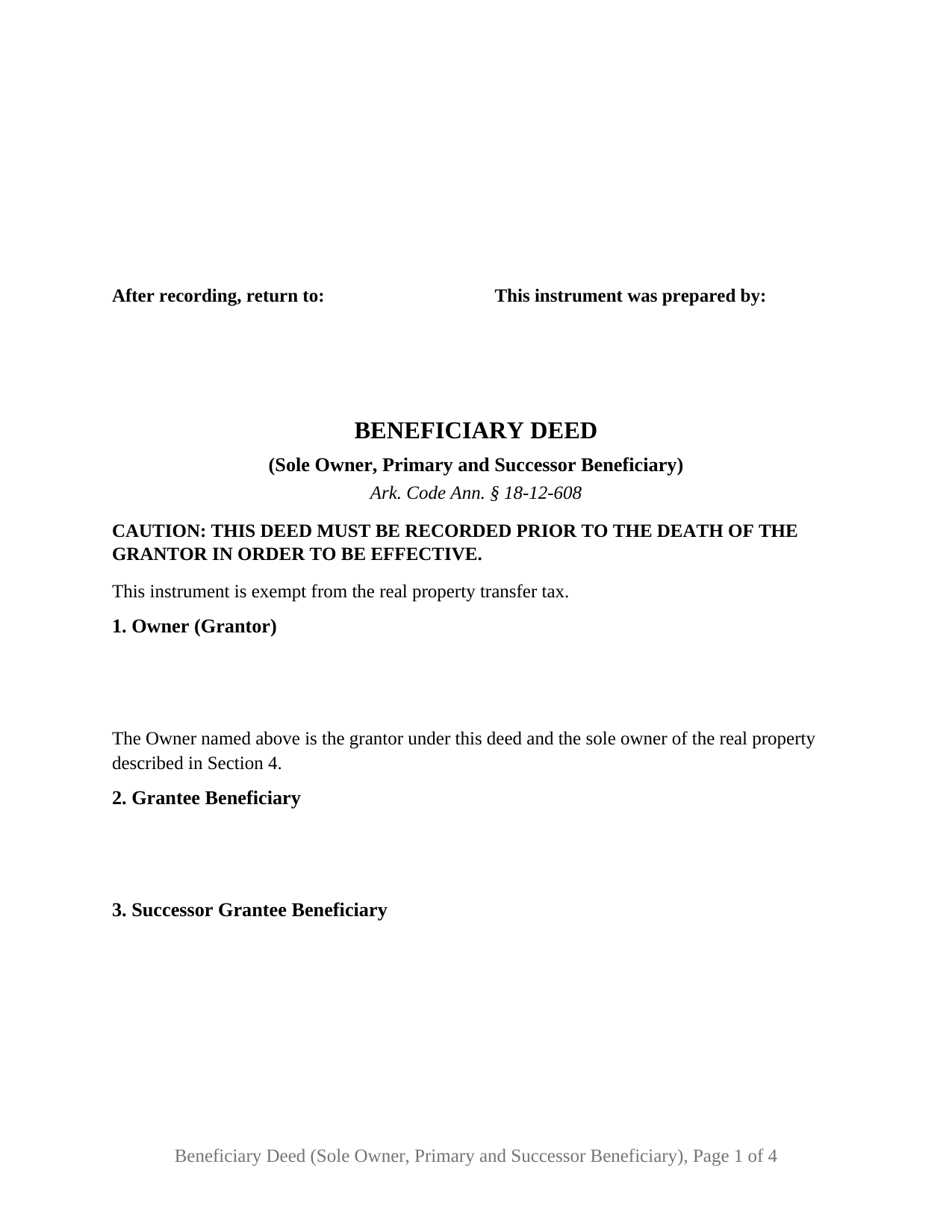
About the Arkansas Beneficiary Deed (Sole Owner, Primary and Successor Beneficiary)
How to Use This Form
- Select your county from the list
- Download the county-specific form
- Fill in the required information
- Have the document notarized if required
- Record with your county recorder's office
What Others Like You Are Saying
"The forms are incredibly easy to fill out. Thanks for the examples!"
"Very easy to find what I was looking for and the cost was reasonable. The documents saved me a lot o…"
"Legit. Reasonable prices."
"Example deed given did not apply to married couples as joint owners with both being grantors. The ex…"
"KVH provided excellent customer service (great communication was provided). I would differently use …"
4.8/5 from 4,847 reviews. Read all
An Arkansas beneficiary deed names who receives real estate when the owner dies, outside probate and without giving up anything during life. This version of the form is built for one owner who holds the property alone and who names two people in order: a Grantee Beneficiary who takes at the owner's death, and a Successor Grantee Beneficiary who takes instead if the first named person fails to survive the owner. The deed is prepared under Arkansas Code Annotated Section 18-12-608, the statute Arkansas enacted in 2005 and rewrote in 2007 for the instrument other states call a transfer on death deed or TOD deed.
A second name already in the deed
The statute leaves the question of a predeceased beneficiary to the deed itself. Section 18-12-608(a)(3) lets the owner designate one or more successor grantees and requires that the condition upon which the successor's interest vests, such as the failure of the original grantee to survive the grantor, be included in the deed. This form writes that condition into its conveyance language in the statute's own example: if the Grantee Beneficiary fails to survive the Owner, the property passes, effective on the Owner's death, to the Successor Grantee Beneficiary. The owner fills in two names, and the deed carries the rule that decides between them. Where a beneficiary deed names a single grantee and that grantee dies first, Section 18-12-608 supplies no fallback; this configuration puts the fallback in the recorded instrument.
Nothing moves until death, and the deed says so
Section 18-12-608(a)(1)(A) defines a beneficiary deed as one that expressly states that the deed is not to take effect until the death of the owner, and the form prints that sentence as fixed text in its conveyance section. Until then no legal or equitable interest vests in either named person, the owner keeps full ownership, and the owner may revoke the deed at any time by a revocation executed and recorded before death. At death the transfer takes effect subject to every mortgage, lien, lease, and other encumbrance the owner made or the property carried, whether created before or after the deed, and the form restates that rule so the recorded instrument reads the way the statute operates. A will does not revoke, alter, or amend a beneficiary deed that complies with the section.
Recorded before death, or not at all
Arkansas makes recording an effectiveness condition. Under Section 18-12-608(c)(1), the deed is valid only if it is recorded before the owner's death in the office of the county recorder of the county where the property is located, and the statutory form carries a caution in capital letters to that effect, which this deed prints near the top of its first page. The recording office in Arkansas counties is the circuit clerk, acting as ex officio recorder. Two more Arkansas rules shape the trip to the recorder. Since August 5, 2025, under Act 752, a deed presented in person is presented by the grantor, who shows a valid photo identification card or driver's license, and a deed presented by mail includes a photocopy of that identification, unless a listed exception applies, such as presentation by an attorney or a title insurance agent. And the real property transfer tax does not reach a beneficiary deed: Section 26-60-102(12) exempts it, and the form carries the exemption statement Section 26-60-110 prescribes, so the recorder sees the exemption on the face of the first page.
One owner, one signature, two witnesses, one certificate
The form recites exactly one owner of record, identified as the grantor and the sole owner of the described property, with the owner's name and mailing address in a free-form block that also carries whatever marital status recital the owner writes. One signature block follows the conveyance language, with two witness blocks for the disinterested witnesses Section 18-12-104 describes, and the deed closes with one acknowledgment certificate in the Arkansas statutory form of Section 16-47-107(b), the acknowledgment that Section 18-12-201 makes the condition of recording and that Section 18-12-202 deems valid and sufficient in that form. A widow or widower who holds the family home alone, a parent who took title in one name, and a single owner of a rental house or a lot present the one-owner pattern this deed recites. Property held by spouses as tenants by the entirety or by co-owners as joint tenants falls under a different subsection of the statute and a different pattern, with a deed signed by all of the surviving owners and a trigger set at the last death; a trust or entity grantee and a deed signed by an attorney-in-fact are likewise outside what this form is set up as.
The package includes the fillable beneficiary deed form, a completed example filled in for a Pulaski County fact pattern, and the guide that walks through every numbered section, the witness and acknowledgment requirements, the dower, curtesy, and homestead statutes a married owner meets, and the recording process. This description and the guide describe the form and the governing Arkansas statutes in general terms; they are not legal advice.
Important: County-Specific Forms
Our beneficiary deed (sole owner, primary and successor beneficiary) forms are specifically formatted for each of the 75 counties in Arkansas.
After selecting your county, you'll receive forms that meet all local recording requirements, ensuring your documents will be accepted without delays or rejection fees.