Arkansas Beneficiary Deed (Sole Owner, Multiple Beneficiaries with Right of Survivorship)
County Specific Legal Forms Validated as recently as November 9, 2026 by our Forms Development Team
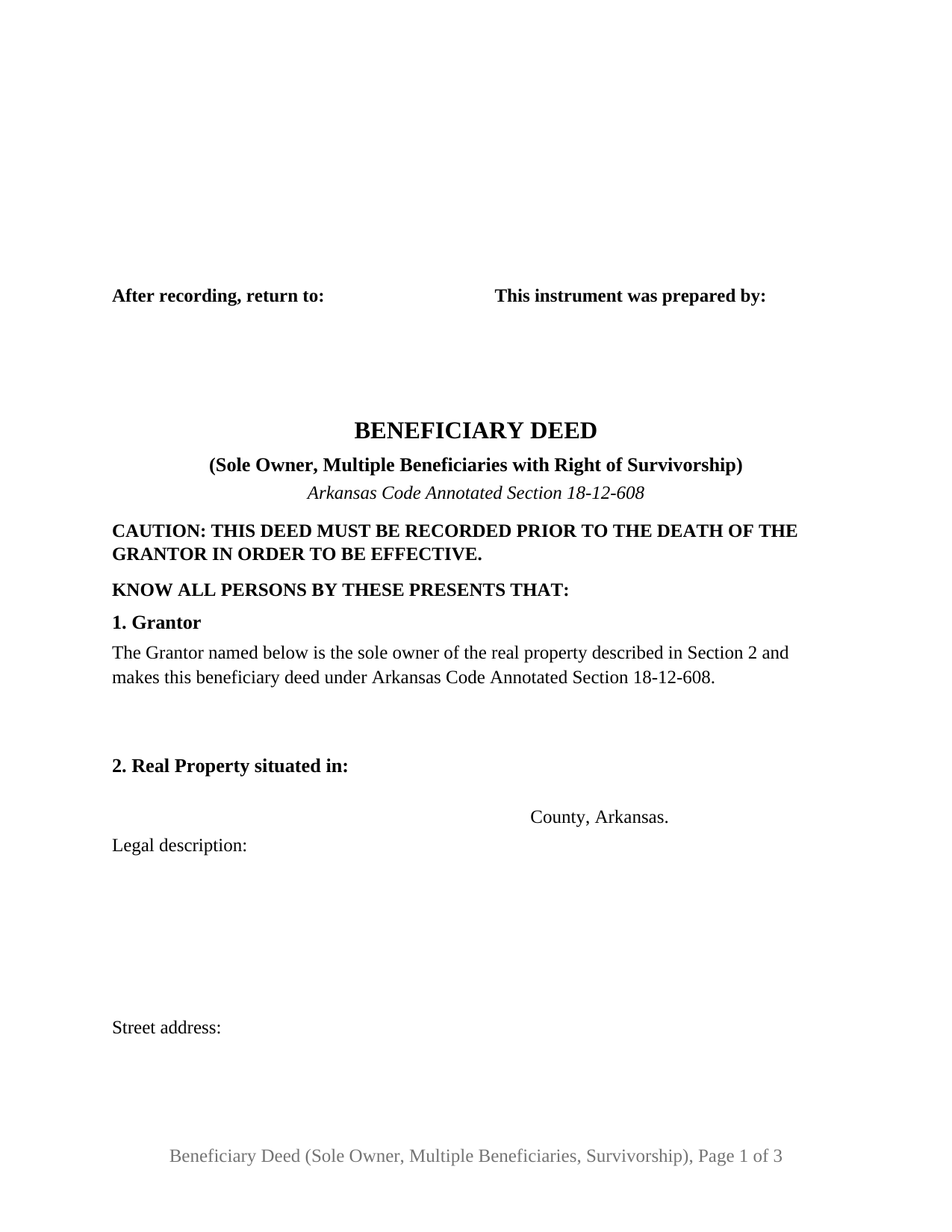
About the Arkansas Beneficiary Deed (Sole Owner, Multiple Beneficiaries with Right of Survivorship)
How to Use This Form
- Select your county from the list
- Download the county-specific form
- Fill in the required information
- Have the document notarized if required
- Record with your county recorder's office
What Others Like You Are Saying
"Deeds.com is helpful to help me finish my forms and submit my forms to the County successfully. Very…"
"A bit pricey for someone on a fixed income."
"easy to use"
"Did not need power to "serve" contractor. All work done well, paid for, nothing more. Wort…"
"Easy to download, great guidelines, and samples of each form needed."
4.8/5 from 4,847 reviews. Read all
This Arkansas beneficiary deed is configured for one record owner who names two or more grantee beneficiaries to take the property at the owner's death as joint tenants with the right of survivorship. The owner, called the Grantor on the form, signs alone, keeps full ownership for life, and leaves a recorded instrument under Arkansas Code Annotated Section 18-12-608 that carries the property to the named group outside probate, with survivorship running among them afterward.
One owner, one signature, a group of beneficiaries
The deed recites that the Grantor is the sole owner of the described real property. Section 1 takes the Grantor's name and mailing address under that recital, Section 2 the county, legal description, and street address, and Section 3 the recorded vesting instrument. Section 4 names the grantee beneficiaries, two or more, and states as fixed deed text that they take as joint tenants with the right of survivorship and not as tenants in common. Section 5 performs the conveyance, for a non-monetary, intangible consideration of value to the Grantor, effective on the death of the Grantor, and states in the words the statute requires that the deed is not to take effect until that death. One signature block headed GRANTOR and one acknowledgment certificate complete the instrument.
Survivorship that begins at the owner's death
Arkansas lets a beneficiary deed name multiple grantees and lets them hold as joint tenants with right of survivorship, tenants in common, or any other tenancy valid in the state. Section 18-12-106 permits a conveyance to two or more persons, regardless of marital relationship, as joint tenants with right of survivorship, and Section 18-12-603 makes a grant to two or more persons a tenancy in common unless the deed expressly declares otherwise. This deed makes the declaration. At the Grantor's death the surviving grantee beneficiaries take the property together, and from then on the interest of each passes at that person's death to the surviving joint tenants rather than through that person's estate. The pattern appears in the record where a parent leaves a home to several adult children who intend the last of them to hold it, and where an owner leaves land to siblings or to a couple who are not married to each other.
Section 18-12-608(a)(3) lets an owner designate successor grantees and requires the deed to state the condition on which a successor takes. The deed carries that condition as fixed text: where a named grantee beneficiary does not survive the Grantor, the deed conveys the property to the grantee beneficiaries who do survive, or to the sole survivor. The deed names no successor outside the named group and leaves open the case in which none of them survives; the guide describes that limit plainly.
What the statute requires of every Arkansas beneficiary deed
A beneficiary deed is a deed without current tangible consideration that conveys at the owner's death and expressly states that it does not take effect until then. No legal or equitable interest vests in a grantee before that death, the owner may revoke at any time by an executed and recorded revocation, and the owner's will cannot revoke, alter, or amend the deed. The grantee beneficiaries take subject to every mortgage, lien, lease, and other encumbrance on the property at the owner's death. Most important, the deed is valid only if it is recorded before the owner's death in the county where the property is located; the capitalized caution under the title, taken from the statutory form, says so on the face of the instrument.
Built for the Arkansas recorder
The form follows the statutory form of Section 18-12-608(g) in its caption, its caution, and its opening words, and restates the form's conveyance sentence in the third person around the named beneficiaries and their tenancy. The first page carries the preparer statement Section 14-15-403 places on the face of page one, and the layout leaves the 2.5 inch reserve at the top of the first page and the bottom of the last page that Section 14-15-402 sets aside for the recorder, on 8.5 by 11 inch pages with 12 point type. Because Section 26-60-102(12) exempts a beneficiary deed from the real property transfer tax, the deed prints the exemption statement of Section 26-60-110(b)(3)(B) with its citation, so the recorder can read the exemption from the instrument itself. The acknowledgment certificate follows the individual form of Section 16-47-107(b), and since August 5, 2025 a deed presented to an Arkansas recorder in person or by mail is accompanied by the grantor's government photo identification under Act 752 of 2025, a step the guide walks through along with the exceptions the act lists.
The configuration this deed is set up as
The deed is set up as a single Grantor's instrument: one owner recital, one signature block, one acknowledgment certificate, and a beneficiary section that names a group and fixes survivorship among them. It does not recite the Grantor's marital status and carries no joinder block for a spouse; the guide describes Arkansas dower, curtesy, and homestead law beside the chapter's rule that no interest vests before the owner's death. The deed is not set up as a deed by two or more owners, which the statute treats differently for property held by the entirety or in joint tenancy, nor as a deed to a single beneficiary, to beneficiaries as tenants in common, or to a trustee. A title standing in one name, left to several people with the survivor among them taking the whole, is the pattern this deed recites.
The package includes the fillable beneficiary deed with its non-recorded instructions page, a completed example filled in for a Pulaski County fact pattern, and a guide that walks through every section, the acknowledgment, and the recording process. The description and the guide describe the form and the governing Arkansas statutes in general terms and are not legal advice.
Important: County-Specific Forms
Our beneficiary deed (sole owner, multiple beneficiaries with right of survivorship) forms are specifically formatted for each of the 75 counties in Arkansas.
After selecting your county, you'll receive forms that meet all local recording requirements, ensuring your documents will be accepted without delays or rejection fees.