Arkansas Beneficiary Deed (Married Owners, Tenancy by the Entirety, Last Survivor)
County Specific Legal Forms Validated as recently as November 9, 2026 by our Forms Development Team
About the Arkansas Beneficiary Deed (Married Owners, Tenancy by the Entirety, Last Survivor)
How to Use This Form
- Select your county from the list
- Download the county-specific form
- Fill in the required information
- Have the document notarized if required
- Record with your county recorder's office
What Others Like You Are Saying
"The website worked fast but the information was limited and the actual deed of trust was what i was …"
"I was only able to download the QC form. Had to print the other docs"
"I found the site very easy to use and upfront about the cost. I had tried two other sites both of wh…"
"nice to get everything I need for the county that the property is located."
"There's nothing to say except it couldn't be easier."
4.8/5 from 4,848 reviews. Read all
Two Arkansas spouses who hold their home as tenants by the entirety can name, in one recorded beneficiary deed, who receives the property after both of them have died. This Arkansas Beneficiary Deed is configured for exactly that pattern: two married owners of record, both signing, with the deed stating in the words of Arkansas Code Annotated Section 18-12-608(b)(1) that it is not to take effect until the death of the last surviving owner.
A deed that waits for the second death
A tenancy by the entirety already carries its own answer to the first death. Under Arkansas common law a conveyance to husband and wife creates an estate in which each spouse holds the whole and the survivor takes everything, so when the first spouse dies the property belongs to the survivor without any deed at all. A beneficiary deed, sometimes searched for as a transfer on death deed or TOD deed, answers the question the entirety estate leaves open: who takes the property when the survivor dies. Section 18-12-608(b)(1) provides that a beneficiary deed of entirety property designated by all of the then-surviving owners, and expressly stating that it is not to take effect until the death of the last surviving owner, transfers the property effective upon that last death. This form prints that statement as fixed deed text in its conveyance section, so the timing is written into the instrument rather than left to be inferred.
During the spouses' lives the deed changes nothing. Section 18-12-608(a)(1)(B) provides that no legal or equitable interest vests in the grantee until the owner's death, and that the grantee takes subject to every mortgage, lien, lease, and other encumbrance on the property at that time. The spouses keep full control, can sell or mortgage the property together, and can revoke the deed under subsection (d) by recording a revocation before death.
Both spouses sign, and why that matters
Section 18-12-608(b)(2) draws a sharp line for survivorship property. A beneficiary deed signed by fewer than all of the owners is valid only if the last surviving owner turns out to be a person who signed it, and invalid if the last survivor did not sign. A deed both spouses execute does not depend on which spouse dies last. This form therefore carries two owner signature blocks, headed FIRST OWNER and SECOND OWNER, and a fixed recital in Section 1 that the owners are married to each other and hold title as tenants by the entirety. Because both spouses are the owners and both sign, the homestead joinder rule of Section 18-12-403 and the spousal consent rule of Section 28-11-301(b) are answered by the two signatures the form already contains; no third signature line appears.
Arkansas Code Annotated Section 18-12-104 provides that a deed is executed in the presence of two disinterested witnesses or acknowledged by the grantor in their presence, with the witnesses subscribing the deed, and the form carries a WITNESS 1 and a WITNESS 2 block under the owner signatures. Below the notary line sit two acknowledgment certificates, one for each spouse, each in the wording of the individual acknowledgment form of Section 16-47-107(b), so the spouses can acknowledge on different dates or before different officers. The separate certificates are the form's design, not a requirement of Arkansas law, which also permits one certificate to name more than one person.
Grantee beneficiaries, tenancy, and a successor
Section 5 names the grantee beneficiary or beneficiaries by full name and mailing address. The statute permits multiple grantees and lets them take as joint tenants with right of survivorship, as tenants in common, as tenants by the entirety, or in any other tenancy valid in Arkansas, and the completed example shows two children taking as tenants in common in equal shares. A trustee of a trust, even a revocable one, may be the grantee under subsection (c)(2). Section 6 is an optional successor grantee beneficiary. Section 18-12-608(a)(3) requires a deed naming a successor to state the condition on which the successor's interest vests, and this form fixes that condition in its own printed sentence: the successor takes only if a grantee beneficiary fails to survive the last surviving owner, and only that grantee's share. Nothing is left for the signer to draft.
What the first page carries for the Arkansas recorder
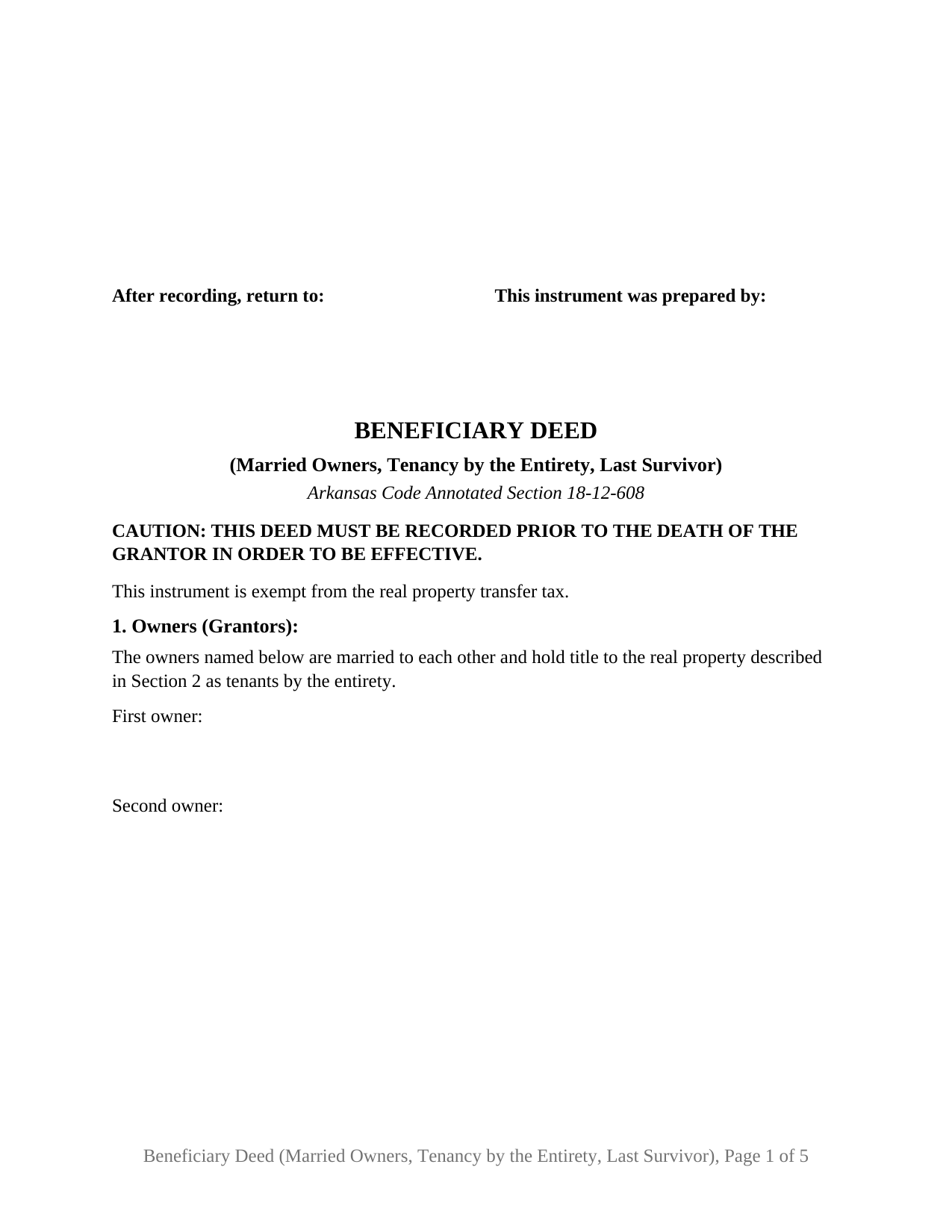
The form opens with the two blocks Arkansas recorders look for before the title: a return address and the preparer statement that Arkansas Code Annotated Section 14-15-403 requires on the face of the first page. Beneath the title sit the uppercase caution the statutory form prints, CAUTION: THIS DEED MUST BE RECORDED PRIOR TO THE DEATH OF THE GRANTOR IN ORDER TO BE EFFECTIVE, and the transfer tax exemption statement of Section 26-60-110(b)(3)(B), since Section 26-60-102 exempts beneficiary deeds from the real property transfer tax. The caution is not decoration: under Section 18-12-608(c)(1) the deed is valid only if recorded before the death of the last surviving owner in the county where the property lies, so recording while both spouses are living is what gives the deed its effect. Since August 5, 2025, a grantor presenting a deed in person or by mail also supplies the photo identification Act 752 of 2025 added to Section 14-15-403, a rule the guide describes together with its exceptions.
The page geometry follows Section 14-15-402(b)(1): letter size paper, two and one half inches reserved at the top of the first page for the file mark, half inch minimum margins, and two and one half inches left open at the bottom of the last page. The form keeps full one inch side margins and twelve point body text, above anything the statute asks for.
The configuration this deed recites
The deed recites exactly two record owners, married to each other and holding as tenants by the entirety, and conveys at the death of the last surviving owner. Spouses who took title together by a deed naming them as husband and wife, as spouses, or as tenants by the entirety present the pattern this deed recites. The form is not set up as a sole owner's deed, as a deed for unmarried co-owners holding as joint tenants with right of survivorship, as a deed for spouses who hold as tenants in common, or as a deed for a trustee, an attorney-in-fact, or an entity; each of those is a different configuration, and the recital in Section 1 would misdescribe it. A divorce after recording dissolves the entirety estate under Section 9-12-317 unless the decree provides otherwise, a change the guide describes.
The package includes the fillable beneficiary deed form, a completed example filled in for a Pulaski County, Arkansas fact pattern, and the guide that walks through every numbered section, the signing formalities, and recording. This description and the guide describe the form and the governing Arkansas statutes in general terms; they are not legal advice.
Important: County-Specific Forms
Our beneficiary deed (married owners, tenancy by the entirety, last survivor) forms are specifically formatted for each of the 75 counties in Arkansas.
After selecting your county, you'll receive forms that meet all local recording requirements, ensuring your documents will be accepted without delays or rejection fees.