Arkansas Beneficiary Deed (Tenant in Common, Undivided Ownership Interest)
County Specific Legal Forms Validated as recently as November 9, 2026 by our Forms Development Team
About the Arkansas Beneficiary Deed (Tenant in Common, Undivided Ownership Interest)
How to Use This Form
- Select your county from the list
- Download the county-specific form
- Fill in the required information
- Have the document notarized if required
- Record with your county recorder's office
What Others Like You Are Saying
"nice to get everything I need for the county that the property is located."
"Absolutely great. The staff is responsive and knowledgeable. The online interface is excellent. The …"
"Completed in 1 day and no problems filing a deed in another county. Price was less than the gas I wo…"
"I ordered the document I needed and it was available for download within a half hour. Very pleased, …"
"easy to download and print. came with instructions also. very helpful."
4.8/5 from 4,848 reviews. Read all
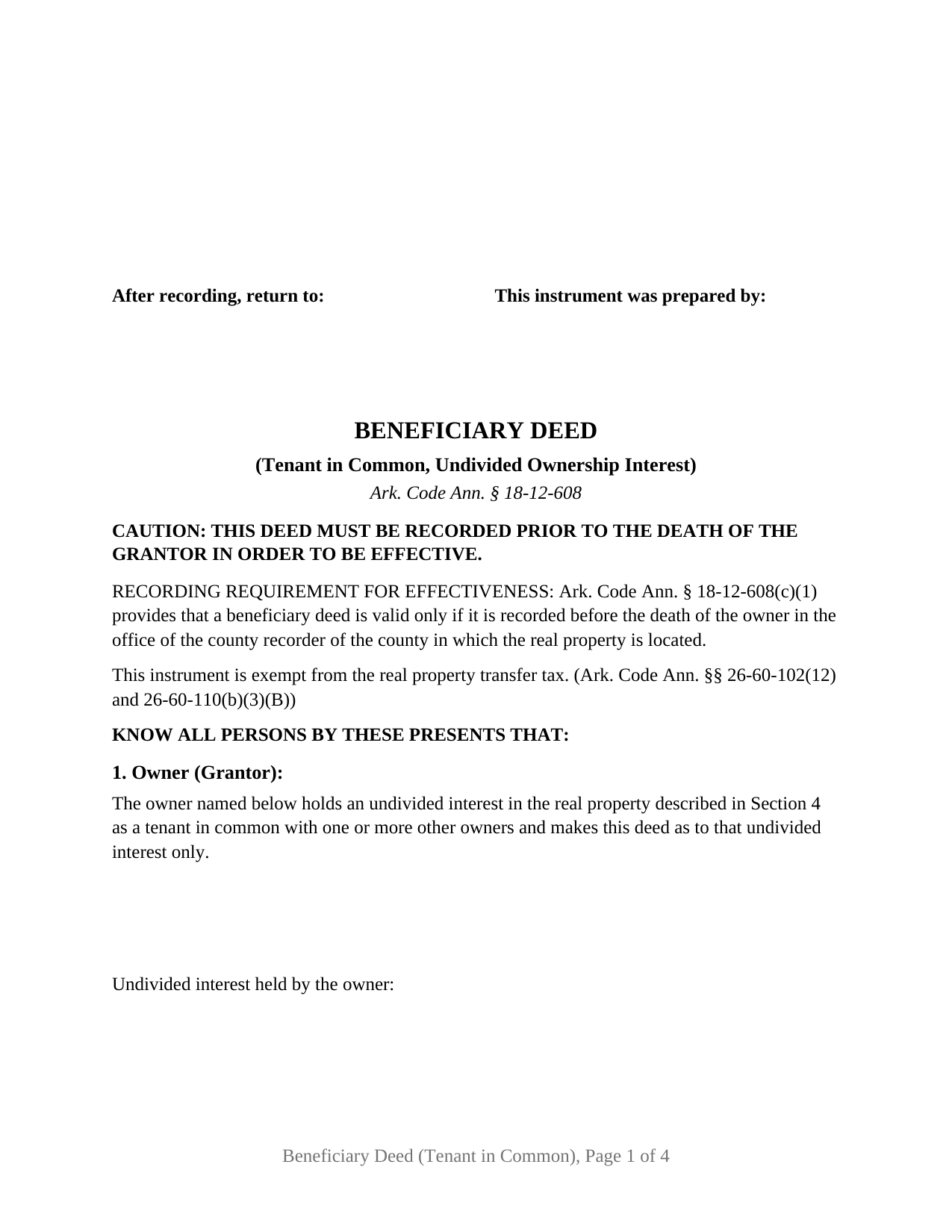
An Arkansas co-owner who holds an undivided interest as a tenant in common can direct where that share goes at death without putting it through probate and without touching the other co-owners' interests. This Arkansas beneficiary deed is drafted for exactly that owner: one tenant in common, conveying all of the undivided interest that owner holds, effective on the death of the owner, under Ark. Code Ann. § 18-12-608. Arkansas uses the name beneficiary deed for the instrument other states call a transfer on death deed or TOD deed.
One undivided share, one deed
A tenancy in common is the form of co-ownership Arkansas supplies by default. Under Ark. Code Ann. § 18-12-603, every interest in real estate granted to two or more persons is a tenancy in common unless the grant expressly declares a joint tenancy, and a tenant in common's share carries no right of survivorship. When one tenant in common dies, that undivided interest does not pass to the other co-owners; it passes through the deceased owner's estate, by will or by intestacy, unless a nontestamentary instrument sends it elsewhere. A beneficiary deed is that instrument. Recorded before the owner's death, it conveys the owner's undivided interest to the named grantee beneficiary at the moment of death, while the co-owners keep exactly what they held before.
The deed in this package recites the arrangement in fixed text: the owner named in Section 1 holds an undivided interest in the described property as a tenant in common with one or more other owners and makes the deed as to that undivided interest only. A short blank records the fraction the vesting deed states, in the style of the completed example, an undivided one-half (1/2) interest, and the conveyance clause reaches all of the undivided interest the owner holds as a tenant in common, whatever fraction is recited. No other co-owner signs, consents, or appears anywhere on the instrument.
Effective on the death of the owner, not the last owner
Section 18-12-608 draws a line that matters for co-owners. For property held as a tenancy by the entirety or as a joint tenancy with right of survivorship, subsection (b) makes a beneficiary deed wait for the death of the last surviving owner and requires all then-surviving owners to execute it. A tenancy in common sits outside that rule. Each tenant in common owns a separately descendible share, so a beneficiary deed of that share takes effect on the death of the owner who signed it, which is the express statement this deed carries and the statement subsection (a)(1)(A) requires of every Arkansas beneficiary deed. The form carries no last-surviving-owner language, because the interest it conveys has no survivor to wait for.
Until that death, the deed changes nothing. Under § 18-12-608(a)(1)(B) no legal or equitable interest vests in the grantee beneficiary before the owner dies, the owner remains free to sell, mortgage, lease, or partition the undivided interest, and the grantee beneficiary takes at death subject to every conveyance and encumbrance then affecting it. The deed is revocable at any time by a recorded instrument of revocation or a later recorded beneficiary deed, and a will cannot revoke, alter, or amend it (§ 18-12-608(d)(4)); where more than one beneficiary deed exists for the same property, the recorded deed last signed before death controls (§ 18-12-608(e)). The revocation is a separate instrument, recorded separately, and is not included in this package.
Grantee beneficiaries, successors, and trusts
The chapter lets the owner name one grantee beneficiary or several. Where several are named, § 18-12-608(a)(2) lets them take as joint tenants with right of survivorship, as tenants in common, or in any other tenancy valid in Arkansas, and the designation follows their names in the grantee block, as the completed example shows with two grantee beneficiaries taking as tenants in common in equal shares. A revocable trust can be the grantee through its trustee under § 18-12-608(c)(2). The deed also carries an optional successor grantee beneficiary section built on the statute's own condition: if no grantee beneficiary named in the deed survives the owner, the interest vests instead in the successor named there. Section 18-12-608(a)(3) requires that condition to appear in the deed itself, and the form prints it as fixed text so that a successor designation is never left to guesswork.
Recording before death at the Arkansas counter
Recording is not a formality for this instrument. Under § 18-12-608(c)(1) a beneficiary deed is valid only if recorded before the death of the owner in the office of the county recorder of the county where the property is located, and the deed opens with the capitalized caution the statutory form prints to say so. Because § 26-60-102(12) exempts a beneficiary deed from the Arkansas real property transfer tax, the deed carries the statutory exemption statement in place of documentary stamps; the guide carries the rest of the recording treatment, from the county's format standards to the identification step Act 752 of 2025 added.
The configuration this form carries
The form recites exactly one owner, signing in that owner's own capacity, and carries one signature block and one acknowledgment certificate in the individual form of Ark. Code Ann. § 16-47-107(b). It fixes the co-ownership as a tenancy in common and the trigger as the death of the owner. Siblings who inherited a parcel in equal shares, unrelated co-owners whose deed declared no joint tenancy, a parent and an adult child holding fractional interests, and a former spouse holding an undivided interest after a divorce dissolved a tenancy by the entirety present the tenant in common pattern this deed recites. The form is not set up as a deed of two owners signing together, a deed of joint tenants or tenants by the entirety that waits for the last death, or a deed signed by a trustee, an attorney in fact, or an entity. It recites nothing about the owner's marital status and carries no spousal joinder; the guide describes the Arkansas homestead, dower, and curtesy statutes that bear on a married owner's deed so the reader can see where that question sits.
The package includes the fillable beneficiary deed, a completed example filled in for a realistic Pulaski County fact pattern, and the guide that walks through each numbered section, the signing and acknowledgment, and the recording process. This description and the guide describe the form and the governing Arkansas statutes in general terms; they are not legal advice.
Important: County-Specific Forms
Our beneficiary deed (tenant in common, undivided ownership interest) forms are specifically formatted for each of the 75 counties in Arkansas.
After selecting your county, you'll receive forms that meet all local recording requirements, ensuring your documents will be accepted without delays or rejection fees.