Arkansas Beneficiary Deed (Sole Owner, Married Beneficiaries as Tenants by the Entirety)
County Specific Legal Forms Validated as recently as November 9, 2026 by our Forms Development Team
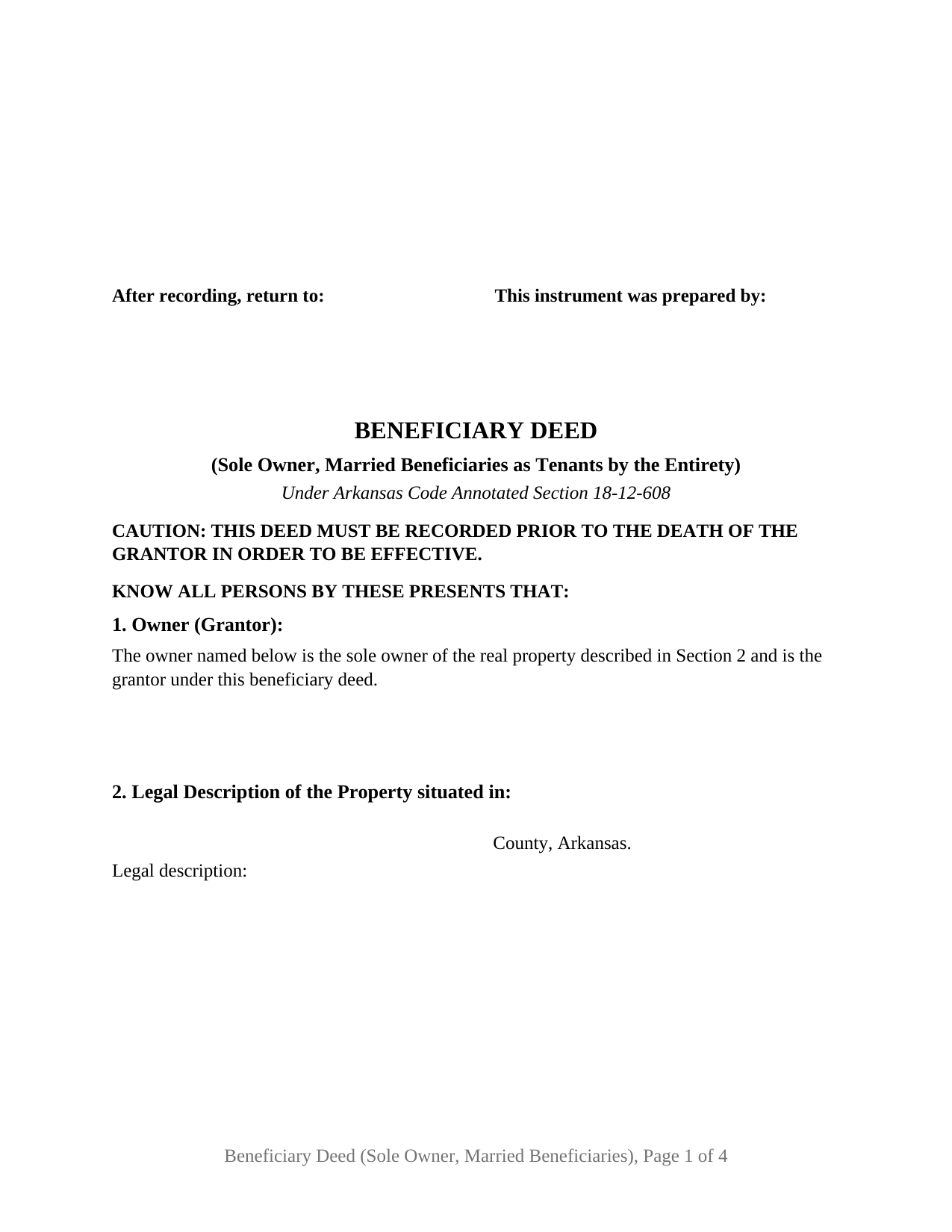
About the Arkansas Beneficiary Deed (Sole Owner, Married Beneficiaries as Tenants by the Entirety)
How to Use This Form
- Select your county from the list
- Download the county-specific form
- Fill in the required information
- Have the document notarized if required
- Record with your county recorder's office
What Others Like You Are Saying
"SIMPLE EASY TO UNDERSTAND PROCESS"
"Was helpful"
"All went well."
"Easy to use."
"Great real estate deed forms."
4.8/5 from 4,850 reviews. Read all
One Arkansas owner, two grantee beneficiaries who are married to each other, and a single estate that passes to them at the owner's death with survivorship already built in: that is the configuration this Arkansas beneficiary deed recites. The deed is prepared under Arkansas Code Annotated Section 18-12-608 for a sole owner of record, and it names the two grantee beneficiaries as tenants by the entirety, the form of co-ownership Arkansas reserves for spouses.
A deed that waits for the owner's death and then vests one estate in two spouses
A beneficiary deed, also searched for as an Arkansas transfer on death deed or TOD deed, conveys nothing while the owner lives. Section 18-12-608 defines it as a deed without current tangible consideration that conveys an ownership interest upon the death of the owner and that expressly states it is not to take effect until that death; under subsection (a)(1)(B) no legal or equitable interest vests in a grantee beneficiary until the owner dies, and the owner may revoke the deed at any time by a recorded instrument. What makes this version distinct is what happens at that moment. Subsection (a)(2)(B) lets multiple grantee beneficiaries hold as joint tenants with right of survivorship, tenants in common, holders of a tenancy by the entirety, or any other tenancy valid in Arkansas, and this deed fixes the entirety designation in its printed text. When the deed takes effect, the two grantee beneficiaries hold the property as one estate, each seized of the whole, with the survivor taking everything when the other dies, the common-law estate the Arkansas Supreme Court described in Weir v. Brigham.
What the fixed recitals say, and what stays blank
The form prints that the owner is the sole owner of the described property and the grantor under the deed, and that the two grantee beneficiaries named below are married to each other and take as tenants by the entirety upon the owner's death. The blanks collect the owner's name and mailing address, the county and legal description, the street address, the source of title, and the two grantee beneficiaries, one per labeled blank, with no vesting words for the person completing the deed to supply. The conveyance clause carries the statutory form's own words, a conveyance for a non-monetary, intangible consideration, of value to the Grantor, effective on the death of the owner, followed by the express statement Section 18-12-608(a)(1)(A) requires and the statutory subject-to clause, so the grantee beneficiaries take subject to mortgages, liens, leases, and other encumbrances affecting the property at the owner's death.
When only one of the two survives the owner
A tenancy by the entirety needs two living spouses to exist, and Section 18-12-608 supplies no rule of its own for a grantee beneficiary who dies before the owner. Subsection (a)(3) instead lets the owner designate successor grantees and requires the deed to state the condition on which a successor's interest vests, giving the failure of the original grantee to survive the grantor as its example. This deed uses that authority in fixed text: if one of the two grantee beneficiaries does not survive the owner, the surviving grantee beneficiary is designated as successor and takes the entire interest; if neither survives, an optional blank names a successor grantee beneficiary who takes the whole. The deed therefore states its own answer to the two-death question rather than leaving it to construction after the owner is gone.
Arkansas execution: two witnesses, one acknowledgment, and the first page
The owner signs alone; a spouse of the owner who is not a record owner has no signature line. Section 18-12-104 describes execution of a conveyance in the presence of two disinterested witnesses, and Sections 18-12-201 and 18-12-206 make acknowledgment the condition of recording, so the deed carries two witness blocks and one acknowledgment certificate worded on the individual form of Section 16-47-107(b), with the venue left blank for wherever the owner actually appears before the officer. The preparer statement Section 14-15-403 places on the face of the first page sits at the top of page one beside the return address, and the upper right of that page is left open for the recorder's file mark under Section 14-15-402. Because Section 26-60-102(12) lists a beneficiary deed among the transfers to which the Arkansas real property transfer tax does not apply, the deed carries the exemption statement Section 26-60-110 permits.
Recording before death decides whether the deed works
Section 18-12-608(c)(1) makes the deed valid only if it is recorded before the owner's death in the office of the county recorder where the property is located, and the deed prints the statutory form's uppercase caution to that effect directly under its title. Since Act 752 of 2025 took effect on August 5, 2025, a deed presented to an Arkansas recorder in person or by mail is accompanied by the grantor's state or federal photo identification, with exceptions for attorneys, title agents, lenders, and brokers who present the deed; the guide walks through that step, the county fee structure under Section 21-6-306, and the page format Arkansas recorders apply.
The configuration this deed is and is not
The deed recites exactly one record owner on the signing side and exactly two grantee beneficiaries, married to each other, holding by the entirety. A widowed parent passing a home to a married child and that child's spouse as a single survivorship estate, and an unmarried owner naming a married sibling and sibling-in-law, present the pattern this deed recites. It is not set up as a deed by two or more owners, whose own entirety or survivorship title brings in the last-surviving-owner rules of Section 18-12-608(b); as a deed to grantee beneficiaries who take as tenants in common or as joint tenants; as a deed to a single grantee beneficiary, a trust, or an entity; or as a deed signed by an attorney-in-fact or a trustee. Each of those patterns changes the recitals or the signature and certificate blocks.
The package includes the fillable beneficiary deed, a completed example filled in for a Pulaski County fact pattern, and a guide that walks through every numbered section, the witness and acknowledgment formalities, and the recording process. This description and the guide describe the form and the governing Arkansas statutes in general terms; they are not legal advice.
Important: County-Specific Forms
Our beneficiary deed (sole owner, married beneficiaries as tenants by the entirety) forms are specifically formatted for each of the 75 counties in Arkansas.
After selecting your county, you'll receive forms that meet all local recording requirements, ensuring your documents will be accepted without delays or rejection fees.