Arkansas Beneficiary Deed (Sole Owner, Multiple Beneficiaries, Unequal Shares)
County Specific Legal Forms Validated as recently as November 9, 2026 by our Forms Development Team
About the Arkansas Beneficiary Deed (Sole Owner, Multiple Beneficiaries, Unequal Shares)
How to Use This Form
- Select your county from the list
- Download the county-specific form
- Fill in the required information
- Have the document notarized if required
- Record with your county recorder's office
What Others Like You Are Saying
"Everything is done in a timely manner which is very much appreciated."
"Easy to use. Good information. Would use again."
"Good service could give a little more detail on where to location some of the information needed. Ov…"
"The Quit Claim form was submitted, accepted, and processed by Davidson County with no hiccups. Recom…"
"As a person working in the title industry, I recommend this site to everyone needing a blank deed. T…"
4.8/5 from 4,847 reviews. Read all
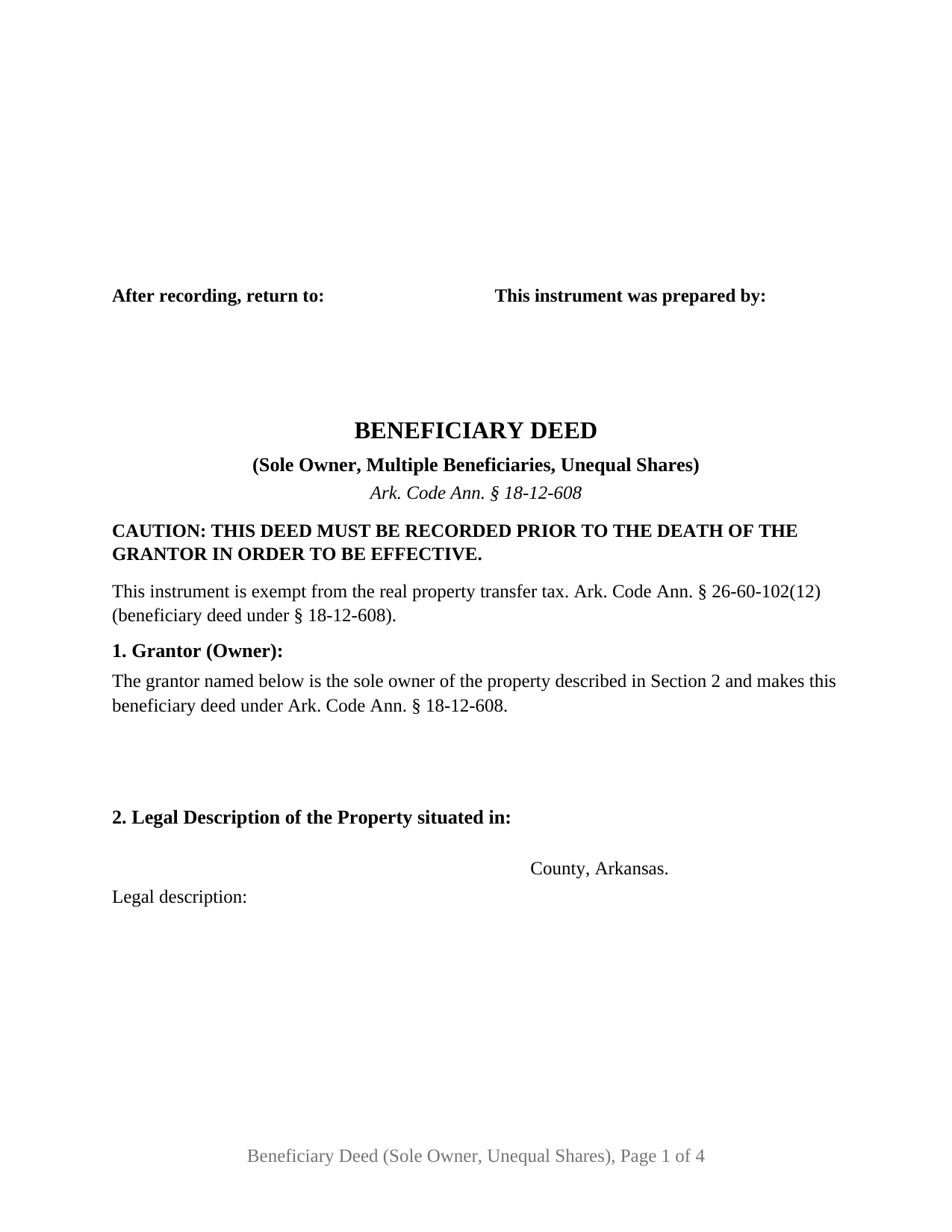
One Arkansas property owner, several people to receive the property at death, and shares that are not equal: that is the configuration this Arkansas beneficiary deed recites. The form prepares a beneficiary deed under Arkansas Code Annotated section 18-12-608 for a sole owner who designates two or more grantee beneficiaries to take the real property at the owner's death as tenants in common in stated, unequal undivided shares, with a successor grantee beneficiary available for each original grantee beneficiary. Arkansas uses the name beneficiary deed for what other states call a transfer on death deed or TOD deed.
Shares written into the deed, not left to a default
Section 18-12-608(a)(2) lets an owner designate multiple grantees and lets those grantees hold as joint tenants with right of survivorship, tenants in common, tenants by the entirety, or any other tenancy valid in Arkansas. This deed fixes tenancy in common and asks for the share next to each grantee beneficiary's name. Its Section 5 provides four rows; each row opens with the undivided share and continues with the grantee beneficiary's full name and mailing address, and the fixed text provides that the shares stated with the names together make up the whole of the property conveyed. One-half to a daughter and one-fourth to each of two sons, the pattern the completed example shows, is the kind of division the form records in the owner's own numbers. Because the grantee beneficiaries take as tenants in common, each share passes through that beneficiary's own estate or by that beneficiary's own deed after the owner's death; the deed creates no survivorship among them.
A successor for each named beneficiary
Section 18-12-608(a)(3) permits successor grantees and requires the deed to state the condition on which a successor's interest vests, giving as its example the failure of the original grantee to survive the grantor. Section 6 of this deed prints that condition as fixed text and provides three rows, each naming an original grantee beneficiary and the successor who takes that beneficiary's share if the original beneficiary does not survive the owner. A row left blank designates no successor for that share, and the deed says so, so an unused row never leaves the designation open to argument. The guide describes what section 18-12-608 does and does not say about a share whose beneficiary dies first with no successor named.
One owner, one signature, two witnesses
The deed recites a single record owner, the sole owner of the described property, and carries one grantor signature block, two witness blocks, and one acknowledgment certificate. Section 18-12-104 describes execution of a deed in the presence of two disinterested witnesses or acknowledgment in their presence followed by their subscription, and the form provides the two witness blocks side by side under the grantor's signature. The acknowledgment certificate reproduces the individual form of section 16-47-107(b), the form the statute deems sufficient for recordation, with the notary's seal and commission information under the signature. The form carries no signature block for a spouse of the owner; the guide describes the Arkansas homestead, dower, and curtesy statutes that bear on a married owner, since section 18-12-608 itself does not mention the owner's spouse. Property held by two owners, as tenants by the entirety or as joint tenants with right of survivorship, follows the co-owner rules of section 18-12-608(b), and that is a different pattern from the one this deed recites.
Recorded before death, or it does nothing
The feature that gives a beneficiary deed its power is also its one hard deadline. Under section 18-12-608(c)(1), the deed is valid only if it is recorded before the owner's death in the office of the county recorder of the county where the property is located. The statutory form prints a caution to that effect in capital letters, and this deed carries the same caution near the top of its first page. Until then the owner gives up nothing: no legal or equitable interest vests in any grantee beneficiary before the owner's death, the transfer at death is subject to any conveyance, lease, mortgage, or lien the owner makes after signing, and the owner may revoke the deed at any time by a revocation executed and recorded before death, a separate instrument that is recorded separately and is not included in this package. A will cannot revoke or alter a beneficiary deed that complies with the section, and when more than one beneficiary deed for the same property is recorded, the one last signed before death controls.
Two statements on the first page
Two Arkansas recording rules shape the first page. Section 14-15-403 directs the recorder not to receive a deed unless the preparer's name and address appear on the face of the first page, so the preparer statement sits at the top of page one beside the return address. Section 26-60-102(12) exempts a beneficiary deed from the real property transfer tax, and section 26-60-110 lets an exempt deed be recorded without the Department of Finance and Administration affidavit when the deed states that it is exempt, so the deed prints that statement with its citation. The guide carries the page format standards, the recorder's fees, and the photo identification step Act 752 of 2025 added for deeds presented in person or by mail.
The package includes the fillable beneficiary deed form, a completed example filled in for a Pulaski County owner naming three grantee beneficiaries in unequal shares with two successors, and the guide that walks through every numbered section, the witness and acknowledgment blocks, and the recording process. This description and the guide describe the form and the governing Arkansas statutes in general terms; they are not legal advice.
Important: County-Specific Forms
Our beneficiary deed (sole owner, multiple beneficiaries, unequal shares) forms are specifically formatted for each of the 75 counties in Arkansas.
After selecting your county, you'll receive forms that meet all local recording requirements, ensuring your documents will be accepted without delays or rejection fees.