Michigan Sworn Statement of Account
County Specific Legal Forms Validated as recently as September 8, 2026 by our Forms Development Team
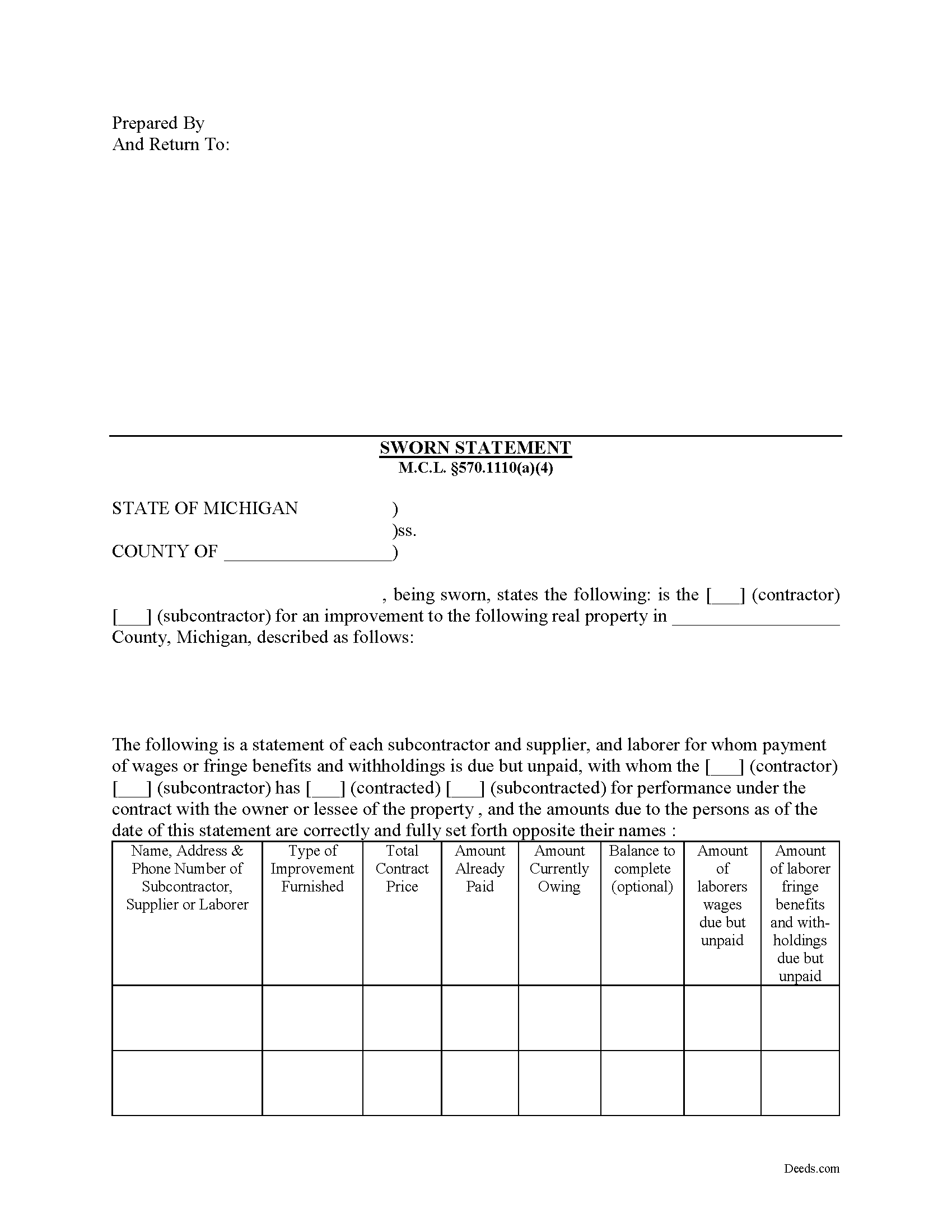
About the Michigan Sworn Statement of Account
How to Use This Form
- Select your county from the list
- Download the county-specific form
- Fill in the required information
- Have the document notarized if required
- Record with your county recorder's office
What Others Like You Are Saying
"I am satisfied with the service. Live in another state and could not go directly to the county offic…"
"I have downloaded all the forms and the guidelines. The information provided is very helpful and eas…"
"Fabulous resource! They provide everything you need at an extremely reasonable price."
"Thank you so much! Quick and easy. Received it in under 5 minutes."
"I believe this is great! It protects the residents from theft of property. Proud of what Wayne Count…"
4.8/5 from 4,819 reviews. Read all
A Michigan sworn statement of account is the document that tells an owner exactly who else has a claim on the money. Under section 110 of the Construction Lien Act, 1980 PA 497, MCL 570.1110, a contractor or subcontractor swears to an itemized account of every subcontractor and supplier under contract on the job, and of every laborer whose wages or fringe benefits and withholdings are due but unpaid, with the contract price, the amount paid, the amount owing, and the balance to complete set out beside each name. The account is sworn before a notary, and it is handed to the person entitled to it rather than filed anywhere.
An account that changes what the owner may pay
The sworn statement is not a courtesy disclosure. Once it has been provided, MCL 570.1110(7) lets the owner or lessee withhold from the amount due or becoming due an amount sufficient to cover the sums the statement shows as owing to subcontractors, suppliers, and laborers, and a written demand from the contractor turns that option into an obligation. Out of what is withheld, the owner may pay those claimants directly, giving the general contractor at least 5 business days notice the first time direct payment is made. Those four money columns are what the owner measures a withholding against.
Three moments that call for the statement
Michigan builds the duty into the payment cycle. A contractor provides a sworn statement to the owner or lessee when payment is due or when the contractor asks for payment, and again whenever the owner or lessee demands one. A subcontractor provides one to the owner or lessee on demand and, if applicable, after the owner or lessee has complied with subsection (6), and provides one to the contractor when payment is due from the contractor or when the subcontractor requests it. Those triggers sit in MCL 570.1110(1), (2), and (3), and one form answers all three, changing only the recipient named.
The warnings the statute prints on the face
Two statutory warnings ride on every Michigan contractor's sworn statement, and both are on this form. The first tells the owner or lessee not to rely on the statement to avoid the claim of a subcontractor, supplier, or laborer who has provided a notice of furnishing under MCL 570.1109, which means a claimant who gave that notice keeps lien rights whether or not the claimant is named in the account. The second tells the deponent that a false sworn statement given with intent to defraud is a crime under section 110, graded by the amount involved and starting at a 93 day misdemeanor. A residential block completes the set, carrying the MCL 570.1110(6) duty to pass word of the statement's receipt to the claimants entitled to hear it and to supply a copy within 10 business days of a request.
Sworn, delivered, and never recorded
The instrument closes with a jurat, not an acknowledgment. The deponent swears to the account and signs in front of a notary public, and the notary certifies the oath under the Michigan Law on Notarial Acts, MCL 55.261 to 55.315, supplying the county of commission and the county of the act under MCL 55.287. Delivery, not recording, completes it: the Construction Lien Act sends the claim of lien to the register of deeds under MCL 570.1111, and leaves the sworn statement in the hands of the owner, lessee, or contractor who receives it. Failing to provide one does not void a lien. Under MCL 570.1110(9) the contractor is entitled to no payment and may not sue to enforce the lien until the statement arrives; under MCL 570.1110(10) the subcontractor meets that enforcement bar alone, with no payment bar attached.
How this form is set up
The form is written for one deponent, with free entry lines where the statutory exemplar prints the paired alternatives of contractor and subcontractor, so the same document expresses either status and either direction of delivery. One combined table substantially following the table in MCL 570.1110(4) carries the itemization: the statute's eight columns, eight numbered rows, and a TOTALS row above the statutory line for columns that do not apply to everyone listed. Longer projects continue on an attached exhibit page delivered with the statement. Material drawn from the issuer's own inventory that was not bought for the job is not required to be listed, which is the carve out in MCL 570.1110(5).
The package contains the fillable sworn statement form, a completed example filled out for a Kent County residential project, and a guide covering the statutory framework, the itemization, the jurat, and delivery. The material is informational and is not legal advice.
Important: County-Specific Forms
Our sworn statement of account forms are specifically formatted for each of the 83 counties in Michigan.
After selecting your county, you'll receive forms that meet all local recording requirements, ensuring your documents will be accepted without delays or rejection fees.