Texas Mineral Deed (Special Warranty)
County Specific Legal Forms Validated as recently as October 27, 2026 by our Forms Development Team
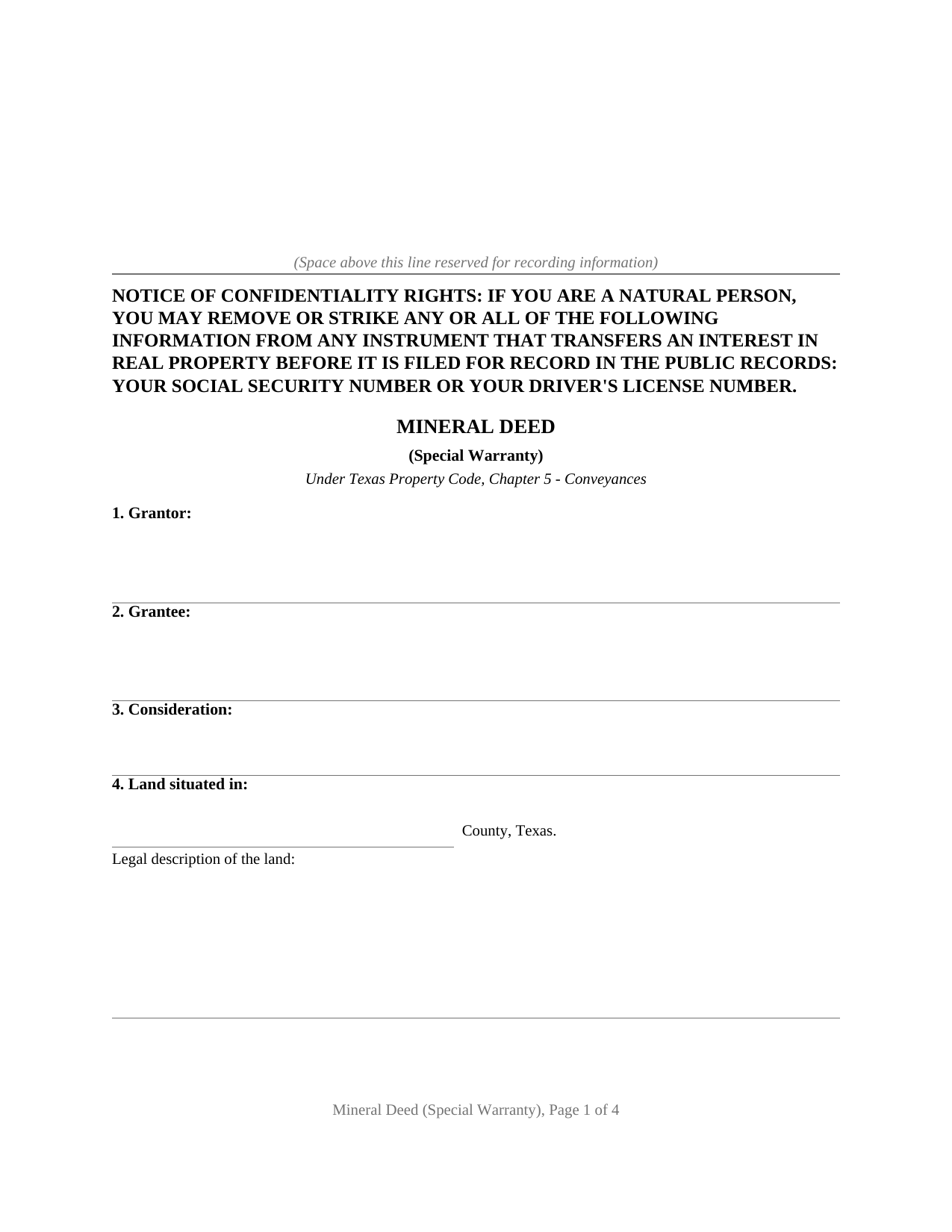
About the Texas Mineral Deed (Special Warranty)
How to Use This Form
- Select your county from the list
- Download the county-specific form
- Fill in the required information
- Have the document notarized if required
- Record with your county recorder's office
What Others Like You Are Saying
"Easy to download. Hopefully easy to fill in. Just wish there was wording for a Beneficiary Deed for …"
"Easy to use and clear instructions."
"Easy to use and just what I was looking for"
"Needed a Limited Power of Attorney form for a real estate transaction in another state. Proper form …"
"Great service and fast"
4.8/5 from 4,836 reviews. Read all
A mineral interest can change hands many times across leases, partial sales, and inherited fractions, and the grantor signing it over today rarely knows what every prior owner did to the title. The Texas mineral deed with a special warranty is built for that reality: the grantor conveys the oil, gas, and other minerals it owns and stands behind the title for its own period of ownership, leaving the deeper history to the records. This form prepares that deed under Chapter 5 of the Texas Property Code.
A warranty that stops at the grantor's own ownership
A general warranty defends the title against every lawful claim, whenever it arose. A special warranty is narrower: the grantor warrants and forever defends the title only against claims arising by, through, or under the grantor, and not otherwise. The Supreme Court of Texas described that scope in Chicago Title Insurance Co. v. Cochran Investments, noting that without the limitation a special warranty deed effectively becomes a general warranty deed. The interest conveyed is identical either way; only the reach of the title promise changes, which is why this warranty is common between businesses and in transactions where the grantor will not vouch for the older chain.
What a mineral interest actually is
Texas treats the mineral estate as a bundle of separable rights, often called the five sticks: the right to lease, the right to develop the land through ingress and egress, and the rights to bonus, delay rentals, and royalty. A mineral deed conveys those rights in the fraction the deed names, together with the right of ingress and egress to develop the minerals, and the form states the interest precisely, as a fraction or decimal, in net mineral acres, and with any limit by depth, formation, or substance. Under Texas law oil, gas, and other minerals reaches oil, gas, uranium, sulphur, and salt, and not limestone, caliche, surface shale, building stone, sand, gravel, or water. The deed uses the words of grant the Texas statute recognizes, grants, sells, and conveys, so it conveys the interest itself; an instrument that passes only right, title, and interest reads instead as a quitclaim, which sits in the chain of title differently.
Leases, signing, and recording
Most producing minerals are already under an oil and gas lease, and a mineral deed usually conveys the interest subject to that lease, carrying the corresponding share of bonus, rentals, and royalty; the form identifies the lease and lists what the grantor reserves. The grantor signs before a notary, and an entity grantor signs through an authorized individual whose name and capacity appear on the deed. A separate line lets a non-owner spouse join where the minerals are part of homestead property, the situation Texas Family Code Section 5.001 reaches. The deed is recorded with the county clerk of the county where the land is located; Senate Bill 16 added a photo identification requirement for instruments presented in person for filing on or after December 4, 2025.
The package includes the deed as a fillable PDF, a completed example on a realistic Reeves County fact pattern, and a plain-language guide that walks through every numbered section. The materials are informational and are not legal advice; a Texas attorney can address how these rules apply to a specific mineral interest and transaction.
Important: County-Specific Forms
Our mineral deed (special warranty) forms are specifically formatted for each of the 254 counties in Texas.
After selecting your county, you'll receive forms that meet all local recording requirements, ensuring your documents will be accepted without delays or rejection fees.