Virginia Transfer on Death Deed
County or Independent City Specific Legal Forms Validated as recently as September 22, 2026 by our Forms Development Team
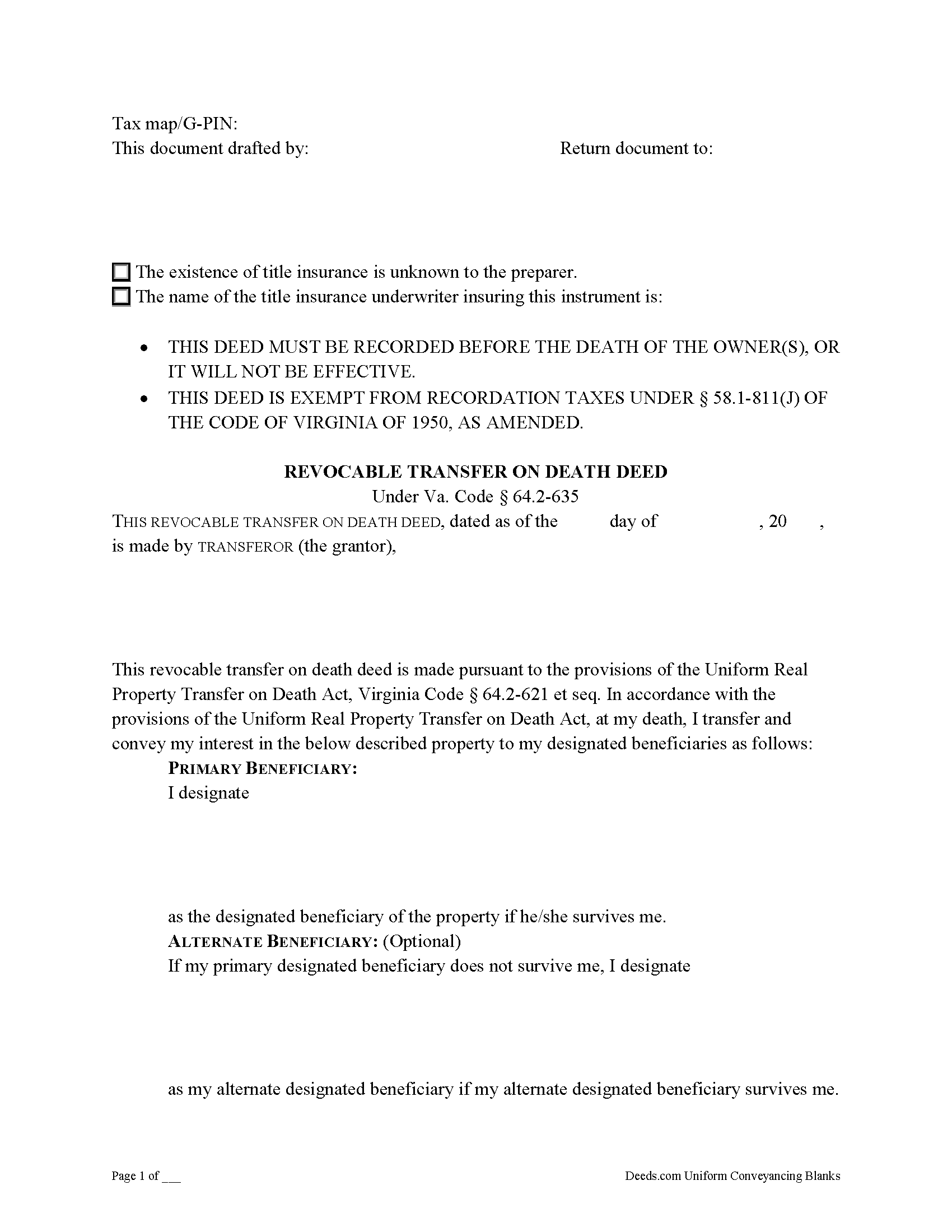
About the Virginia Transfer on Death Deed
How to Use This Form
- Select your county or independent city from the list
- Download the county or independent city-specific form
- Fill in the required information
- Have the document notarized if required
- Record with your county or independent city recorder's office
What Others Like You Are Saying
"The service was great. Thank you."
"Happy with the forms and the service, would recommend to others."
"Complete coverage of deeds, laws, etc."
"Very easy and fast service for legal forms."
"On multiple tries, I could not get validation mail through my Yahoo email address. I tried Gmail, wo…"
4.8/5 from 4,810 reviews. Read all
Virginia's statutory transfer on death deed became effective on July 1, 2013. These deeds are governed by the Uniform Real Property Transfer on Death Act (URPTODA), which is incorporated into the Virginia statutes at 64.2-621 et seq.
A transfer on death deed is an instrument that allows owners of Virginia real estate to convey land to chosen beneficiaries without the need for a will or probate distribution ( 64.2-624). To be valid, the completed and notarized form must, among other things, meet the same standards as a regular inter vivos deed (one that transfers title while the owner is still living); state that the transfer will only occur at the owner/transferor's death; and be recorded <i>while the transferor is alive</i> in the land records at clerk's office of the county where the property is located ( 64.2-628).
The deeds are revocable, which means that while alive, the owner retains 100% control over the property, may use or sell it as desired, and may also redirect, modify, or even cancel the future transfer at will. As a result, there is no requirement for notice, delivery, acceptance, or consideration, all necessary for standard deeds ( 64.2-629). This is possible because the named beneficiaries only have a potential future interest in the real estate. The process and requirements for revocation are specified in 64.2-630.
During the owner/transferor's life, the recorded transfer on death deed does not change the owner's interest or rights to sell or mortgage the property; grant the beneficiary any interest in the land; change a creditor's interest in the real estate; affect the owner's or beneficiary's eligibility for public assistance; create a legal or equitable interest in favor of the beneficiary; or open the property up to claims from the beneficiary's creditors ( 64.2-631).
When the transferor dies, the title to the real property vests in the beneficiary according to the rules stated in 64.2-632. In some cases, however, the beneficiary may not wish to accept the property. If that happens, he/she may "disclaim all or part of the beneficiary's interest as provided by Chapter 26 (64.2-2600 et seq.)" (64.2-633).
Overall, Virginia's transfer on death deed adds an efficient, flexible tool for those considering options for estate planning. As with other important financial decisions, take the time to carefully review the different options. Each case is unique, so when in doubt, contact an attorney or other appropriate professional for advice.
(Virginia TODD Package includes form, guidelines, and completed example)
Important: County or Independent City-Specific Forms
Our transfer on death deed forms are specifically formatted for each of the 132 county or independent cities in Virginia.
After selecting your county or independent city, you'll receive forms that meet all local recording requirements, ensuring your documents will be accepted without delays or rejection fees.