Apache County Revocation of Beneficiary Deed Form
Last validated August 26, 2026 by our Forms Development Team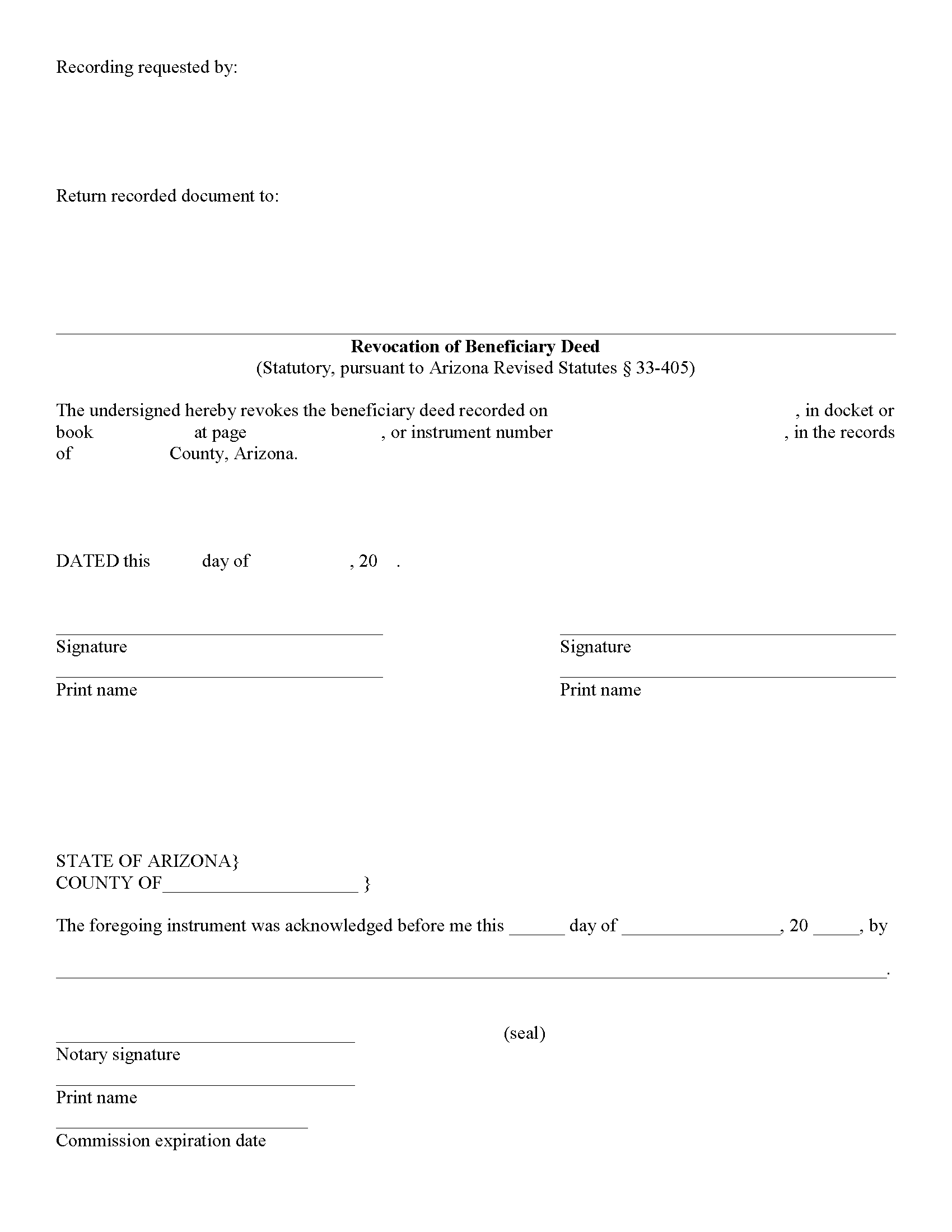
Apache County Revocation of Beneficiary Deed Form
Fill in the blank form formatted to comply with all recording and content requirements.
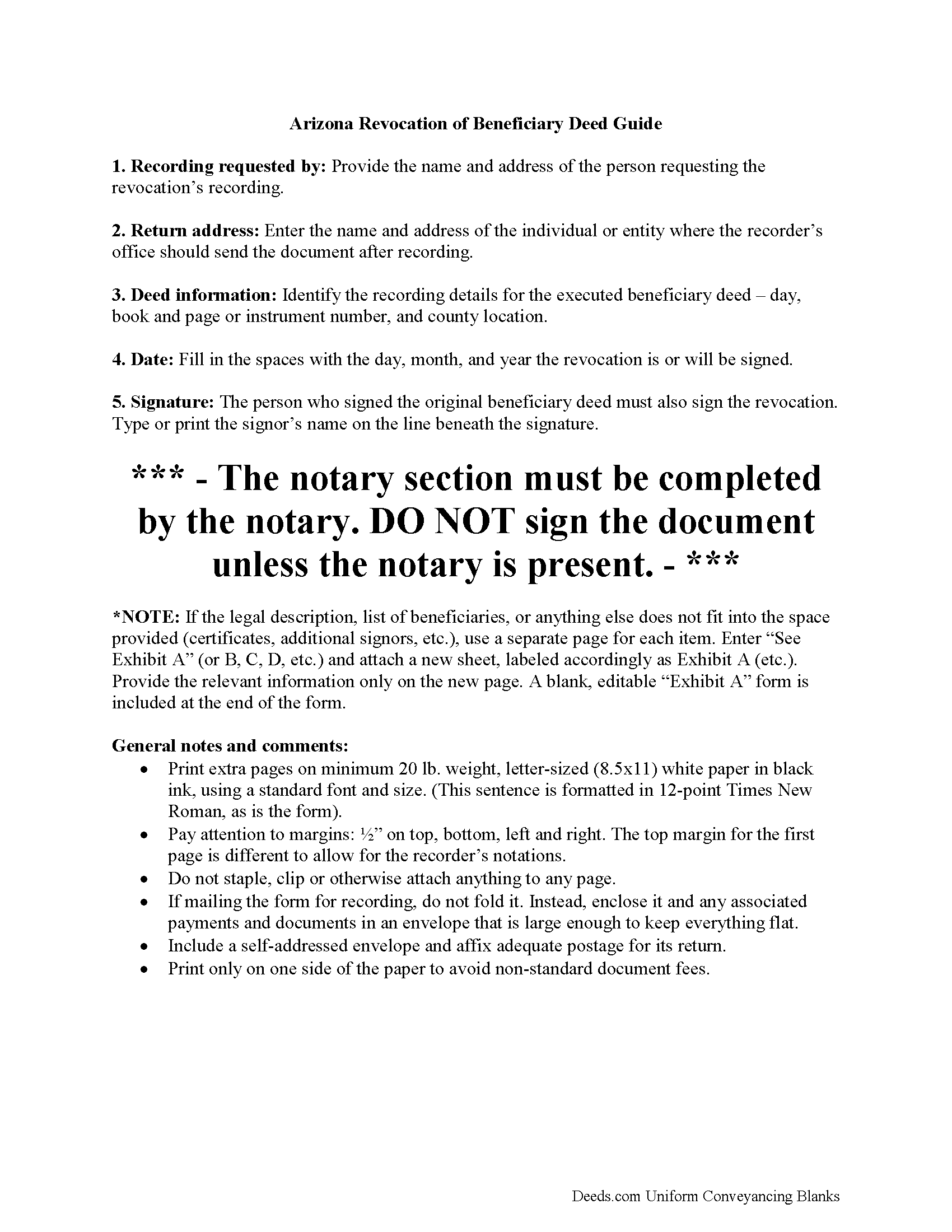
Apache County Revocation of Beneficiary Deed Guide
Line by line guide explaining every blank on the form.
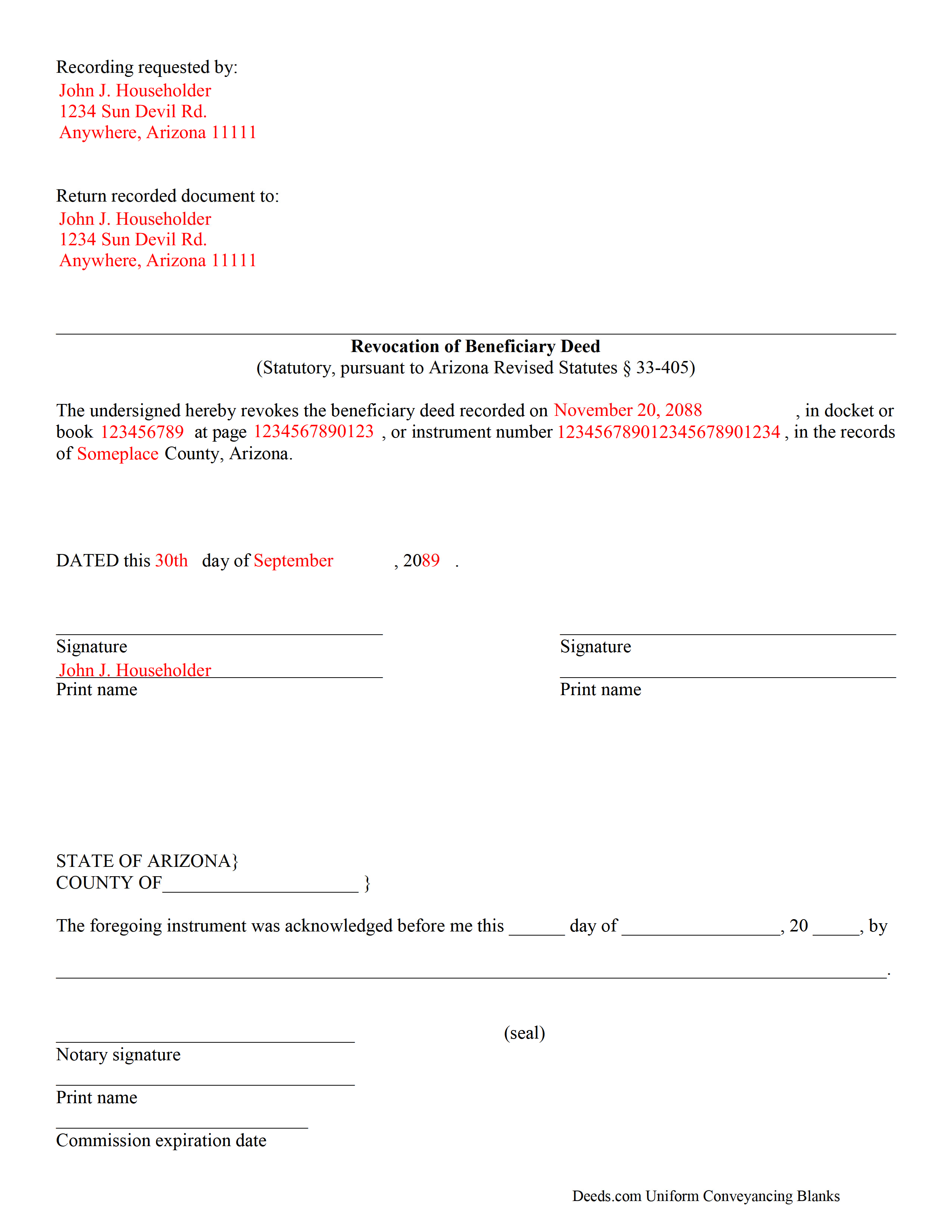
Apache County Completed Example of the Revocation of Beneficiary Deed Document
Example of a properly completed form for reference.
All 3 documents above included • One-time purchase • No recurring fees
Immediate Download • Secure Checkout
Additional Arizona and Apache County documents included at no extra charge:
Where to Record Your Documents
County Recorder Office - County Annex Bldg
St. Johns, Arizona 85936
Hours: Monday through Thursday 6:30am - 5:30pm. Closed Fridays
Phone: 928-337-7515
Recorder's Sub Office
Springerville, Arizona
Hours: Mon, Tue 8:00 - 5:00, Wed 9:00 - 12:00
Phone:
Recording Tips for Apache County:
- Documents must be on 8.5 x 11 inch white paper
- Check margin requirements - usually 1-2 inches at top
- Avoid the last business day of the month when possible
Cities and Jurisdictions in Apache County
Properties in any of these areas use Apache County forms:
- Alpine
- Chambers
- Chinle
- Concho
- Dennehotso
- Eagar
- Fort Defiance
- Ganado
- Greer
- Houck
- Lukachukai
- Lupton
- Many Farms
- Mcnary
- Nazlini
- Nutrioso
- Petrified Forest Natl Pk
- Red Valley
- Rock Point
- Round Rock
- Saint Johns
- Saint Michaels
- Sanders
- Springerville
- Teec Nos Pos
- Tsaile
- Vernon
- Window Rock
Hours, fees, requirements, and more for Apache County
How do I get my forms?
Forms are available for immediate download after payment. The Apache County forms will be in your account ready to download to your computer. An account is created for you during checkout if you don't have one. Forms are NOT emailed.
Are these forms guaranteed to be recordable in Apache County?
Yes. Our form blanks are guaranteed to meet or exceed the applicable formatting requirements used for recording in Apache County, including margin requirements, font requirements, and other layout standards. This guarantee applies to formatting, not to the legal sufficiency of information entered by the user or the suitability of a form for a particular transaction.
Can I reuse these forms?
Yes. You can reuse the forms for your personal use. For example, if you have multiple properties in Apache County you only need to order once.
What do I need to use these forms?
The forms are PDFs that you fill out on your computer. You'll need Adobe Reader (free software that most computers already have). You do NOT enter your property information online - you download the blank forms and complete them privately on your own computer.
Are there any recurring fees?
No. This is a one-time purchase. Nothing to cancel, no memberships, no recurring fees.
How much does it cost to record in Apache County?
Recording fees in Apache County vary. Contact the recorder's office at 928-337-7515 for current fees.
Questions answered? Let's get started!
The Arizona Revocation of Beneficiary Deed is the instrument used to undo a previously recorded beneficiary deed under ARS 33-405 before the owner's death. Two rules drive why a dedicated revocation form exists in Arizona. First, a beneficiary deed — like the revocation itself — is effective only if it is recorded in the county where the property is located during the owner's lifetime, so the revocation has to clear the record before death the same way the original deed did. Second, and distinctive to Arizona's statute, a beneficiary deed cannot be revoked by will: a testamentary attempt to cancel the designation has no legal effect, because the deed lives in the real property records, not in the probate estate. The only reliable way to undo a beneficiary deed during life is to record an instrument that satisfies ARS 33-405.
When the Arizona Revocation of Beneficiary Deed Is Used
Revocation is appropriate any time the owner's circumstances or wishes have changed since the beneficiary deed was recorded. Common triggers include a falling-out with the named beneficiary, the beneficiary's death before the owner, a decision to handle the property through a revocable living trust instead, sale or refinance planning that is cleaner without an outstanding beneficiary deed on the record, divorce (discussed below), and second-marriage planning where competing family interests need to be re-balanced. Revocation does not require the beneficiary's consent, signature, or even knowledge; the beneficiary has only an expectancy during the owner's life, and the owner is free to eliminate it at any time.
The Three Methods of Revocation
ARS 33-405 recognizes three effective methods of revoking a beneficiary deed during the owner's lifetime. The first is recording a formal revocation instrument — this form — that identifies and cancels the earlier deed. The second is recording a new beneficiary deed that supersedes the earlier one; the most recently recorded beneficiary deed controls, and an owner who wants to replace the named beneficiary can do so by recording a fresh deed rather than a separate revocation. The third is conveying the property during life to someone else by ordinary deed, which leaves the beneficiary deed with no property to operate on when the owner dies.
Each method has its place. A formal revocation is the cleanest choice when the owner wants the beneficiary designation removed but is not ready to name a replacement. A superseding beneficiary deed is more efficient when the owner is simply swapping one beneficiary for another. A lifetime conveyance is typically driven by other planning reasons — funding a trust, selling the property, transferring to a successor owner — with the effect on the beneficiary deed being a consequence rather than the goal.
Revocation by Will Has No Effect
This point is sharp enough in Arizona to deserve its own heading. ARS 33-405 specifically provides that a beneficiary deed cannot be revoked by a will or other testamentary instrument. An owner who signs a will saying "I hereby revoke the beneficiary deed I recorded in 2019" has accomplished nothing: the deed continues to stand, and at the owner's death the property passes to the named beneficiary regardless of what the will says. This rule exists because the deed is a non-probate transfer recorded in the real property records; a document that never reaches those records cannot cancel an entry in them. Owners who want to change a beneficiary designation through their estate plan should coordinate with their estate planner to record a revocation or a superseding beneficiary deed — updating the will alone is not enough.
The Lifetime Recording Requirement
ARS 33-405 requires that a revocation be executed and recorded in the office of the county recorder of the county where the property is located before the owner's death. The rule mirrors the requirement for the original beneficiary deed and is just as strict. A signed and acknowledged revocation that sits unrecorded when the owner dies does not cancel the beneficiary deed — the earlier deed remains on the record, and the named beneficiary takes the property. This is the single most consequential drafting and handling rule for the revocation. Signing and recording should happen in the same sitting, and the recording should be confirmed against the county's index rather than assumed from a mailing receipt.
Reference to the Original Beneficiary Deed
The revocation must tie itself to the specific beneficiary deed it is canceling. The instrument should identify the original deed by recording date, recording reference (docket and page or instrument number), county of recording, and the names of the owner-grantor and beneficiary. The legal description of the property should be recited, matching the description used in the original deed. Without an explicit tie, the county recorder's index will not link the revocation to the original, and a title examiner running the chain may miss the revocation and assume the beneficiary deed is still operative. This is not a formality — it is how the revocation actually does its job on the record.
Co-Owners, Spouses, and Who Must Sign
Who must sign the revocation depends on who signed the original beneficiary deed. When both spouses signed the original deed conveying community property, both spouses generally need to sign the revocation; a revocation by one spouse alone revokes only that spouse's designation, which can produce unintended results depending on how the couple's ownership is structured and who dies first. When multiple owners of property held in tenancy in common or joint tenancy signed the original deed, each owner has the independent ability to revoke their own portion of the designation by recording a revocation as to their interest, but coordinated revocation by all signers is the cleaner approach when the intent is to wipe the entire designation.
When the original deed was executed by a single owner — either because the property is sole and separate property or because only one owner held title — that owner can revoke alone. The marital status of the owner-revoker belongs in the revocation instrument's recitals just as it did in the original deed.
Divorce and Automatic Statutory Revocation
Arizona's revocation-on-divorce statute at ARS 14-2804 automatically revokes a revocable beneficiary designation in favor of a former spouse upon the entry of a final decree of divorce or annulment, and that rule applies to beneficiary deeds as well as to wills, trusts, and other non-probate transfer instruments. An owner whose beneficiary deed named a spouse, and who has since divorced, does not need to record a revocation to cut off the former spouse's designation — the statute does it automatically. That said, the original deed still sits in the county recorder's office naming the former spouse, which can create title questions when the property is later sold or when the owner dies. Recording a formal revocation (or a superseding beneficiary deed naming a new beneficiary) after the divorce is cleaner than relying on the statutory revocation alone, because it puts the cancellation plainly on the record where a title examiner will find it.
Execution and Acknowledgment
Under ARS 33-401 and 33-405, the revocation must be in writing, subscribed by the owner who is revoking, and acknowledged before a notary public or other officer authorized to take acknowledgments. Arizona does not require subscribing witnesses. Acknowledgments taken outside Arizona must comply with ARS 33-501. The beneficiary does not sign — as with the original beneficiary deed, the revocation is a one-way instrument that requires no cooperation or acknowledgment from the person whose designation is being canceled.
Affidavit of Property Value Exemption
Arizona normally requires an Affidavit of Property Value to accompany instruments affecting interests in real property (ARS 11-1133), but a revocation of beneficiary deed qualifies for an exemption under ARS 11-1134 because no property is being transferred — the instrument is canceling a designation that would have transferred property at a future date. The exemption must be claimed on the face of the instrument: a statement that the transfer is exempt, together with a citation to the specific exemption subsection, belongs below the legal description. A revocation that omits the exemption recital is frequently rejected at the recorder's window even though the transaction is plainly exempt.
Formatting and Recording
ARS 11-480 sets the formatting requirements for every recordable instrument: legible type of at least ten points, white paper no larger than 8.5 by 14 inches, a caption identifying the document (for example, "Revocation of Beneficiary Deed"), a top margin of at least two inches on the first page reserved for the recorder's stamp, and half-inch minimums elsewhere. Record the revocation in the same county where the original beneficiary deed was recorded, and confirm fees and accepted forms of payment with the recorder's office in advance. Because the lifetime recording rule is absolute, confirm that the revocation has actually been indexed rather than relying on a drop-off or mailing receipt.
What's Included in the Download Package
The Arizona Revocation of Beneficiary Deed package includes the revocation form drafted to satisfy ARS 33-405's requirements and to reference the original beneficiary deed's recording information, detailed guidelines covering the Arizona-specific drafting and lifetime recording requirements, and a completed example showing how the form should look for a typical revocation. All files are available for instant download after purchase.
Important: Your property must be located in Apache County to use these forms. Documents should be recorded at the office below.
This Revocation of Beneficiary Deed meets all recording requirements specific to Apache County.
Our Promise
The documents you receive here are guaranteed to meet or exceed the applicable Apache County recording format requirements. If there is a rejection caused by our formatting, we will correct the issue or refund your payment. This guarantee applies to document formatting only and does not extend to information entered by the user, the selection of the form, or the legal effect of the completed document.
Save Time and Money
Get your Apache County Revocation of Beneficiary Deed form done right the first time with Deeds.com Uniform Conveyancing Blanks. At Deeds.com, we understand that your time and money are valuable resources, and we don't want you to face a penalty fee or rejection imposed by a county recorder for submitting nonstandard documents. We constantly review and update our forms to meet rapidly changing state and county recording requirements for roughly 3,500 counties and local jurisdictions.
4.8 out of 5 - ( 4785 Reviews )
Vickey W.
February 5th, 2021
Your company was great, you all walked me through every step of the process. With the pandemic and the inability to go into the DC Recorder of Deeds office. I look forward to working with you in the future.
Thank you for your feedback. We really appreciate it. Have a great day!
Dana H.
September 8th, 2021
Thanks for making this process a seamless one! I love Deeds.com and will recommend it to others!
Thank you for your feedback. We really appreciate it. Have a great day!
Jack A.
March 26th, 2021
First time user. Great service. If I need other forms, I'll definitely be using Deeds.
We appreciate your business and value your feedback. Thank you. Have a wonderful day!
James J.
July 28th, 2024
Ive been looking for a complete packet with all the forms needed!!
Thank you for your positive words! We’re thrilled to hear about your experience.
Fernando C.
April 13th, 2019
I was able to get what I needed!! Easy and fast!
We appreciate your business and value your feedback. Thank you. Have a wonderful day!
Laura M.
November 12th, 2023
Very easy and I appreciate that when you hover over the blank, directions pop up and tell you what to put in that blank. I also appreciated that when I lost the original password, I sent an email and Deeds.com cancelled my order, refunded my account, so that I could start over.
It was a pleasure serving you. Thank you for the positive feedback!
PATRICK C.
September 29th, 2021
Fast, honest company Worth every penny! DO IT YOURSELF SAVE THOUSANDS
We appreciate your business and value your feedback. Thank you. Have a wonderful day!
Laryn A.
March 3rd, 2020
Very happy with the beneficiary deed forms packet. It was helpful to have an example of a properly filled out form. The only suggestion would be is to show where the exemption code should be placed on the form.
Thank you for your feedback. We really appreciate it. Have a great day!
James B.
February 20th, 2020
Does everything I expected it to do. Very helpful. It is in compliance with applicable Nevada State regulations
Thank you for your feedback. We really appreciate it. Have a great day!
Kelly M.
August 27th, 2021
Deeds.com made it so easy and convenient to get my homestead document recorded. Thank you!
We appreciate your business and value your feedback. Thank you. Have a wonderful day!
Eric L.
June 28th, 2021
Great service, but still needs some knowledge to complete. Also missing Michigan right to farm paragraph.
Thank you!
Bernique C.
May 18th, 2022
Was very pleased to be referred by another user for needed documents. Add me to "satisfied customers"
Thank you for your feedback. We really appreciate it. Have a great day!
Fernando B.
June 11th, 2021
It works
Thank you!
Marilyn C.
April 6th, 2020
My document got recorded right away. Thank you! Will use again in the future when needed.
We appreciate your business and value your feedback. Thank you. Have a wonderful day!
Melody P.
November 10th, 2021
Great service, as always!!
We appreciate your business and value your feedback. Thank you. Have a wonderful day!