California Quitclaim Deed (Corporation Grantor)
County Specific Legal Forms Validated as recently as October 2, 2026 by our Forms Development Team
About the California Quitclaim Deed (Corporation Grantor)
How to Use This Form
- Select your county from the list
- Download the county-specific form
- Fill in the required information
- Have the document notarized if required
- Record with your county recorder's office
What Others Like You Are Saying
"I had my doubts going in but was pleasantly surprised at the thoroughness of the documents and infor…"
"The Deed of trust form was fine but the promissory note was less user friendly since I needed to cha…"
"Definitely recommend. Superb customer service. Well worth the money! Thanks again!"
"Very pleased with deeds.com. I highly recommend them to anyone, from clueless beginners like myself …"
"Seamless and prompt service."
4.8/5 from 4,829 reviews. Read all
California measures a corporate deed by the offices standing behind the signatures. A quitclaim executed for a corporation therefore does something an individual release never has to: it names the entity and states the office each signer holds, so both can be checked against the statute that protects the instrument. This form prepares the California quitclaim deed with a corporation as grantor, built around two officer signature blocks and carrying no warranty of title.
Two Groups of Offices, One Instrument
Corporations Code Section 313 sorts the offices that can sign for a corporation into two groups: the chairperson of the board, the president, and any vice president on one side; the secretary, any assistant secretary, the chief financial officer, and any assistant treasurer on the other. A conveyance signed by an officer from each group is not invalidated as to the corporation by any lack of authority of the signers, unless the other party actually knew of it. In Snukal v. Flightways Manufacturing, Inc. (2000) 23 Cal.4th 754, the California Supreme Court applied the section where one individual in fact occupied offices in both groups. Section 8 answers the statute directly, with a signature block for each of two officers and an office held entry under each.
Authority runs on a different provision. Corporations Code Section 208, subdivision (b), binds the corporation to a conveyance in its name that the board authorized or ratified, or that falls within the executing officer's agency power; subdivision (c) reaches conveyances by foreign corporations of California real property, which is why the grantor section asks for the state or country of incorporation. Section 6 records the board action relied on, and its date.
Standing Is Part of the Power to Convey
One California rule reaches corporate deeds and no others. Under Revenue and Taxation Code Section 23302, subdivision (d), a taxpayer whose powers, rights, and privileges have been suspended or forfeited is not entitled to sell, transfer, or exchange real property in this state while that lasts. Section 23304.1 makes a contract entered into during such a period voidable at the other party's request, with relief available under Section 23305.1. Standing here is not counter paperwork; it reaches the corporation's capacity to deliver the deed.
A Release With Nothing Promised
The instrument, often typed as a quit claim deed, warrants nothing. California ties its two everyday deed covenants to a single statutory word under Civil Code Section 1113, and this deed never uses that word, so neither covenant arises. What moves is the interest the corporation holds at delivery; an interest picked up afterward stays outside, the traditional line California cases draw between this deed and its warranty cousin.
The Configuration, and the Patterns That Present It
The form recites one corporation as grantor, executing through no more than two officers, with a Civil Code Section 1189 acknowledgment certificate for each block, headed by the boxed identity notice that section prints on certificates taken in this state. Corporate releases reach California's grantor indexes in recognizable shapes: a remnant strip released to the adjoining owner after a lot line adjustment, an interest given up under a terminated agreement that reached the record, and a parcel conveyed under a court approved plan of reorganization. An individual signing personally, a partnership holding title in the partnership name, and a trustee holding legal title each sign through a capacity structure other than the officer blocks this deed carries.
Transfer Tax on a Corporate Conveyance
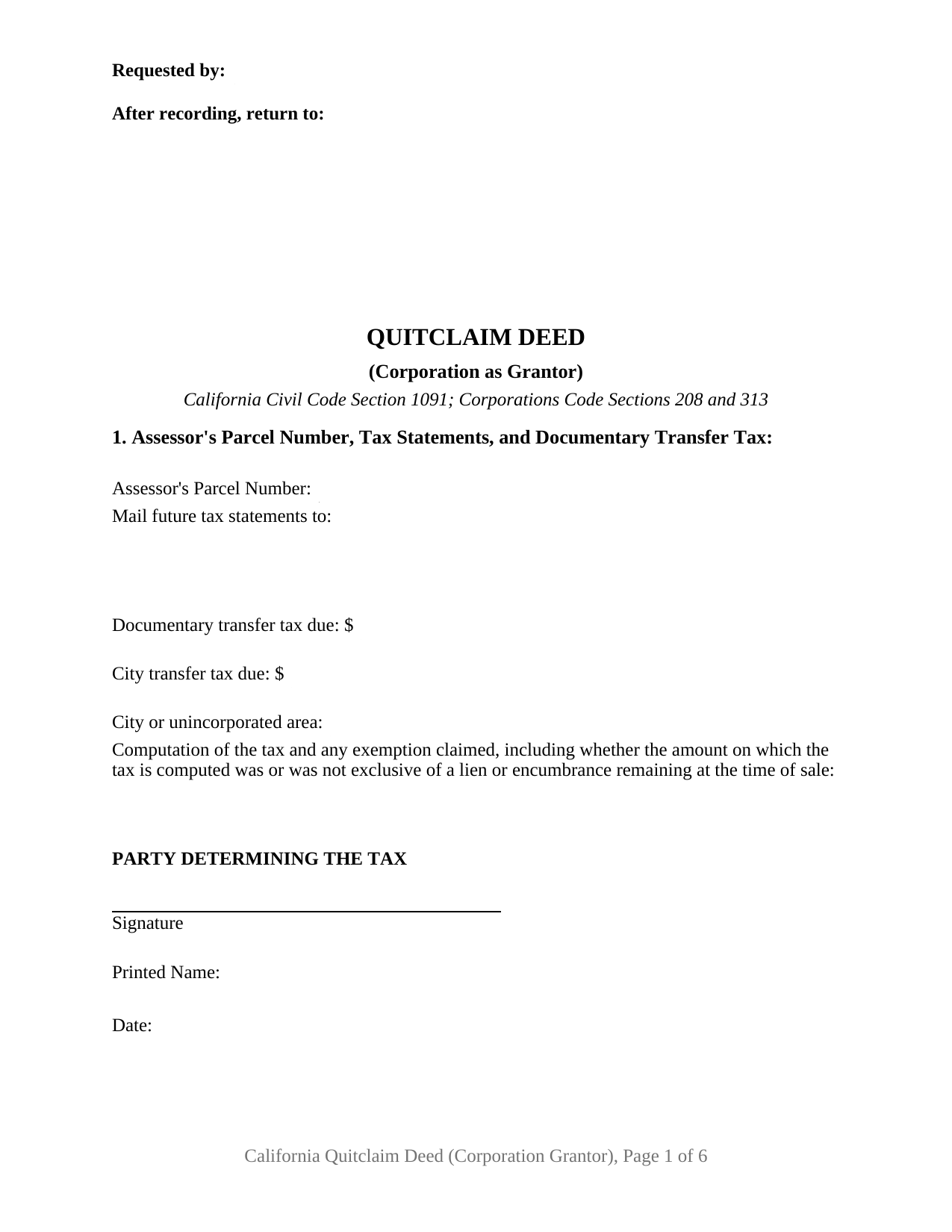
Page one arrives arranged for intake: the reserved recording space and its requester and return entries, the indexed title, the future tax statement address, and the transfer tax lines over a signature from whoever determined the amount. Reorganizations have an exemption of their own. Revenue and Taxation Code Section 11923 excuses conveyances making a plan of reorganization or adjustment effective, including one by which a mere change in identity, form, or place of organization is effected, within five years of that change. The guide takes up that section, the county rate, the charter city taxes layered over it, and the entity level statement Sections 480.1 and 480.2 call for after a change in control, filed separately and not part of this package.
Three files ship: the fillable deed, a completed example worked through a Riverside County release, and a plain language guide covering every section, the certificates, the fees, and recorder intake. It describes California law in general terms and is not legal advice about a particular corporation or parcel.
Important: County-Specific Forms
Our quitclaim deed (corporation grantor) forms are specifically formatted for each of the 58 counties in California.
After selecting your county, you'll receive forms that meet all local recording requirements, ensuring your documents will be accepted without delays or rejection fees.