California Quitclaim Deed (Married Grantor with Non-Owner Spouse Joinder)
County Specific Legal Forms Validated as recently as September 25, 2026 by our Forms Development Team
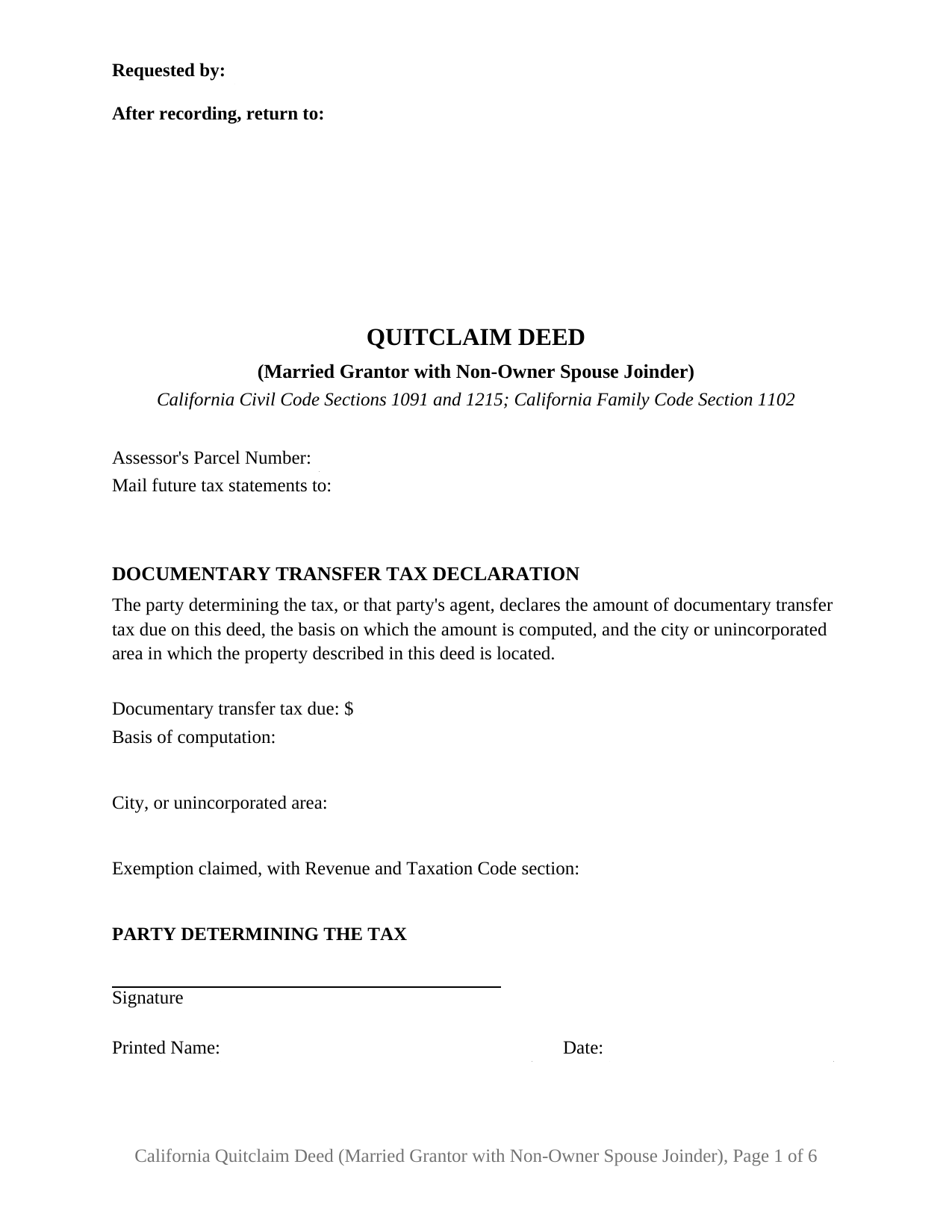
About the California Quitclaim Deed (Married Grantor with Non-Owner Spouse Joinder)
How to Use This Form
- Select your county from the list
- Download the county-specific form
- Fill in the required information
- Have the document notarized if required
- Record with your county recorder's office
What Others Like You Are Saying
"thank you for all your help and patience. I would highly recommend Deeds.com to everyone. Sincerely,…"
"A very easy site to use and got the documents that I needed without any problems. Would highly recom…"
"Haven't used yet but I will check it out tomorrow"
"Very good, very expensive. I hope that this is what my lawyer needed for us to finish our wills. Geo…"
"Was successful, I'm happy. Tks"
4.8/5 from 4,828 reviews. Read all
A California quitclaim deed can carry a signature from someone whose name appears nowhere in the chain of title. When the grantor of record is married, the spouse who is not on the title may hold a community interest the record does not show, and the way that interest leaves the property is a joinder written into the same deed. This form prepares the California quitclaim deed in that configuration: one married owner of record as grantor, and a joinder block for that grantor's spouse, who holds nothing of record and takes nothing under it.
Why a Spouse Who Is Not on the Title Signs
California characterizes marital property by how and when it was acquired, not by whose name reached the recorder. Under Family Code Section 760, what a married person picks up while living in this state belongs to the community unless a statute says otherwise, and In re Brace, decided by the California Supreme Court in 2020, held that the shape of recorded title does not by itself answer the characterization question. Family Code Section 1102 then treats a conveyance of community real property as a two spouse act. A release signed by the owner of record alone may reach everything the grantee bargained for, or it may not, and the record does not say which. The joinder settles it in writing.
The One Year Window the Statute Leaves Open
Section 1102 supplies two backstops for an instrument executed by one spouse alone, and neither is the equal of a signature. Subdivision (c)(2) presumes valid the sole deed of the spouse holding record title when it runs to a purchaser or encumbrancer in good faith without knowledge of the marriage relation, a presumption unavailable to a grantee who knows of the marriage. Subdivision (d) bars an action to avoid such an instrument one year after it is filed for record, placing the exposure on a clock rather than ending it. A deed carrying the non-owner spouse's release depends on neither provision.
One Grantor Block, One Joinder Block
Section 1 names the grantor, the married owner who holds record title, and Section 2 names the joining spouse. Section 6 recites the marriage between them, quitclaims the grantor's right, title, and interest to the grantee, and quitclaims whatever interest the joining spouse holds, stating the joinder as the execution by both spouses described in Family Code Section 1102. Two signature lines follow, one apiece, and each signer has an acknowledgment certificate headed by the boxed identity notice California places on certificates taken in the state. An owner who took title before the marriage and releases it to the co-owner of the other half, and a married owner of record who releases an interest while the other spouse stays off the title, present the asymmetric pattern this deed recites: one conveyance, one release, two signatures. The form is not arranged for two owners of record who both convey, and its grantee section names a party other than the two spouses.
A Release Without Covenants
The instrument, often typed as a quit claim deed, says nothing about the condition of the title. California folds its everyday deed promises into a single word: Civil Code Section 1113 implies two covenants and no others from the word grant, and this deed leaves that word out. Each release reaches the interest its signer holds at delivery, and Section 6 states the traditional California rule that title acquired later does not follow a quitclaim.
Two Names in the Recorder's Index
A joinder puts a second executing party on a deed that conveys one owner's interest, and recording law treats that name as data. Government Code Section 27280.5 requires the name of every person executing a document to be legibly signed, typed, or printed at the side of or below the signature, and the printed name blank under each signature line answers it, so the joining spouse is indexed as a signer even while holding no interest of record. On the first page, the documentary transfer tax declaration is measured by the consideration paid for the interest the grantor releases, since the joinder conveys no separate thing of value.
The package includes the deed as a fillable PDF, a completed example worked through a San Diego County release between co-owners, and a plain language guide covering each section, the notarization of both signers, and the county recording steps. It describes California law in general terms and is not legal advice about any particular title or marriage.
Important: County-Specific Forms
Our quitclaim deed (married grantor with non-owner spouse joinder) forms are specifically formatted for each of the 58 counties in California.
After selecting your county, you'll receive forms that meet all local recording requirements, ensuring your documents will be accepted without delays or rejection fees.