California Quitclaim Deed (Interspousal)
County Specific Legal Forms Validated as recently as September 25, 2026 by our Forms Development Team
About the California Quitclaim Deed (Interspousal)
How to Use This Form
- Select your county from the list
- Download the county-specific form
- Fill in the required information
- Have the document notarized if required
- Record with your county recorder's office
What Others Like You Are Saying
"This was amazingly easy to access."
"Excellent service and quick turnaround time.I ordered a copy of my property deed and I received a do…"
"Awesome services. Quick and efficient."
"in one of the reviews, the person said they wished that there was more room allowed for use in the g…"
"Quick, clean, easy. A hat trick."
4.8/5 from 4,829 reviews. Read all
A quitclaim deed between California spouses carries an extra sentence that an ordinary release does not need. Alongside the words that move one spouse's interest to the other, it declares in writing what the transfer does to the character of the property. This form prepares the interspousal configuration of the California quitclaim deed: one spouse named as grantor, the other spouse named as grantee, and an express declaration of changed character in the operative section.
The Declaration That Family Code Section 852 Looks For
Family Code Section 760 treats what a married person acquires during marriage, while domiciled in the state, as community property except as a statute provides otherwise. Changing that character takes a writing: Family Code Section 852 makes a transmutation invalid unless it is made by an express declaration that is made, joined in, consented to, or accepted by the spouse whose interest is adversely affected. Estate of MacDonald requires no particular words, but requires the writing itself to state that the characterization or ownership is being changed. In re Marriage of Kushesh and Kushesh-Kaviani read an interspousal transfer grant deed as meeting that standard, pointing to the word interspousal, the words transfer and grant, and the statement of how the grantee takes title. A quitclaim leaves the statutory word grant out, so this deed says the rest out loud: Section 9 declares that the character and the ownership of the grantor's interest are changed as Section 7 states, and that the grantor makes, joins in, consents to, and accepts that declaration.
One Conveying Spouse, One Signature Line
Section 2 of the form names the grantor, the spouse conveying, and Section 3 names the grantee, the spouse receiving; the operative section recites the marriage between them. Only the conveying spouse signs, and one California all-purpose acknowledgment certificate follows, with the boxed identity disclaimer Civil Code Section 1189 prints above the venue lines. Two statutes explain the single signature. Family Code Section 1102 requires both spouses to join in a conveyance of community real property, then excludes a transfer of real property between the spouses themselves from that rule. Family Code Section 852 aims its declaration at the spouse whose interest is adversely affected, the grantor here. Spouses dividing the family residence under a written marital settlement agreement, and a spouse stepping off record title so the other holds as sole and separate property, present the asymmetric pattern this deed recites. The form is set up for two spouses, one conveying and one receiving; a grantee who is not the grantor's spouse, and two spouses conveying together to an outside buyer, present grantee and signature patterns outside these blocks.
What Passes, and What Is Promised
Nothing is promised. The instrument, often typed as a quit claim deed, carries no covenant or warranty of title, and Civil Code Section 1113 attaches its two implied covenants only to conveyances using the word grant. The operative section states the traditional California limit as well: only the interest held at delivery passes, and title the grantor picks up afterward does not follow the deed. Section 7 carries the other half of the transfer, the statement of how the grantee holds title, which on a deed of this kind commonly reads as sole and separate property.
Transfer Tax, the Assessor, and the Record
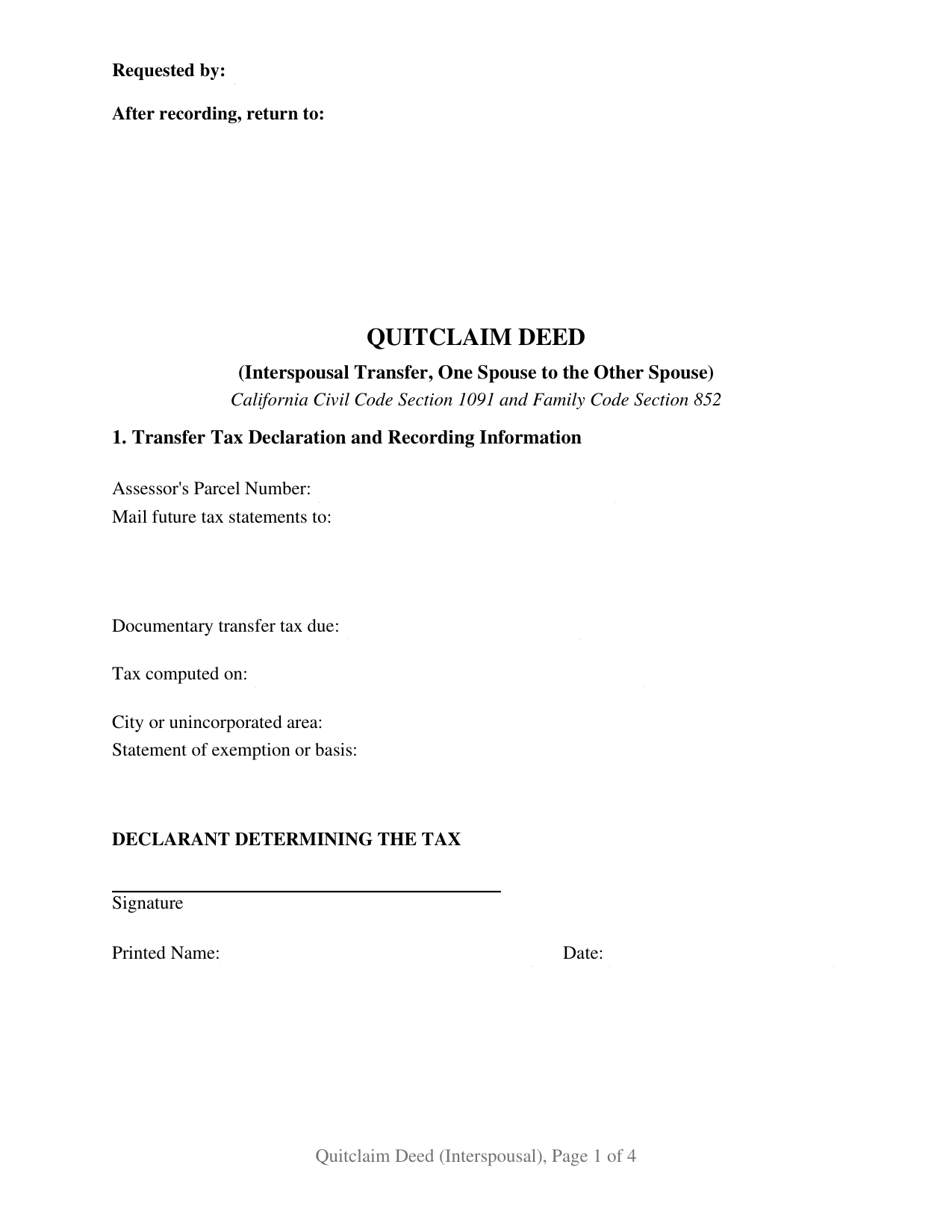
Everything the counter reads before the operative words sits in Section 1: the parcel number the assessor indexes, the mailing address for future tax bills, and the transfer tax lines, closed by a signature from whoever determined the amount. Revenue and Taxation Code Section 11927 exempts a transfer effecting a division of community property in connection with a dissolution or legal separation, conditioned on a written recital signed by either spouse, and Section 11930 covers gifts. Revenue and Taxation Code Section 63 separately excludes interspousal transfers from change in ownership for property tax purposes, which the assessor administers through the Preliminary Change of Ownership Report accompanying the deed. Recording matters twice over here: California follows a race-notice rule, and Family Code Section 852 leaves a real property transmutation ineffective as to third parties without notice until the instrument is recorded.
The package delivers this configuration complete: the interspousal quitclaim deed as a fillable PDF, a completed example worked through a Ventura County division between spouses, and a plain language guide covering each section, the notarization, and the recording steps. The materials describe California law in general terms and are not legal advice about any particular title or marriage.
Important: County-Specific Forms
Our quitclaim deed (interspousal) forms are specifically formatted for each of the 58 counties in California.
After selecting your county, you'll receive forms that meet all local recording requirements, ensuring your documents will be accepted without delays or rejection fees.