California Quitclaim Deed (Trustee Grantor)
County Specific Legal Forms Validated as recently as September 23, 2026 by our Forms Development Team
About the California Quitclaim Deed (Trustee Grantor)
How to Use This Form
- Select your county from the list
- Download the county-specific form
- Fill in the required information
- Have the document notarized if required
- Record with your county recorder's office
What Others Like You Are Saying
"Fast service, very responsive. Thank you!"
"Great website and very easy to use"
"Fast, honest company Worth every penny! DO IT YOURSELF SAVE THOUSANDS"
"Easy to use,thanks"
"Forms used, created quitclaim deed that the county accepted without a second look (turns out they se…"
4.8/5 from 4,828 reviews. Read all
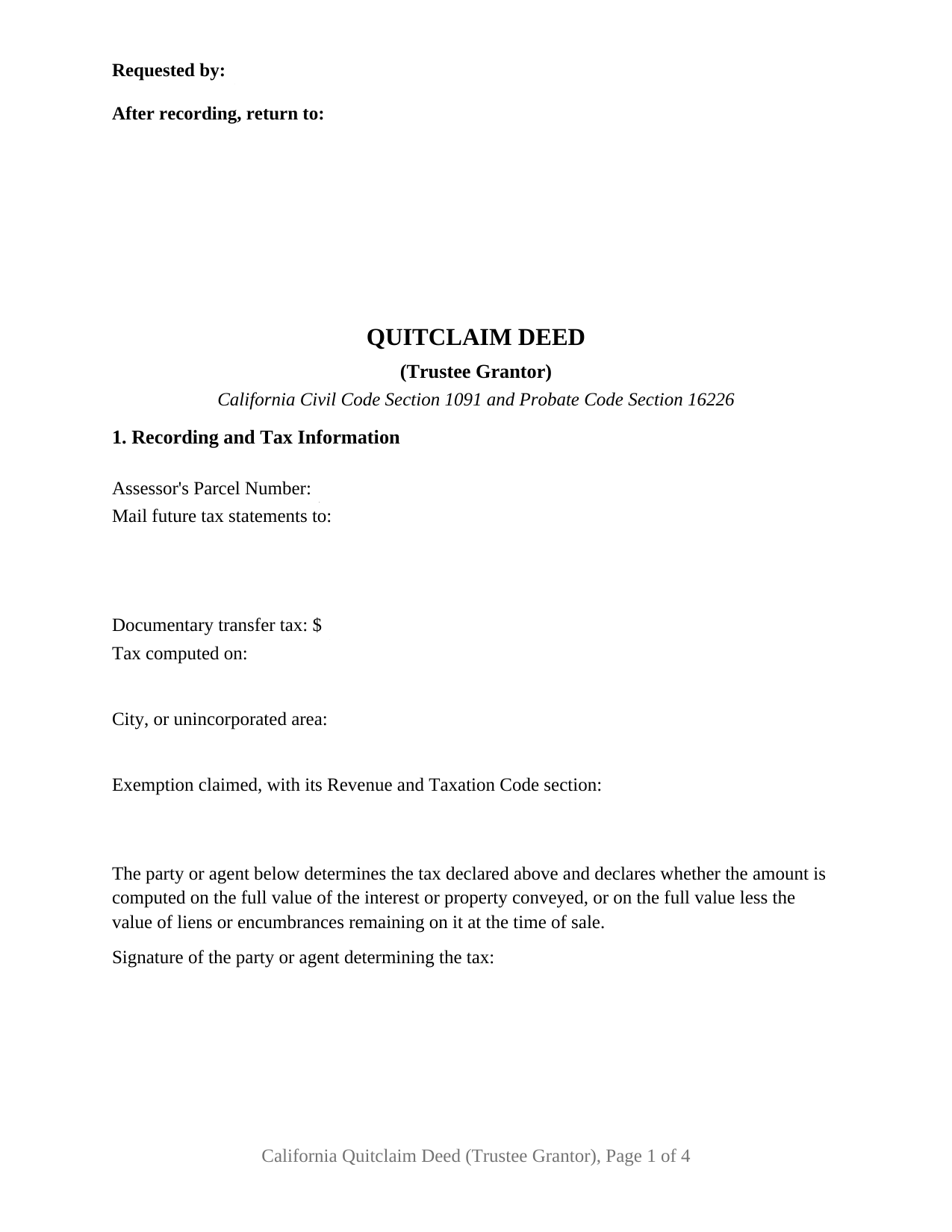
A deed signed by a trustee has to answer a question an ordinary release never raises: who is signing, and for whom. This form prepares the trustee grantor configuration of the California quitclaim deed, and it answers in three places: the grantor block names the person, the trust, and the date of the trust instrument, the signature line repeats the trustee capacity, and a numbered section states that the signer acts as trustee and not individually.
The Power Behind the Signature
California gives a trustee a default power to move real property. Probate Code Section 16226 gives the trustee power to acquire or dispose of property, at public or private sale or by exchange, and the trust instrument may widen or narrow it. Probate Code Section 15620 sets the boundary that decides how many signatures a trust conveyance carries: unless the trust instrument provides otherwise, a power vested in two or more trustees may only be exercised by their unanimous action. Naming the capacity in print matters for a second reason: Probate Code Section 18000 shields a trustee from personal liability on a contract properly made in the fiduciary capacity, so long as the trustee reveals that capacity and identifies the trust.
One Trustee, One Signature Line, One Certificate
The form recites a single currently acting trustee of a single trust. Section 2 carries the trustee's name, the trust's name, and the date of its instrument; Section 9 carries one signature line under the heading GRANTOR (TRUSTEE); and one California all-purpose acknowledgment certificate follows, headed by the boxed identity notice Civil Code Section 1189 puts at the top of a certificate taken in this state. Three patterns present this configuration in California's grantor indexes: a successor trustee distributing a parcel to the person entitled to it, a settlor serving as trustee of a revocable trust taking a parcel back into that person's own name, and a trustee releasing whatever the trust holds along a boundary to the neighbor. The form is not arranged for two trustees signing together, and it names a trustee on the giving side rather than the receiving side.
A Release With No Covenants
Nothing is warranted. California keeps its everyday deed promises inside one word: Civil Code Section 1113 implies two covenants, and no others, from the word grant, and a quitclaim, sometimes searched as a quit claim deed, leaves that word out. Section 7 states the rest expressly. Only the interest standing in the trustee's name at delivery passes, and title picked up afterward does not follow the deed. Section 8 adds the limit that matters on a trust conveyance: the deed exercises the power the trust instrument and state law already give the trustee, and enlarges nothing.
What the Grantee Reads Instead of a Warranty
Because no covenant travels with a quitclaim, the party on the other side looks past the deed for comfort about authority. Probate Code Section 18100 protects a third person who deals with a trustee in good faith, for valuable consideration, and without actual knowledge that the trustee is exceeding or misusing a power: that person need not inquire into the power at all. Probate Code Section 18100.5 supplies the certification of trust, a signed and acknowledged declaration covering the trust's existence, the acting trustees, their powers, and their signature authority, without opening the dispositive terms. Escrow holders and title insurers routinely call for one; it is prepared separately and is not included in this package.
Transfer Tax on a Trust Distribution
Section 1 collects what a California recorder reads first: the parcel number, the address for future tax bills under Government Code Section 27321.5, and the transfer tax lines, closed by the signature of whoever determined the tax. Distributions out of a trust frequently enter a code section rather than a dollar figure, and the example enters Revenue and Taxation Code Section 11930, which reaches a conveyance made by reason of a death or by inter vivos gift. A Preliminary Change of Ownership Report goes to the assessor with the deed.
The package holds three files: the fillable deed, a completed example worked through a Fresno County distribution to a trust beneficiary, and a plain language guide covering every section, the notarial certificate, the fees, and the recording steps. It states what California law provides in general terms and is not legal advice about a particular trust or title.
Important: County-Specific Forms
Our quitclaim deed (trustee grantor) forms are specifically formatted for each of the 58 counties in California.
After selecting your county, you'll receive forms that meet all local recording requirements, ensuring your documents will be accepted without delays or rejection fees.